
A dog harness manufacturer can look great on paper yet fail when you test load-bearing seams or color consistency. That mismatch wastes time and sample fees. The fix is simple: qualify materials and processes first, then request samples. I run this pre-check on every project, and it filters out most unsuitable factories early.
Before ordering samples, qualify a dog harness manufacturer’s materials, construction, compliance, and QC capacity. Ask for a component-level BOM with grades and tensile specs, stitch plans at stress points, on-file REACH/CA65 reports[^1], and AQL-based inspection steps[^2]. Lock a one-page spec and golden sample plan so production can follow it.

This upfront filter sounds tedious, but it saves weeks. And it turns vague “premium” claims into verifiable parameters your team can re-check in mass production. I share the exact questions I use and what good answers look like.
Which materials prove a dog harness manufacturer is worth sampling?
It is tempting to judge harnesses by color and hand-feel. The risk is that glossy samples hide weak webbing, soft plastics, or inconsistent dye lots. Ask for the materials bill by component and grade. Make the factory show tensile numbers and usable alternatives before you pay for samples.
A solid answer includes: nylon or polyester webbing[^3] with tensile ratings, lining/padding composition and abrasion notes, hardware brand/grade with break strength, and stated “good/better/best” alternatives with how each affects cost, MOQ, and lead time. Tie colors to dye lots for repeatability in reorders.
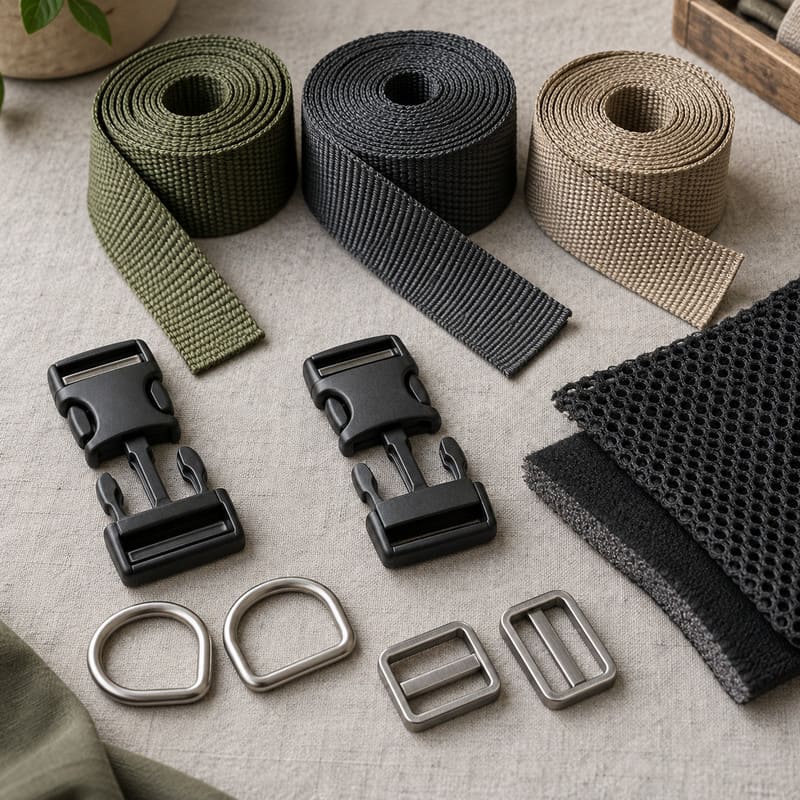
Dive deeper: how I screen materials quickly
- I ask for a BOM table with specs and alternatives. This turns aesthetics into engineering.
| Component | Base Option | Alt Option | Key Spec | Impact |
|---|---|---|---|---|
| Webbing | Nylon 25mm | Poly 25mm | ≥800N tensile | Poly saves cost; may stretch less |
| Buckle | Acetal[^4] | POM branded | ≥400N break | Branded improves consistency |
| D-ring | Welded steel | 304 SS[^5] | ≥600N | SS resists corrosion |
| Lining | Air-mesh | Neoprene | Abrasion ≥10k cycles | Comfort vs. drying time |
- I request color method: piece-dyed vs. yarn-dyed; and dye lot tracking. Yarn-dyed often reduces shade variance in mass runs[^6], but lead time can be longer.
- I ask for padding hardness (Shore A[^7]) and foam recovery notes. One buyer once asked, “Can you do a free sample without specs?” My answer: we can quote fast, but samples without a locked BOM create mismatched expectations and rework.
- I mark any claimed tensile/pull numbers as “to be verified” in production with third-party or internal fixtures. I am not a lab; I rely on reports from named labs and pull tests we repeat during pilot runs.
What construction details separate a dog harness manufacturer’s sample from a repeatable product?
Pretty samples often use one-off handiwork. Repeatable products need stitch density, reinforcement patterns, and a size base that scaling can follow. Without those, you get harnesses that pass day one but fail on lot three under load and abrasion.
Ask for thread type, stitch density (SPI), bar-tack count/position, and reinforcement patterns (cross/triangle stitches) at D-rings, leash points, and size adjusters. Request process photos or annotated sketches for these seams. Lock a golden sample and a one-page spec sheet for QC.
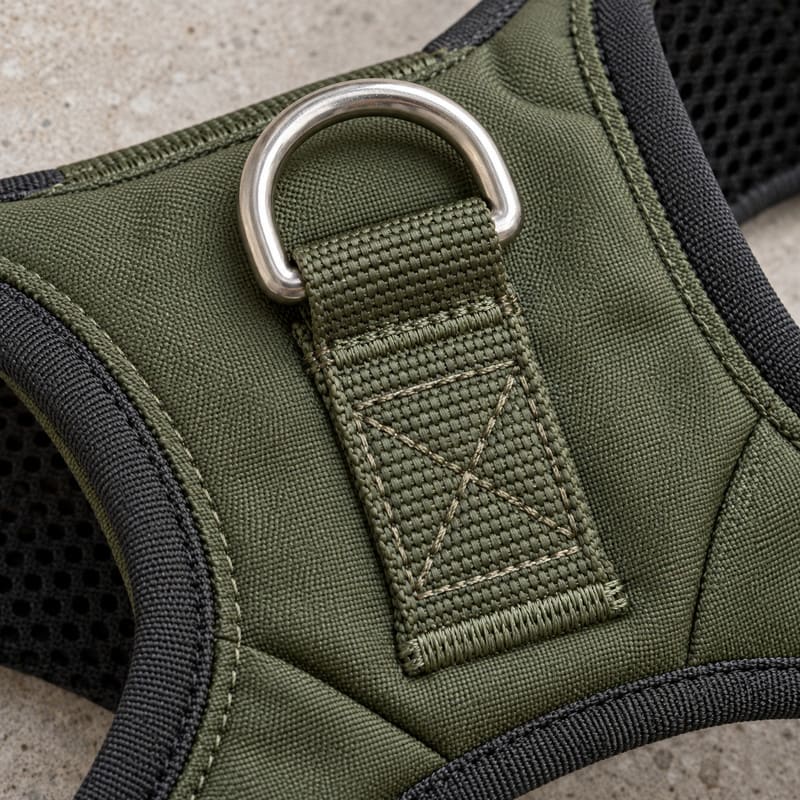
Dive deeper: stitch plans that actually hold up
- H3: Reinforcement at stress points
- I require bar-tacks[^8] at leash attachment: at least 3 bar-tacks, 8–12 stitches per bar-tack, plus a cross stitch. In one case, a customer’s harness failed at 350N. We moved from single bar-tack to triple with a triangle stitch and used bonded nylon thread; the same joint later held 600+N in a re-test.
- H3: Stitch density and thread spec
- I specify bonded nylon Tex 70 or polyester thread with UV resistance[^9] for outdoor use. Stitch density 8–10 SPI on edge binding reduces fray.
- H3: Pattern, size base, and tolerance
- I ask for the pattern base (S/M/L grid), plus tolerance per size (+/– 0.5 cm on strap lengths). That way, production can scale consistently instead of eyeballing.
- H3: Visual proof
- Process photos or simple sketches with circles and arrows work wonders. If the factory cannot show how they reinforce a D-ring tab, I park the project until they can.
Compliance and QC: admission tickets, not add-ons
- Verify on-file REACH/CA65 reports[^10] for materials and plastic hardware, noting issuing labs (e.g., SGS, Intertek). Treat internal reports as preliminary and re-verify in mass.
- Confirm incoming inspection steps (e.g., webbing width check, colorfastness rub test[^11]), in-process checks, and AQL-based final inspections (often AQL 2.5 for majors[^12]).
- Clarify MOQ per variant, sample lead time, peak-season capacity, and reorder responsiveness. Know who bears rework costs and how nonconformities are handled.
Frequently Asked Questions
How many sample iterations should I plan before locking a dog harness manufacturer?
Plan 1–2 paid samples: an engineering sample to validate materials and seams, then a golden sample against a one-page spec. Extra iterations add cost but usually prevent bigger delays in mass production.
Can I push color approvals without confirming dye lots and materials?
You can, but expect shade variance later. Tie colors to specific materials and dye lots (piece- or yarn-dyed). Request lab dips and record lot numbers so reorders match within acceptable tolerances.
Do I need third-party tests if a factory has internal pull-strength data?
Use internal data as a starting point. For market entry, re-verify with a recognized lab or at least replicate pull tests during pilot. Treat compliance reports as “on file, to be re-verified” in mass runs.
Conclusion
Choosing a dog harness manufacturer starts with materials, stitching, compliance, and QC maturity. Lock the BOM, reinforcement plan, and a golden sample before you order. If you want help structuring specs or reviewing stitch photos, send your brief to FungoMate in Ningbo. We specialize in OEM/ODM harnesses and can align grades, timelines, and AQL so your launch stays predictable.
[^1]: "SVHC Compliance: A Guide to Substances of Very High ...", https://go.ipoint-systems.com/blog/svhc-compliance. Under the EU’s REACH regulation, suppliers of articles must communicate the presence of substances of very high concern (SVHC) above 0.1% w/w and ensure compliance with applicable restrictions, which is why documentation is typically maintained and requested in supply chains. Evidence role: definition; source type: government. Supports: REACH regulates chemicals in articles sold in the EU and requires communication about SVHC content, making compliance documentation a standard expectation.. Scope note: The regulation sets obligations but does not prescribe specific test report formats or refer to pet harnesses specifically. [^2]: "What kinds of Lot Acceptance Sampling Plans (LASPs) are ...", https://www.itl.nist.gov/div898/handbook/pmc/section2/pmc22.htm. Acceptance sampling plans use the acceptable quality level (AQL) to set a tolerable defect rate and to determine sampling and acceptance criteria, which is why AQL-based steps are widely included in quality control programs. Evidence role: definition; source type: government. Supports: AQL is a standard parameter in acceptance sampling that defines a tolerable defect level and guides sample size and acceptance criteria in inspection plans.. Scope note: The reference defines AQL and its role but does not prescribe specific inspection stages for any particular product category. [^3]: "Webbing", https://en.wikipedia.org/wiki/Webbing. Webbing is widely manufactured from high‑strength fibers including nylon and polyester, which are used for load‑bearing applications and specified with tensile properties. Evidence role: general_support; source type: encyclopedia. Supports: Webbing is commonly produced from high-strength fibers such as nylon and polyester for load-bearing applications.. Scope note: Actual tensile performance varies with weave, width, and manufacturer; specific ratings must be verified. [^4]: "Polyoxymethylene", https://en.wikipedia.org/wiki/Polyoxymethylene. Polyoxymethylene (acetal, POM) is a stiff, low‑friction engineering thermoplastic used for precision molded components, including buckles and similar hardware. Evidence role: general_support; source type: encyclopedia. Supports: Polyoxymethylene (acetal, POM) is a high-stiffness engineering thermoplastic commonly used for precision molded parts such as buckles and hardware.. Scope note: Suitability for a specific load case depends on part design and grade; testing is still required. [^5]: "Stainless steel", https://en.wikipedia.org/wiki/Stainless_steel. Austenitic stainless steel Type 304 (AISI 304) is widely used due to its good corrosion resistance in many service environments, supporting its selection for hardware like D‑rings. Evidence role: general_support; source type: encyclopedia. Supports: Type 304 stainless steel is widely used for its corrosion resistance in many environments, making it a common choice for hardware.. Scope note: Corrosion performance depends on service conditions (e.g., chloride exposure) and surface finish; 304 is not universally corrosion-proof. [^6]: "Dye lot", https://en.wikipedia.org/wiki/Dye_lot. Shade variation between production lots is a recognized phenomenon in textiles; because coloration occurs earlier and more uniformly in yarn dyeing, it can mitigate lot‑to‑lot differences compared with piece dyeing. Evidence role: general_support; source type: encyclopedia. Supports: Shade differences between batches (dye lots) are a known issue in textile coloration; dyeing earlier in the process (e.g., yarn dyeing) can reduce lot-to-lot variation compared with batch piece dyeing.. Scope note: Consistency depends on specific processes and controls; not all yarn‑dyed goods are free from shade variation. [^7]: "Shore durometer", https://en.wikipedia.org/wiki/Shore_durometer. The Shore hardness scales include Shore A, which is used to measure the hardness of softer rubbers and elastomers with a standardized durometer method, making it relevant for padded materials. Evidence role: definition; source type: encyclopedia. Supports: Shore A is the durometer scale used to measure the hardness of softer rubbers and elastomers.. Scope note: Hardness alone does not capture other comfort attributes such as recovery and breathability. [^8]: "Bar tack", https://en.wikipedia.org/wiki/Bar_tack. A bar tack is a dense series of stitches used to reinforce locations prone to stress or wear in sewn items, supporting its use at leash attachment points. Evidence role: mechanism; source type: encyclopedia. Supports: Bar tacks are a stitch pattern used to reinforce areas of a sewn product that experience concentrated stress or wear.. Scope note: While the purpose is clear, the source does not quantify how many bar-tacks or stitch counts are required for a given load. [^9]: "UV Resistance - the truth? : r/Ultralight", https://www.reddit.com/r/Ultralight/comments/11hs5mg/uv_resistance_the_truth/. Polyester fibers generally exhibit better resistance to degradation from sunlight than nylon, which is more susceptible to UV-induced deterioration, making UV-resistant thread selection relevant for outdoor products. Evidence role: mechanism; source type: encyclopedia. Supports: Polyester is generally more resistant to photodegradation from sunlight than nylon, supporting the emphasis on UV-resistant thread for outdoor applications.. Scope note: The comparison describes fiber behavior broadly; actual thread performance also depends on finishes, stabilizers, and construction. [^10]: "About Proposition 65 - OEHHA - CA.gov", https://oehha.ca.gov/proposition-65/about-proposition-65. California’s Proposition 65 obligates businesses to provide warnings for exposures to listed chemicals above safe harbor levels, leading many consumer-product suppliers to implement testing and maintain compliance documentation to manage Prop 65 risks. Evidence role: definition; source type: government. Supports: California Proposition 65 requires warnings if exposures to listed chemicals exceed safe harbor levels, prompting businesses to conduct testing and maintain documentation for consumer products.. Scope note: Prop 65 sets exposure-based warning requirements rather than mandating specific material ‘reports,’ so documentation practices vary by company. [^11]: "TM008 Test Method for Colorfastness to Crocking", https://members.aatcc.org/store/tm8/481/. AATCC Test Method 8, Colorfastness to Crocking, specifies a standardized rubbing procedure to evaluate the transfer of color from dyed textiles, aligning with the use of a colorfastness rub test in inspections. Evidence role: definition; source type: institution. Supports: There is a standardized textile test method for color transfer by rubbing (crocking) that is commonly used in quality control.. Scope note: The method defines how to test, not when in a production process it must be applied. [^12]: "Acceptable quality limit", https://en.wikipedia.org/wiki/Acceptable_quality_limit. In sampling inspection for consumer products, acceptable quality limit (AQL) values are routinely used to set defect thresholds; values such as 2.5% are commonly applied for major defects across many sectors. Evidence role: general_support; source type: encyclopedia. Supports: AQL is commonly used to set defect thresholds in consumer goods inspections, and values around 2.5% are frequently applied for major defects.. Scope note: Standards define how AQL is used but do not mandate a specific value; actual targets vary by buyer, risk tolerance, and regulations.