
A holder that fits a round dummy device may still obstruct charging, distort a collar, or release the real tracker during use. Device generations also change. Buyers developing tracker accessories within harnesses and walking gear should treat the holder as an interface between a named device and a defined strap system.
Specify the device model and revision, retention geometry, collar compatibility, service access, and intended animal. Evaluate the complete installed arrangement without implying that a passive holder improves tracking performance.
Which device information should the brief include?
Identify the exact device, reference dimensions, mass, surface shape, and any required clearance. Obtain a representative physical unit or an accurate authorized reference for fit development. Do not rely on a retailer photograph or a generic diameter.
Apple’s model-specific AirTag dimensions illustrates model-specific dimensional information, while Tractive’s model-specific mounting instructions shows that mounting arrangements differ across dedicated pet trackers. Use the actual device manufacturer’s information for the product being developed; one brand’s accessory design is not a universal template.
Record the device revision with the holder drawing using principles from ISO 10007 configuration-management guidance. If the device manufacturer changes shape or service access, reassess compatibility before repeating the old holder order.
How should retention and service access be balanced?
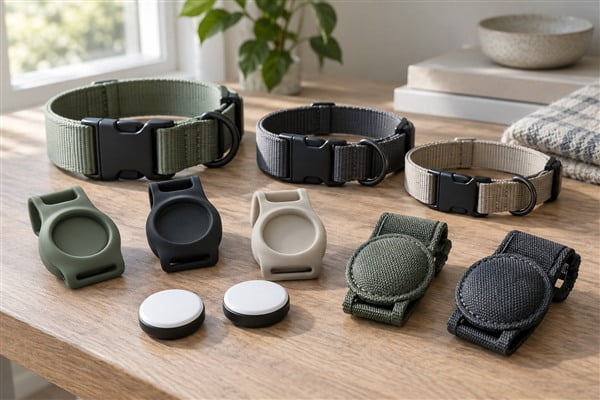
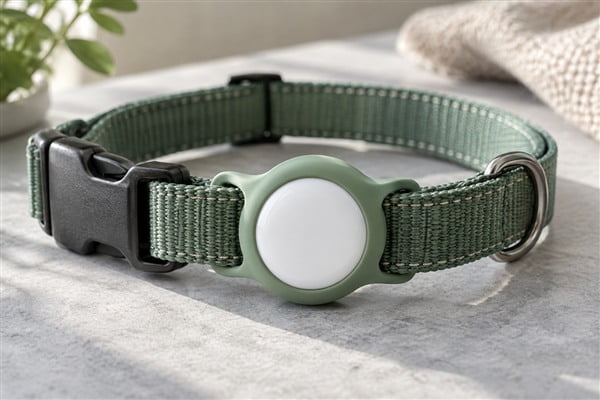
Compare a flexible sleeve, a shaped clip, and a textile pouch against the intended use. The device should be retained in the agreed conditions while remaining removable for the service operations the design permits. Specify the removal sequence rather than simply requesting a tight fit.
Check access to charging contacts, buttons, battery covers, sound openings, and other relevant features. Ask whether the device manufacturer restricts covering particular areas. A close-fitting shell should not obstruct required operation or maintenance.
Keep the holder’s claims separate from the device’s claims. A fabric pouch does not automatically preserve a device’s water-resistance rating in every arrangement, and a silicone shell does not establish waterproofing of the assembled system.
Which collar and harness dimensions matter?
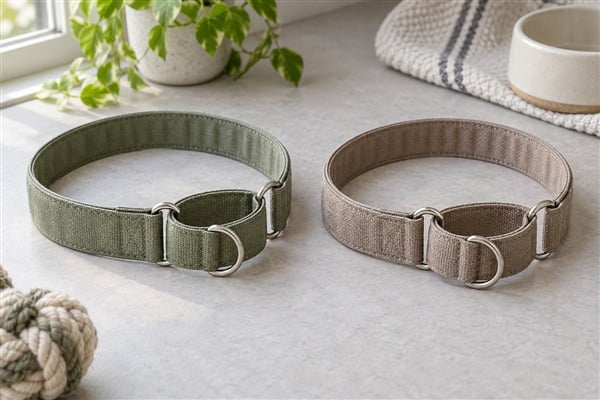
Define strap width, thickness, stiffness, and the path used to install the holder. Consider whether a buckle or ring must pass through an attachment loop. Compare actual collars, not just flat strips cut to the nominal width.
When specifying clips and D-rings, review nearby hardware clearance and movement. The holder should not block adjustment or become an unintended leash connection. Record how much it rotates or slides in the intended position.
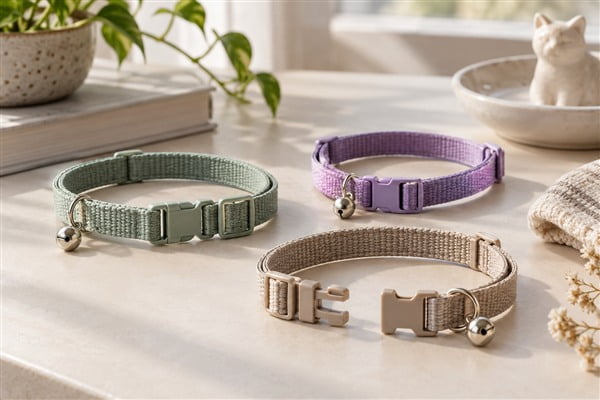
For cat applications, Cats Protection outdoor-cat guidance highlights size, weight, entrapment, and interference with quick release. A holder must not bridge a breakaway connection. Review the whole configuration rather than assuming that an existing collar’s release behavior remains unchanged.

What should the sample checks cover?
Use the sample development process to review insertion, removal, retention, attachment wear, and the effect of repeated handling. Begin with suitable fixtures and dummy loads where needed. Do not perform experimental retention or release tests on an animal.
Agree conditioning relevant to the intended use, such as cleaning, moisture, or temperature exposure. If the holder is washable, ISO 6330 washing and drying procedures can inform an applicable procedure; remove electronics unless the device manufacturer explicitly permits the planned process.
Ask the test provider to identify the device, holder, strap, settings, and observed failure modes. ISO/IEC 17025 laboratory guidance can guide competence questions. Avoid reporting a successful test on one strap as proof of compatibility with every collar.
What should production and retail information control?
Approve material, finished dimensions, hardness or textile construction where relevant, closure, and attachment details. Apply approving material substitutions to proposed substitutes. Small changes can alter both insertion effort and retention.
Choose customization options that preserve the evaluated geometry. Review the supplier’s manufacturing capabilities for molding or sewing consistency and for checking dimensions that are difficult to see after assembly.
Use IEC/IEEE 82079-1 instruction principles to structure installation and inspection instructions, and plan retail identification through GS1 barcode implementation steps. Name compatible devices accurately without implying authorization, endorsement, or affiliation that the brand has not obtained.
Use dummy devices for early geometry work where suitable, then confirm fit and required functions with the real intended model. A dimensionally correct mock-up cannot demonstrate charging access, sound output, or other device-specific behavior.
Frequently Asked Questions
Can a holder fit all generations of one tracker?
Only if the relevant versions have been checked. Similar product names do not guarantee identical dimensions, service access, or mounting requirements.
Does the holder include or improve the tracker?
Keep that distinction explicit. A passive accessory should be described as a holder, with device inclusion and performance claims stated separately and accurately.
Prepare an interface brief
Send device references, strap samples, target users, attachment preferences, and test priorities. Then contact FungoMate to discuss a holder whose compatibility can be explained and verified before production.