

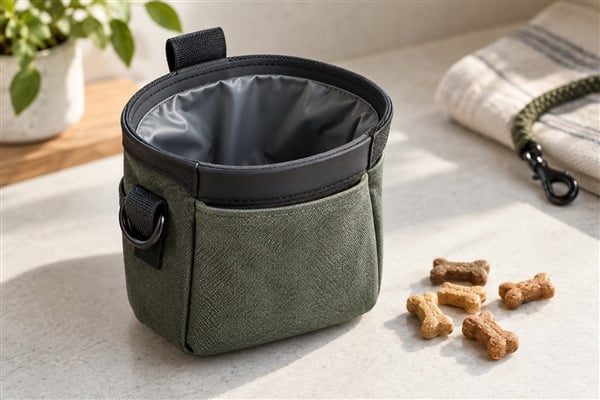
A treat pouch is handled repeatedly during a walk, often while the owner holds a leash. A closure that looks premium but interrupts access can be frustrating, while a convenient opening may spill when the user bends. Buyers extending harnesses and walking gear should compare closures and attachment systems as one usable accessory.
Define access, spill control, cleaning, attachment stability, and carrying position before selecting the closure. Approve the filled pouch on the intended belt or clothing, not only as an empty tabletop sample.
What should the pouch be designed to carry?
Specify approximate capacity, intended treat type, and whether separate compartments hold waste bags, keys, or a phone. Keep food-contact areas separate from dirty accessories. Do not use a single capacity number without stating how it is measured.
FDA pet-food handling guidance provides practical handling context for pet food and treats. For the product brief, translate the intended use into accessible seams, a suitable liner, and clear cleaning instructions. Avoid unsupported antibacterial or food-safe claims without relevant evidence.
Record the liner material, finish, and attachment method. Consider whether it is removable, reversible for cleaning, or permanently sewn in. A removable liner needs a secure fit so it does not pull out unintentionally during access.
How should closure types be compared?
A drawstring offers adjustable opening size but requires attention to cord ends and operation. A zipper can provide a more complete closure but may be slower to use repeatedly. A magnetic mouth may support convenient access, yet its retention and sewn enclosure still need evaluation.
Compare operation with one hand, repeated opening, bending, and normal walking movement. Record how much the pouch is filled during each check. Do not compare an almost-empty magnetic pouch with an overfilled zipped sample and treat the result as a fair comparison.
For zippers, discuss relevant ASTM D2061 zipper-strength methods with the supplier. For other closures, agree appropriate component and assembly checks. If magnets are used, verify secure enclosure and inspect the finished product for loose parts; a closure should not release small components during expected use.
Which attachment system suits the collection?
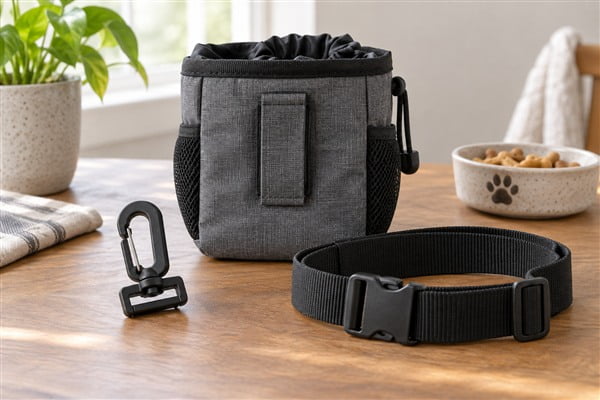
Compare belt loops, belt clips, waist straps, and detachable attachment points against the intended clothing and carrying position. A clip that holds well on one thick belt may perform differently on a thin waistband. State the compatibility range in the brief.
Review the pouch filled, then observe rotation, bounce, detachment risk, and access to the opening. Apply the same dimensional discipline used when specifying clips and D-rings. Include attachment testing in the sample development process before committing to colors and artwork.
For strap materials, ASTM D6775 webbing test method can inform strength discussions. For woven stitched connections, consider ASTM D1683 for woven sewn seams where applicable. Component results should be linked to the exact material and construction being quoted.
How should cleaning and material choices be approved?
Check corners, seam allowances, and liner attachment points for trapped crumbs. Review how the pouch drains and dries after the intended cleaning method. A water-resistant outer fabric does not establish that the interior is easy to clean.
Use ISO 6330 washing and drying procedures when an applicable machine-wash procedure is part of the plan. For strongly colored outer materials, consider transfer during handling through ISO 105-X12 rubbing-fastness method. Agree the actual procedure and acceptance criteria before the sample is evaluated.
Keep approving material substitutions controlled, especially changes to the liner, coating, magnet enclosure, or attachment clip. For independent tests, discuss the appropriate laboratory scope using ISO/IEC 17025 laboratory guidance. Evidence for one material should not silently be applied to a replacement.
What belongs in the quotation?
List closure type, capacity definition, liner construction, attachment options, pockets, and packaging. Separate essential functions from optional customization options. Ask how assembly steps and component sourcing fit the supplier’s manufacturing capabilities so a low quotation does not hide a different construction.
Confirm product identification and retail scanning needs using GS1 barcode implementation steps. Include care instructions and a clear explanation of the intended attachment arrangement. The customer should not need to guess whether a supplied clip replaces or supplements the waist strap.
Frequently Asked Questions
Is a magnetic opening always the best choice?
No. Compare convenience against retention, cleaning, component enclosure, and cost. Different retail users may prefer a simpler closure they can operate consistently.
Should the pouch include a waist strap?
Only if it supports the intended use and price. Quote it separately if distributors want different attachment configurations, and verify each sold configuration on its own.
Prepare an accessory brief
Send capacity, treat-use assumptions, closure preferences, attachment details, and cleaning expectations. Then contact FungoMate to discuss samples that can be compared under the same conditions.