
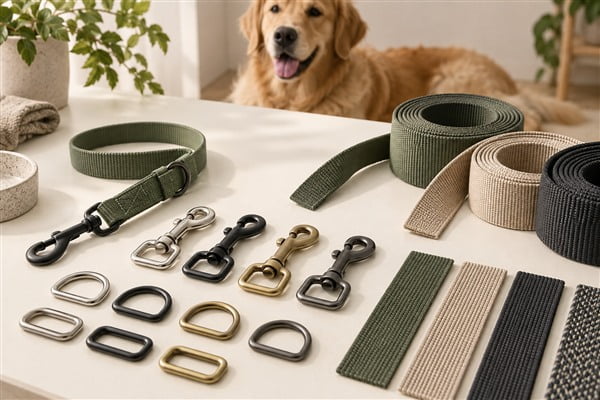
A leash clip and D-ring may be small parts, but their geometry and connection to the strap influence the complete product. Buyers specifying harnesses and walking gear should compare documented components and assembled samples rather than selecting hardware by finish or an unexplained strength number.
Specify material, dimensions, gate clearance, swivel behavior, attachment construction, and test conditions. Evaluate the clip, ring, webbing, and connection as one assembly before approving product claims.
What information belongs on the component drawing?
Record the part code, material specification, manufacturing method where relevant, finish, overall dimensions, ring section, internal opening, and webbing slot. Include tolerances for dimensions that affect assembly and operation.
Wichard component specifications provides an example of a hardware manufacturer publishing part-specific dimensions and strength information. This is a documentation reference, not a recommendation to substitute a marine component into pet equipment without validation.
When choosing a harness manufacturer, ask how the supplier locks component identity between approved samples and production. Two visually similar clips should not be treated as equivalent without checking construction and evidence.
Will the clip and ring work together?
Test the pair with the actual strap assembly. Check whether the gate opens far enough for the ring section, closes fully, and remains accessible to the handler. Rotate the connection through normal positions to identify binding or contact that interferes with closure.
Review private-label harness customization and the available material and hardware options before fixing the appearance. A heavier clip, thicker ring, or decorative finish can affect handling and geometry. Color matching is only one purchasing requirement.

Check the swivel under the intended setup, including whether the webbing twists or bunches around the attachment. Inspect burrs, sharp edges, plating defects, and gaps. Record the acceptable operating behavior in words and photographs so incoming inspection can repeat it.
How should buyers interpret load figures?
Ask whether a number describes breaking force, a working limit, or an internal screening result. Wichard’s industrial hardware catalogue distinguishes working and breaking loads in its own applications. Do not import a ratio from another industry as a universal rule for pet products.
NIST force-unit guidance identifies the newton as a force unit. Keep force and mass clearly distinguished in specifications; “supports a certain number of kilograms” is incomplete without a defined setup, direction, and basis.
Request the specimen configuration, conditioning, load application, equipment, sample count, observations, and criteria. ASTM E4 force-verification practices is a reference for testing-machine force verification. Appropriate equipment control supports reliable measurements but does not choose a safe product limit for you.
Why must the complete attachment be tested?
The weakest point may be the ring, clip, webbing fold, stitching, or fastener. ASTM D6775 webbing test method addresses webbing strength and elongation. ASTM D1683 for woven sewn seams addresses applicable woven sewn seams. Neither isolated result establishes the strength of your complete lead.
Agree assembly-level evaluation with a qualified provider, including the relevant orientation and conditioning. Do not conduct overload checks with a live animal. Review failure location and deformation, not only the highest number recorded.
Build these checks into the sample development process before approving size variants. Changing strap width, stitch pattern, ring thickness, or clip design may change how the assembly behaves even if the finish remains identical.

What about corrosion and repeated operation?
Consider the intended environment and care routine. ISO 9227 salt-spray methods describes corrosion procedures but does not set a universal exposure period or pass criterion for leash hardware. Define the relevant conditions and acceptable result before testing.
Inspect gate return, swivel movement, surface damage, and connection wear after the agreed conditioning. Do not translate a salt-spray result directly into a guaranteed number of years outdoors. Keep cosmetic and functional acceptance criteria distinct.
Review manufacturing capabilities for part traceability, incoming checks, assembly consistency, and change control. When external reports are supplied, ISO/IEC 17025 laboratory guidance helps frame questions about laboratory competence; confirm the actual test scope and specimen identity.
A quotation should identify component codes, finishes, quantities, dimensions, attachment method, testing scope, and replacement policy for unauthorized substitutions. Approve the matched assembly rather than separate attractive samples that have never been evaluated together.
Frequently Asked Questions
Is stainless steel automatically the best choice?
No single material description resolves geometry, workmanship, strength, finish, or suitability. Assess the specified grade and complete construction against the product brief.
Can one clip serve every leash size?
Only where handling, compatibility, and performance support it. Small and large assemblies may need different proportions and separate evaluation.
To define hardware for your next range, contact FungoMate with the intended use, strap dimensions, preferred operation, finishes, quantities, and evidence requirements.