A buckle that opens when someone pulls it by hand is not enough evidence for a breakaway cat collar. The assembled collar, adjustment, accessories, loading direction, and condition can all affect the release assessment. Buyers extending harnesses and walking gear need a documented mechanism and test plan rather than a general “safety buckle” description.
Specify the release design and intended cat population, then review test evidence for the complete collar under defined conditions. Agree acceptance criteria with appropriate expertise; do not invent one universal release-force value.
What should the product claim actually mean?
Cats Protection collar guidance recommends quick-release or snap-opening collars and highlights risks associated with unsuitable collars and loose adornments. This is useful welfare guidance, but it does not certify a supplier’s buckle or establish a force threshold for every cat.
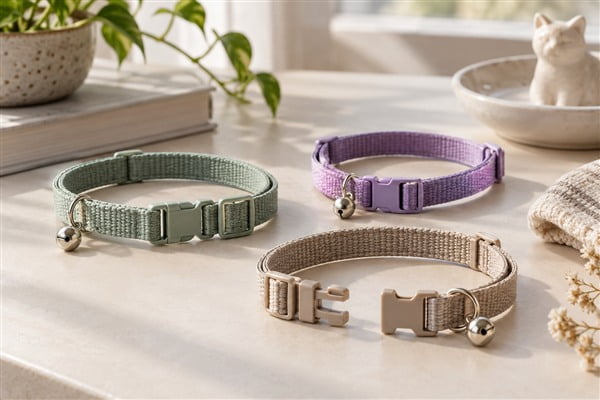
Distinguish a connector designed to separate under tension from an ordinary buckle that opens only when its tabs are pressed. Ask for a clear demonstration of the intended mechanism and a drawing identifying the relevant parts.
Record material, component reference, molding revision, and assembled collar version. ISO 10007 configuration-management guidance provides useful principles for controlling these details. A new resin, mold, or connector geometry should not inherit the old approval automatically.
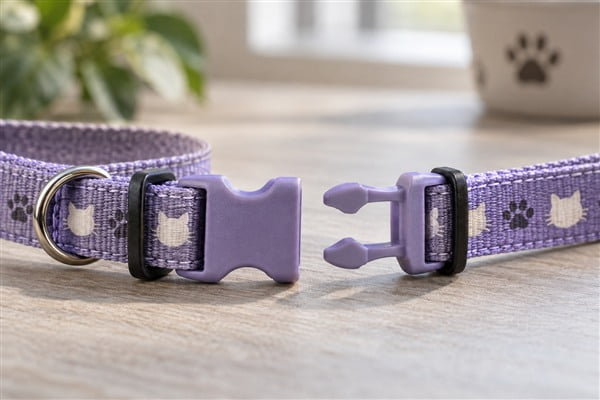
What information belongs in the test request?
State the collar sizes, adjustment settings, samples, conditioning, loading directions, and repeat-release sequence to be evaluated. Define the fixture and measurement method with the test provider. Ask for individual results and observed failure modes rather than only a pass statement.
Use force units and documented equipment. ASTM E4 force-verification practices is a reference for applicable force-verification practices, while ISO/IEC 17025 laboratory guidance helps identify relevant laboratory competence. Neither document establishes the correct release criterion for the proposed cat collar.
Keep animals out of experimental force tests. Use appropriate fixtures, and seek suitable product-safety and animal-welfare expertise when setting the intended-use criteria. An adult-cat configuration should not automatically be offered for kittens without review.
Why should the complete collar be evaluated?
Webbing thickness, adjustment, seams, and the way the connector is attached may affect the assembly. Evaluate the final construction, not just loose buckle samples. Include the collar’s smallest and largest intended settings in the agreed review.
Inspect for sharp edges, loose stitching, and detachable small parts. Apply the dimensional discipline used when specifying clips and D-rings, while recognizing that a breakaway collar has a different functional objective from load-retaining dog walking gear.
Include repeated opening, normal contamination, and appropriate conditioning where the test provider considers them relevant. If washing is claimed, ISO 6330 washing and drying procedures can inform a suitable care-related conditioning procedure. Do not assume the connector behaves identically after use.
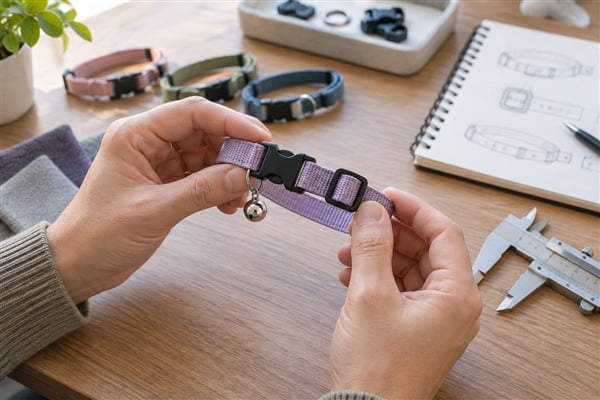
How should accessories and substitutions be handled?
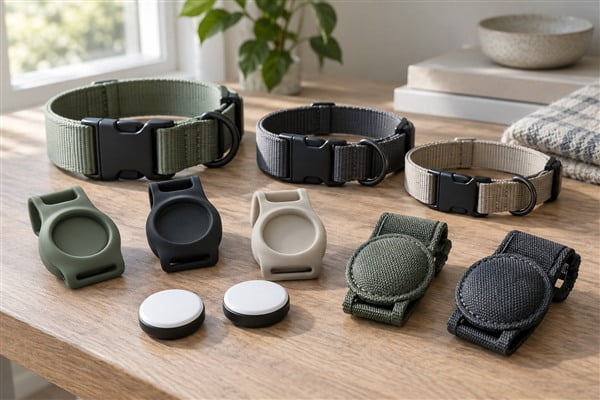
Assess bells, tags, and tracker holders in the configuration actually sold. Cats Protection outdoor-cat guidance notes that tracker size, weight, entrapment risk, and interference with quick release require consideration. A holder must not bridge the connector or obstruct its intended separation.
Use the sample development process to review the complete accessory arrangement. Keep any proposed customization options within the evaluated configuration, or reopen the affected checks. Removing an accessory from the test while including it in retail packaging leaves an evidence gap.
Require approval when approving material substitutions changes webbing, buckle, thread, or attachment details. Ask the supplier to identify what changed and which existing results remain relevant. Similar color and shape are not sufficient evidence of equivalence.
What should instructions and records contain?
Provide product-specific fitting, inspection, replacement, and intended-use information. IEC/IEEE 82079-1 instruction principles can guide instruction structure. Avoid guaranteeing that a collar will release safely in every situation or presenting a breakaway collar as a leash restraint.
Plan identification with GS1 barcode implementation steps and retain production-lot records tied to component versions. Review these controls within the supplier’s manufacturing capabilities so a reported issue can be investigated against the actual supplied batch.
Retain the tested samples or clear identifying records where practical. The evidence package should distinguish connector batches and collar sizes, and state whether results describe new samples, conditioned samples, or samples opened repeatedly during the agreed sequence.
Frequently Asked Questions
Is a stronger closure always better?
No. The intended release function is central to this product. Strength alone is not the correct purchasing objective, and criteria should balance the defined use with release behavior.
Can a buckle report cover every collar using it?
Not automatically. Check whether the finished assembly, adjustment range, and accessories match the reported configuration and whether additional evaluation is needed.
Ask for a complete evidence package
Send the intended users, collar construction, accessory configuration, and requested test documentation. Then contact FungoMate to discuss a development plan with clear approval decisions and appropriately limited product claims.