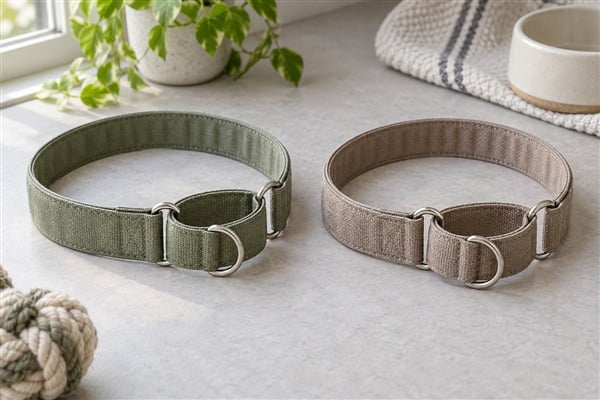
A martingale collar limits tightening through its loop geometry, but that limit is meaningful only when construction and fit are clearly defined. Similar-looking collars can have different control-loop travel or adjustment behavior. Wholesale buyers adding these products to harnesses and walking gear should specify the mechanism rather than ordering from a photograph alone.
Define the neck loop, control loop, adjustment range, attachment point, and minimum closed circumference. Verify the assembled geometry and instructions together; do not translate limited-slip construction into an escape-proof or injury-prevention guarantee.
What construction should the supplier identify?
Request a drawing showing the main neck loop, control loop, connecting rings, adjustment slider, and intended leash attachment. Identify whether the model is slipped over the head or uses an additional buckle. Each arrangement changes fitting and inspection.
PetSafe’s model-specific martingale instructions demonstrates why instructions must be model-specific. Its adjustment directions describe that manufacturer’s product, not a universal setup for every martingale. The private label design needs instructions validated against its own geometry.
Keep the approved component arrangement versioned using ISO 10007 configuration-management guidance. A new ring size or webbing thickness may change the closed geometry even if the supplier retains the same overall appearance.

Which dimensions should be measured?
Record the adjustable neck range, the fully relaxed opening, the minimum circumference when the control loop reaches its designed limit, and the effective control-loop travel. Define the measurement condition so samples can be compared consistently.
For slip-over styles, consider the opening needed to pass over the head as well as neck fit. AKC measuring guide offers general measurement context, but the brand must specify the measurements relevant to this construction. Do not size the range from body weight alone.
Review the smallest and largest settings. Check whether hardware meets as intended, whether the loop twists, and whether the collar can be adjusted consistently. Include representative sizes in the sample development process instead of approving the entire range from one medium sample.
What should be checked in webbing, rings, and seams?
When specifying clips and D-rings, identify ring dimensions, weld or forming details where applicable, finish, and contact edges. Check that webbing moves as intended without catching or folding into a narrow opening.
Discuss ASTM D6775 webbing test method for relevant webbing evaluation and ASTM D1683 for woven sewn seams where a woven seam method fits the construction. Finished collar tests should also address the assembled load path, including the control loop and attachment point.
For exposed metal, consider ISO 9227 salt-spray methods if appropriate to the intended environment. Keep the result tied to the exact material and finish. A corrosion report does not establish strength, and a strong ring does not establish reliable adjustment.

How should the test evidence be reviewed?
Agree a test plan covering the intended loading directions, repeated use, adjustment movement, and inspection criteria. Use suitable fixtures and test equipment rather than applying experimental loads to a dog. Record deformation or unwanted movement, not only complete separation.
ASTM E4 force-verification practices provides a reference for force-verification practices, while ISO/IEC 17025 laboratory guidance helps frame competence and scope questions. Ask which collar version, size, components, and conditioning were represented by the report.
Require review when approving material substitutions changes the approved combination. A substitute webbing may interact differently with a slider; a different ring may alter the limited-slip travel. Cost changes should not bypass geometry checks.
What should retail instructions explain?
Show fitting, adjustment, the intended leash connection, and the point at which the loop reaches its designed limit. Make intended use and supervision clear. Do not recommend unattended tethering or present the collar as appropriate for every dog.
Keep identification tags and other accessories from interfering with the moving loop. Demonstrate the approved arrangement in instructions and photographs. Seek appropriate product and animal-welfare expertise for intended-use decisions.
Compare customization options against the supplier’s manufacturing capabilities. Decorative changes should preserve the inspected load path, adjustment function, and readable product information. Confirm the final construction before preparing retail photography.
Keep a measurement sheet for every approved size, including relaxed and limited positions. Ask the inspector to reproduce the measurements without verbal guidance. Any ambiguity should be resolved in the drawing before the bulk inspection begins.
Frequently Asked Questions
Does limited-slip mean the collar cannot become too tight?
No. The designed limit and the actual fit must be appropriate together. Incorrect sizing or adjustment can undermine the intended function.
Can the same geometry be scaled proportionally across all sizes?
Do not assume so. Hardware dimensions and minimum usable adjustment may change differently from strap length. Review each size’s finished measurements and function.
Start with a mechanism drawing
Send the loop arrangement, size range, hardware references, intended use, and evidence requirements. Then contact FungoMate to discuss samples that can be assessed consistently before the wholesale order.