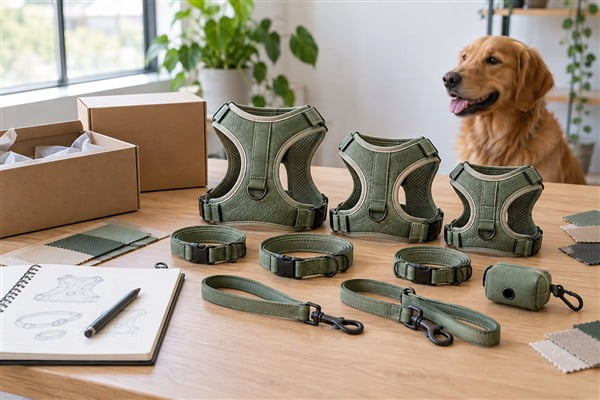

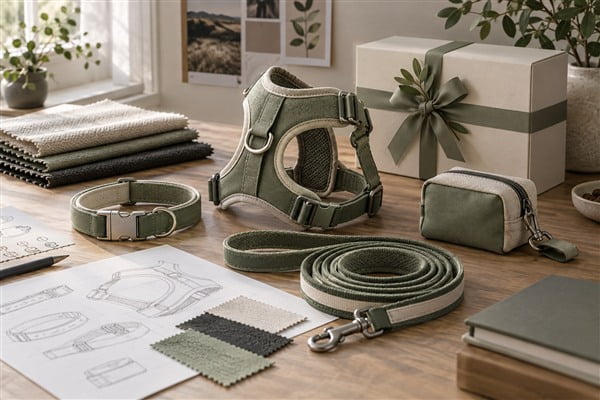
A coordinated pet set needs more than a list of attractive items. The supplier must know which combinations are sold, how sizes are paired, what “matching” means, and how the finished order is packed. Brands developing pet sets and bundles can avoid repeated clarification by briefing the set as a complete product system.
Define the customer task, component specifications, combination rules, appearance standards, packaging, quality checks, and commercial scope. Every sellable configuration should map to an unambiguous contents list.
What is the set intended to do?
Start with a clear use case: a walking kit, travel collection, seasonal gift, or another defined need. Identify the selling channel, customer, expected retail presentation, and target cost. Remove items that do not support that purpose.
Decide between fixed versus mix-and-match sets before finalizing the brief. A fixed kit can still offer approved size variants; a configurable set needs rules for which components may change. State where assembly occurs and who maintains those rules.
List each item with its quantity, specification, and code. Separate mandatory items from optional additions. Do not let a product photograph become the only record of what belongs in the set.
How should component sizes and compatibility be defined?
Use measurements appropriate to each wearable. The AKC measuring guide provides a starting reference, but a harness, collar, and garment still need their own fit requirements. One outer “Medium” label should identify an approved pairing rather than imply identical component dimensions.
Create a matrix connecting each set variant to exact component sizes and colors. Check hardware compatibility, attachment clearance, care needs, and the intended wearing arrangement. Record exclusions when a combination is unsuitable.

Review customization options as a coordinated brief. Define color references, materials, surface finishes, logo placement, and allowable differences between unlike surfaces. Matching appearance does not require using the same construction where the products perform different jobs.
What should the packaging brief include?
Use the principles in planning a pet gift-set packaging budget to define protection, presentation, and packing effort. Supply the contents layout, size identification, care inserts, folding method, and any retail requirements.
GS1 US packaging-level guidance helps distinguish the consumer set from inner packs and shipping cases. GS1 barcode implementation steps supports the identification workflow. Assign responsibility for providing identifiers and checking the printed result before packing begins.
For fixed physical assortments, review GS1 predefined-assortment guidance when included trade items change. Product identification should follow the actual configuration, not remain unchanged simply because the gift-box artwork is familiar.
Discuss the final packaged product and route with reference to the ISTA test-procedure overview where appropriate. Packaging tests should use the intended contents and arrangement rather than an unrelated empty box.
How should approval and quality checks be structured?
Use the sample development process to approve individual components first, then the assembled set. Keep a complete reference pack alongside the component samples, so inspectors can check both construction and packing accuracy.
ISO 10007 configuration-management guidance is a useful reference for controlling linked specifications. If one component changes, identify which set variants, drawings, packaging layouts, and instructions need review. Do not rely on a single email saying the range is approved.

Review manufacturing capabilities for component traceability, size segregation, matching checks, and final contents verification. For specialist evaluation, ISO/IEC 17025 laboratory guidance helps frame questions about relevant competence and scope. Define the methods and criteria needed for each product rather than asking for one generic bundle test.
Which commercial details make quotations comparable?
State order quantities by set variant, expected repeats, material and color assumptions, packaging, testing, and development scope. Ask suppliers to identify component-level minimums and any shared stock commitments.
Use ICC Incoterms guidance when agreeing the delivery basis and named place. Separate one-time development charges from recurring product, assembly, and packing costs. Ask which assumptions would change the quotation.
Define what happens if one item becomes unavailable. A supplier should not silently replace it with something visually similar. Agree the change-review process, customer-facing implications, and treatment of incomplete stock before production.
Include the schedule for artwork, sample approval, material purchasing, assembly, and shipment. A coordinated launch can be delayed by its slowest required component, even when every other item is ready.
Include a packing checklist that names every component and variant. An outer set code is useful, but staff also need to distinguish similar colors and sizes when checking the actual contents before sealing.
Frequently Asked Questions
Can a supplier choose the component sizes?
The supplier can propose pairings, but the brand should approve the documented fit and variant matrix before production.
Is one combined price sufficient?
It may be convenient for ordering, but request enough detail to understand component, assembly, packaging, and development assumptions.
To build a complete set brief, contact FungoMate with your customer task, channel, proposed contents, quantities, fit requirements, and the presentation your brand wants to deliver.