

Pet travel bundles can get bloated fast. The problem is simple: more accessories often mean more weight, more cost, and more returns.[^1] That pain spikes in in-cabin air travel.[^2] The fix is a lean, standardized base bundle and channel-ready add-ons. I’ll share what actually gets used, verified by OEM/ODM volume runs and buyer feedback.
The best pet travel bundles ship with three essentials: a built-in safety tether (used with a harness), a washable reversible pad with pee‑pad anchoring points, and a detachable shoulder strap plus luggage trolley sleeve/back strap. Everything else—privacy shade, document sleeve, spare pad cover, collapsible bowl, and small pouch—works better as add‑ons by route or channel.
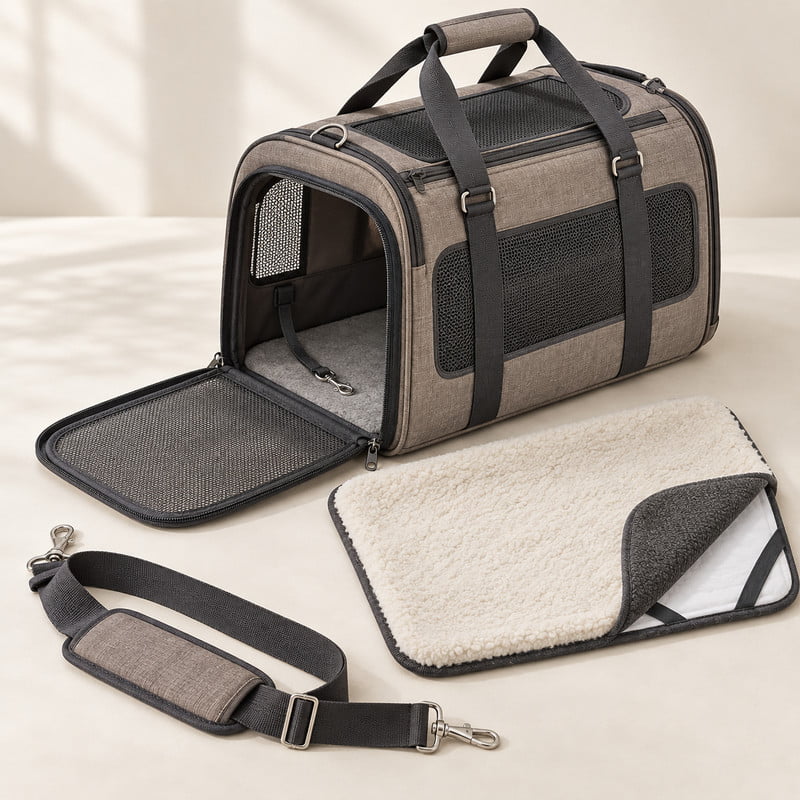
Those three items solve the highest-frequency pain: escape risk, hygiene during delays, and hands-free transfers. Add-on accessories should flex by airline, route, and retail channel. Below is how I structure pet travel bundles to lower return risk and keep cube and cost under control.
What goes in the base pet travel bundles for in-cabin flights?
Crowded terminals, security checks, and tight under-seat space create real risks. Buyers want safety, hygiene, and carry comfort without overpacking. Too many accessories can hide weak structure and inflate dimensional weight.[^3] Let’s keep it focused and defensible for procurement, QC, and channel merchandising.
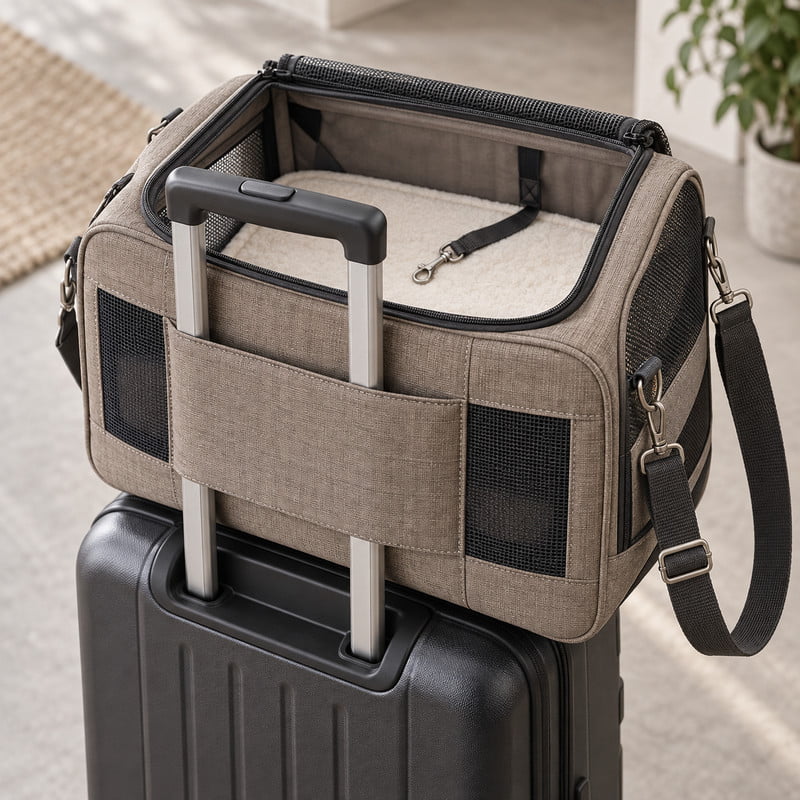
The base set should include a secure internal tether (for harness use), a reversible machine-washable pad with pee‑pad anchor points, and a detachable shoulder strap with a luggage trolley sleeve/back strap. These three touch safety, hygiene, and mobility—the top levers behind positive reviews and lower returns in air-travel use.
Why these three—and not more
I keep coming back to what buyers and end users actually use:
- Safety tether: Prevents bolt-outs at check-in and TSA.[^4] Always specify “use with a harness, not a collar.”[^5]
- Reversible pad with pee‑pad anchors: Hygiene during long waits. Anchors stop shifting, leaks, and bunching.
- Detachable shoulder strap + trolley sleeve/back strap: Hands-free movement between gates, shuttles, and restrooms.
Everything else carries variability—pet temperament, airline documentation, and merchandising preferences. Instead of stuffing boxes, I set up add-ons as optional SKUs or bundle tiers:
- Privacy or roll‑down shade
- Document/ID sleeve for vaccine papers and tickets
- Spare pad cover
- Collapsible travel bowl
- Small accessories pouch
This approach keeps cubic weight, landed cost, and return risk in check, especially for DTC and marketplace channels where buyers punish overpromises. It also avoids a common trap: trading structure for grams. Airport transfers stress strap anchors, sleeves, and base support. I prioritize reinforced anchor points, a pad that stays put, and a leak‑resistant base over chasing a headline “ultralight.” I have read too many reviews where a flimsy anchor tore or the pad slid mid‑transit. That is a guaranteed return.
For compliance framing, I never “guarantee to board.” Airline rules differ by aircraft and route.[^6] I give buyers a checklist they can localize:
- Under‑seat fit with soft‑sided compression[^7]
- Ventilation on multiple sides[^8]
- Leak‑resistant base and secured pad[^9]
- Internal tether (for harness use)
- Clear external dimensions and weight
Species and size matter. A calm 4 kg cat is not a 7 kg anxious dog. Build your assortment with behavior and body length in mind, not just weight.[^10] Set MOQ logic around core sizes and hold add-ons as modular. That keeps pet travel bundles clean, flexible, and profitable.
Frequently Asked Questions
Should I include a collapsible bowl in the base bundle?
I suggest no. Hydration is important, but bowls vary by buyer preference and add weight and cube. Offer a branded bowl as an add-on or bundle tier, especially for retail sets. Keep the core carrier box lean and travel-focused.
How do I position airline compatibility without overpromising?
Use a compliance checklist and state “verify with your airline and route.” Call out under‑seat compression, ventilation, leak resistance, tether usage with a harness, and exact dimensions. Avoid “fits all airlines.” That language increases returns and disputes.
Do I need both a trolley sleeve and a shoulder strap?
Yes, for air travel. The sleeve stabilizes on suitcases during long transfers; the strap covers stairs, shuttles, and tight spaces. Together they cut carry fatigue. Reinforce anchor points and bartacks; do not trade structure for grams.
Conclusion
A smart approach to pet travel bundles is a tight base and flexible add‑ons. Lead with the tether, reversible pad with pee‑pad anchors, and shoulder strap plus trolley sleeve. Treat shades, documents, spare covers, bowls, and pouches as optional. If you want OEM/ODM specs, bundle tiers, and samples tuned for your channels, reach out and we’ll map it to your routes and MOQs.
[^1]: "Dimensional weight", https://en.wikipedia.org/wiki/Dimensional_weight. Dimensional weight pricing explains why larger packages incur higher shipping charges, so adding accessories that increase size or volume generally raises cost; this mechanism can contribute to dissatisfaction but is not direct evidence of higher return rates. Evidence role: mechanism; source type: encyclopedia. Supports: That increasing package volume/size raises billed shipping weight and cost via dimensional weight pricing.. Scope note: This supports the cost mechanism only and does not quantify or prove an increase in return rates for pet travel products. [^2]: "Pet Travel | Domestic and International Travel With a Pet", https://www.aphis.usda.gov/pet-travel. U.S. Department of Agriculture (APHIS) guidance notes that airlines set their own pet-in-cabin requirements and destination rules vary by route and country, underscoring that air travel imposes added constraints beyond general transport. Evidence role: general_support; source type: government. Supports: That in-cabin air travel is governed by airline-specific and route/destination-specific requirements that create additional constraints.. Scope note: This does not quantify how much difficulty increases and does not compare directly to other travel modes. [^3]: "Parcel Size, Weight & Fee Standards", https://faq.usps.com/s/article/Parcel-Size-Weight-Fee-Standards. USPS explains that dimensional weight pricing charges based on a package’s volume when it exceeds a size threshold, so added bulk can raise the billed weight even if the item is light. Evidence role: mechanism; source type: government. Supports: That dimensional weight pricing bases charges on package volume when large, so extra bulk increases billed weight.. Scope note: This is a U.S. postal example and specific thresholds and formulas vary by carrier and contract. [^4]: "TSA offers tips for traveling with small pets through the security checkpoint ...", https://www.tsa.gov/news/press/releases/2022/12/14/tsa-offers-tips-traveling-small-pets-through-security-checkpoint. TSA cautions that pets can bolt from carriers at checkpoints and instructs owners to remove the animal and keep it leashed and controlled during screening, indicating that secure restraint reduces escape risk at check‑in and security. Evidence role: general_support; source type: government. Supports: That pet escape is a known risk at checkpoints and securing the pet is recommended to reduce that risk.. Scope note: This is advisory guidance and does not provide statistical measures of escape prevention. [^5]: "TSA offers tips for traveling with small pets through the security checkpoint ...", https://www.tsa.gov/news/press/releases/2022/12/14/tsa-offers-tips-traveling-small-pets-through-security-checkpoint. Transportation Security Administration guidance advises travelers to keep pets secured with a leash and well‑fitting harness during screening to prevent escape, supporting the preference for harness attachment over collar use in airport handling. Evidence role: general_support; source type: government. Supports: That a harness is recommended for controlling pets during airport screening to prevent escape.. Scope note: This guidance pertains to checkpoint handling and does not evaluate harnesses versus collars across all travel scenarios. [^6]: "Flying with a Pet | US Department of Transportation", https://www.transportation.gov/airconsumer/flying_with_pet. The U.S. Department of Transportation notes that each airline sets its own pet policies and may impose additional restrictions, so acceptance can vary by carrier and itinerary. Evidence role: general_support; source type: government. Supports: That airlines set their own pet policies and may restrict carriage on certain aircraft or routes.. Scope note: Specifics vary internationally and can change; this is general consumer guidance rather than a comprehensive policy catalog. [^7]: "Traveling with pets - American Airlines", https://www.aa.com/web/i18n/travel-info/special-assistance/pets.html. For example, American Airlines states that soft‑sided pet carriers may slightly exceed listed dimensions because they can be collapsed to fit under the seat, illustrating the role of soft‑sided compression in meeting under‑seat fit. Evidence role: case_reference; source type: other. Supports: That at least some airlines allow soft-sided carriers to slightly exceed listed dimensions if they can compress to fit under the seat.. Scope note: This is an illustrative single-airline policy; allowances differ by airline and are subject to change. [^8]: "Container Requirement 1", https://www.iata.org/contentassets/b0016da92c86449f850fe9560827bbea/pet-container-requirements.pdf. IATA container guidance requires ample ventilation—commonly on three sides for cats and dogs—to ensure airflow, supporting the recommendation for ventilation on multiple sides. Evidence role: expert_consensus; source type: institution. Supports: That container standards call for ventilation on several sides to maintain airflow for cats and dogs.. Scope note: These are general container standards, more formalized for cargo; airline cabin policies may specify different details. [^9]: "[PDF] Container Requirements - IATA", https://www.iata.org/contentassets/b0016da92c86449f850fe9560827bbea/pet-container-requirements.pdf. IATA’s pet container guidance specifies a waterproof bottom with absorbent bedding and adequate fastening so bedding remains in place, supporting the recommendation for a leak‑resistant base and secured pad. Evidence role: expert_consensus; source type: institution. Supports: That recognized container guidance calls for a waterproof/leak-resistant bottom and absorbent bedding that stays in place.. Scope note: IATA guidance is primarily oriented to cargo and international transport; cabin-specific airline requirements may differ. [^10]: "Traveler's Pet Corner - IATA", https://www.iata.org/en/programs/cargo/live-animals/pets/. IATA’s container sizing method bases crate dimensions on the animal’s body length and height (e.g., nose to root of tail plus leg length), showing that fit depends on body measurements rather than weight alone. Evidence role: mechanism; source type: institution. Supports: That recognized container sizing methods are based on an animal’s body length and height, not weight alone.. Scope note: Behavioral considerations (e.g., anxiety level) are individual and not fully addressed by sizing formulas.