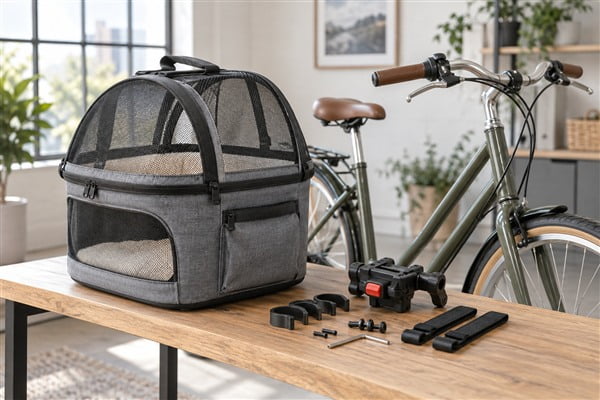


Picking a pet carrier manufacturer is risky if you start with price. If seams fail or anchors pull out, you face returns, bad reviews, and safety claims.[^1] I learned this the hard way on buyer walk‑throughs. The fix is simple: prioritize proven materials and structural sewing capability, then negotiate cost. Start by reviewing the pet travel bags and carriers range to identify the carry formats that match your market.
To choose a pet carrier manufacturer, start with safety and buildability, not price. Map load paths from handles/straps to body panels, lock measurable specs (fabric denier, coatings, mesh grade, board type, thread size), and require defined stitch programs (box‑X + bartacks[^2]). Front‑load compliance with a BOM and certificates. Iterate samples, then demand anchor pull tests before PO.
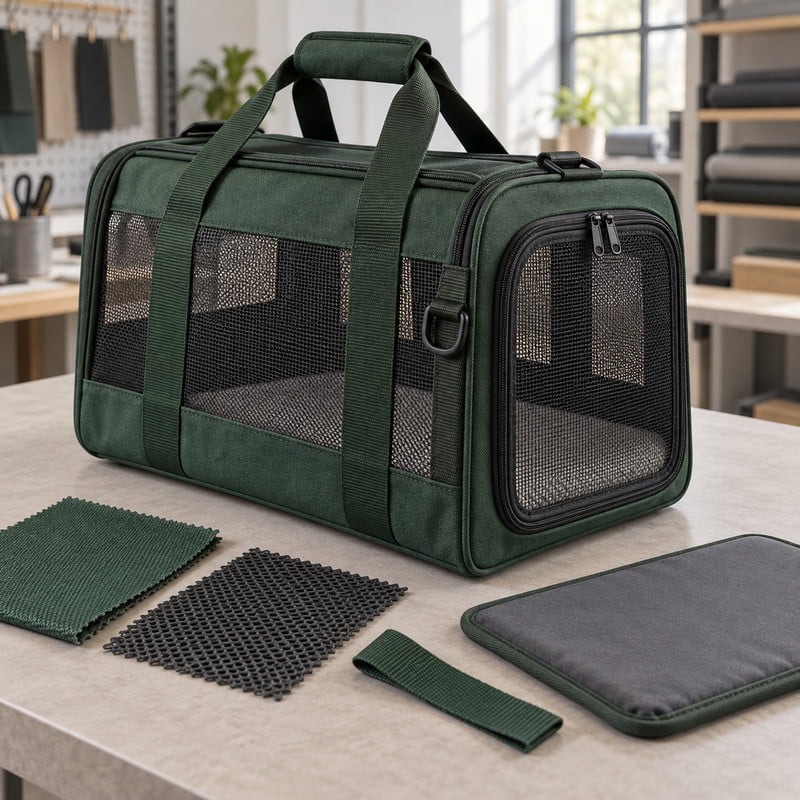
You now have the short answer. The deeper work is translating your use case into buildable specs and verifying the factory can actually sew them. That is where most private labels win or lose. Review the supplier’s OEM/ODM development services to understand how the team can support your project from the initial brief onward.
What proves a pet carrier manufacturer can build safe, compliant carriers?
Worried your launch will stall on safety issues? Agitate that. Returns and lab failures are expensive. The solution is a simple proof path: lock specs, iterate samples, and test anchors before PO. You should see SOPs, seam samples, and pre‑compliance paperwork up front.
A capable pet carrier manufacturer can show measurable material specs, defined stitch programs, in‑house pull testing, and a real BOM with certificates. They will fix issues between sample iterations fast, with clean workmanship. You then verify with third‑party labs and a PP sample anchor pull test (values to be verified). Compare these requirements with the supplier’s manufacturing and quality-control capabilities.
Dive deeper: turn your use case into load paths, specs, and tests
Here is the approach I use with private‑label buyers. It keeps projects on track and prevents seam/anchor failures.
- Translate use case into load paths:
- Define pet weight range and carry modes (hand/shoulder/backpack).
- Map how weight flows from handles/strap anchors through webbings into body panels and boards.
- Lock buildable, measurable specs with the right customization options:
- Fabric: denier (e.g., 600D/900D to be verified)[^3], coating/backer (PU/TPU), abrasion, colorfastness.[^4]
- Mesh: grade/opening size, tensile, tear.
- Boards/foam: PP/EVA type, thickness, density; where they sit under anchors.
- Webbing: width, tensile strength, finish; how it is anchored to panels.
- Zippers/hardware: gauge, slider type, D‑rings, buckles with rated strength.
- Thread: size (Tex), fiber type; stitch length; needle spec to prevent cutting.
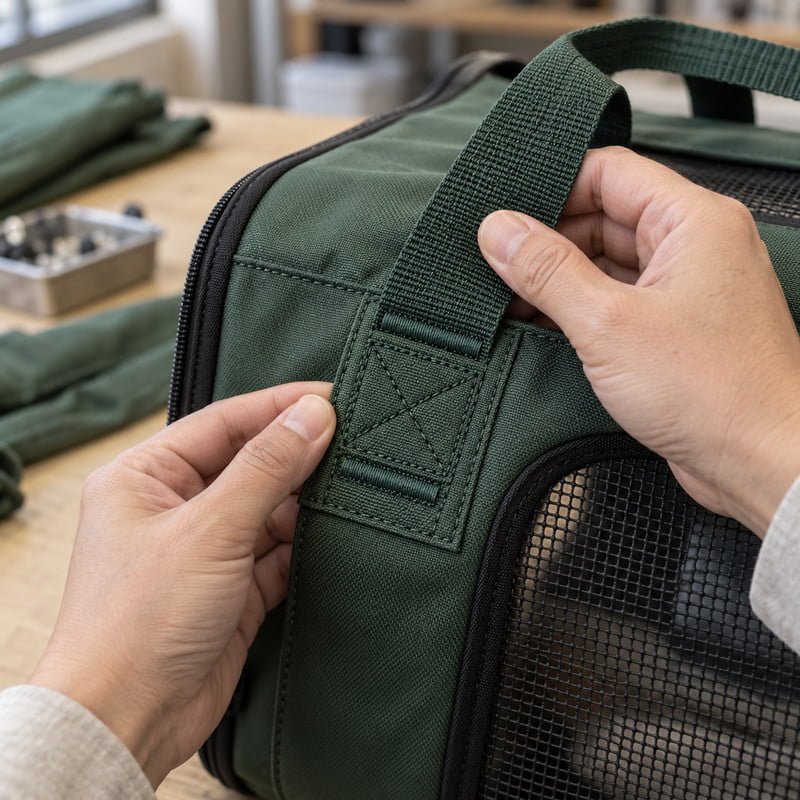
- Sewing: stitch program with box‑X + bartacks, seam allowance, reinforcement patches, binding and edge finishing.
- Ask for factory proof:
- SOPs for anchor sewing and quality checks.
- Seam swatches and anchor samples with documented pull values (to be verified).
- Evidence of jigs/templates; consistency across duplicate samples.
- Front‑load compliance:
- Real BOM with certificates for fabric, mesh, boards, foams, webbings, zippers, and hardware.
- Plan pre‑compliance for REACH[^5]/CPSIA[^6]/CA65 and basic mechanical tests (seam/anchor pull[^7]).
- Confirm their routine with third‑party labs and what documents arrive before PO.
- Use a defined sample development and approval process to refine workmanship:
- Check pattern accuracy, panel alignment, consistent seam allowance.
- Inspect binding, zipper straightness, bartack placement.
- Evaluate whether they fix issues cleanly between iterations.
A quick anecdote from our sampling: a shoulder anchor tore on the first lift. Root causes were thin backing and the wrong stitch density.[^8] We corrected with a larger patch, a tighter box‑X + added bartacks, increased seam allowance, and upgraded thread/webbing. The PP sample then passed our internal anchor pull with a safety factor over rated pet weight (values to be verified), and the lab confirmed mechanical integrity.
Frequently Asked Questions
What specs should I lock before sampling?
Lock measurable inputs: fabric denier and coatings/backer, mesh grade and tensile, board/foam type and thickness, webbing width and tensile, zipper gauge, hardware rating, thread size, stitch length, seam allowance, and a defined stitch program (box‑X + bartacks). This turns “quality” into buildable, testable work. Prepare this checklist when you start a private-label project so the initial brief is ready for a technical review.
How do I front‑load compliance without overpaying?
Request a BOM with certificates for each material. Run pre‑checks for REACH/CPSIA/CA65 and basic mechanical tests on your sample. Use third‑party labs selectively, and only after the factory has shown internal pull‑test capability and fixed known issues. All thresholds should be verified with your lab.
Which tests matter most before PO?
Do handle/shoulder anchor pull tests with a safety factor over rated pet weight (to be verified)[^9], seam pull tests at stress points, zipper cycling,[^10] and strap adjuster slip tests. Require a PP sample with documented results. If anchors and seams pass, you reduce the biggest safety risk.
Conclusion
Choosing a pet carrier manufacturer is about proven materials, structural sewing, and pre‑compliance, not the cheapest quote. If you want OEM/ODM sampling with measurable specs, SOPs, and documented seam/pull tests, reach out to FungoMate. FungoMate in Ningbo supports private labels in the US, EU, Japan, and Korea with responsible build standards and buyer‑friendly iteration.
[^1]: "Recalls & Product Safety Warnings | CPSC.gov", https://www.cpsc.gov/Recalls. Consumer safety recall notices document pet carriers or similar pet products recalled for strap or seam failures that created safety hazards and required corrective action. Evidence role: casereference; source type: government. Supports: That failures in pet carriers involving seams or straps have prompted safety-related recalls or warnings.. Scope note: Recall records illustrate specific incidents and do not quantify overall industry failure rates. [^2]: "What Is Bartack Stitching and Why It Matters", https://nanobag.com/en-de/blogs/blogs/what-is-bartack-stitching?srsltid=AU7gw4WcM-qEzavu5D403zjS2Ic8tytd2Y0eZ6YI7E-CPDc8BfnOyY7l. Textile engineering references describe bartacks and box‑X stitch patterns as standard reinforcement methods that improve load distribution and resistance to tearing at strap and handle attachment points. Evidence role: mechanism; source type: education. Supports: That bartacks and box‑X stitch patterns are commonly used to reinforce stress points and distribute loads at webbing/strap attachments.. Scope note: Optimal stitch program depends on fabric, thread, and construction and should be validated by testing. [^3]: "Units of textile measurement", https://en.wikipedia.org/wiki/Denier(measure)?useskin=monobook. Denier is defined as grams per 9,000 meters of fiber; higher denier typically indicates thicker, heavier yarns that can contribute to sturdier fabrics. Evidence role: definition; source type: encyclopedia. Supports: The formal definition of denier and the general relationship between denier and yarn/fabric heft.. Scope note: Fabric strength also depends on fiber type, weave/knit, and finishing, not denier alone. [^4]: "ISO 105 Guide: Rubbing, Washing & Light Fastness ...", https://begoodtex.com/blog/iso-105-color-fastness-test-guide/?srsltid=AU7gw4X-YOfXqLsWuC2xU-myaDnDyEmvat0sln30lbrj0WHv1WGB7Rpq. Colorfastness refers to a fabric’s resistance to fading or dye transfer and is evaluated using standardized methods such as ISO 105 series and AATCC procedures. Evidence role: definition; source type: encyclopedia. Supports: That colorfastness is defined and evaluated by standardized test methods in textiles.. Scope note: Specific test selection depends on the intended use and exposure conditions. [^5]: "EU REACH", https://www.trade.gov/eu-reach. The EU’s REACH regulation manages the registration and restriction of chemicals and sets limits for certain substances present in articles sold in the EU. Evidence role: definition; source type: institution. Supports: That REACH governs chemical substances in the EU, including restrictions applicable to articles placed on the market.. Scope note: Obligations vary by substance, concentration, and article; testing is required only if relevant substances may be present above thresholds. [^6]: "Total Lead Content | CPSC.gov", https://www.cpsc.gov/Business--Manufacturing/Business-Education/Lead/Total-Lead-Content. Under the U.S. Consumer Product Safety Improvement Act (CPSIA), children’s products must meet lead and certain phthalate limits and comply with testing and certification requirements. Evidence role: definition; source type: government. Supports: That CPSIA imposes chemical limits and compliance requirements specifically for children’s products.. Scope note: CPSIA applies to children’s products; pet carriers may be outside its scope unless marketed for children or containing covered childcare components. [^7]: "Standard Test Method for Failure in Sewn Seams of Woven ...", https://store.astm.org/d1683_d1683m-22.html. Textile test standards such as ASTM D1683 (seam strength) and ASTM D6775 or ISO 13935 methods provide pull test procedures to quantify seam and strap assembly strength prior to production. Evidence role: general_support; source type: other. Supports: That established standards provide procedures for seam strength and webbing/strap pull testing.. Scope note: There is no single universal method for all anchor constructions; the applicable standard depends on materials and design. [^8]: "Impact of stitch density on seam strength, seam elongation ...", https://www.academia.edu/59045054/Impact_of_stitch_density_on_seam_strength_seam_elongation_and_seam_efficiency. Experimental textile studies report that seam strength varies with stitch density, stitch length, and thread size, and that inappropriate stitch density can reduce seam efficiency. Evidence role: mechanism; source type: paper. Supports: That seam strength depends on stitch density and related sewing parameters, with nonoptimal settings lowering strength.. Scope note: Results are material- and seam-type specific and should be validated for the target construction. [^9]: "Factor of safety", https://en.wikipedia.org/wiki/Factor_of_safety. In engineering, a factor of safety is the ratio between the capacity of a system and the expected load, and designs typically include safety factors to mitigate uncertainty and variability. Evidence role: definition; source type: encyclopedia. Supports: That a factor of safety is the ratio of capacity to expected load and is commonly incorporated in design/testing.. Scope note: Appropriate safety factor levels vary by application and relevant standards. [^10]: "Zipper Rotation Testing Machine, Zipper Puller Torque Tester ...",
. Standardized zipper test methods such as ASTM D2061 include reciprocation (cycling) and strength procedures to evaluate durability and performance. Evidence role: general_support; source type: other. Supports: That standard methods exist for zipper reciprocation (cycling) and strength testing.. Scope note: Access to full ASTM or ISO methods may require purchase; equivalent ISO standards can be used depending on market.