

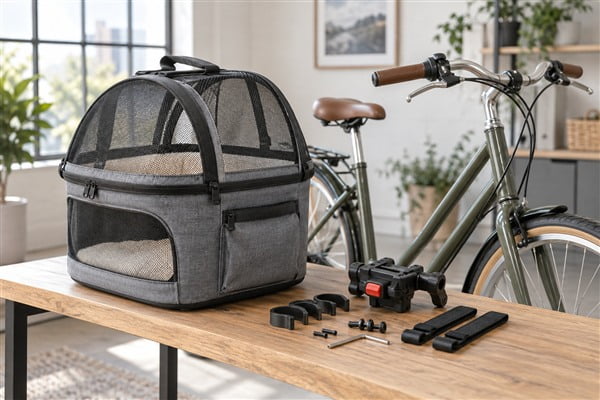
A bicycle carrier can appear to fit a handlebar or rack while still interfering with steering, cables, or the mounting system’s load limits. A product photograph cannot resolve those interfaces. Buyers expanding pet travel bags and carriers need a compatibility brief that identifies the bicycle, mounting hardware, carrier, and intended use together.
Define the supported mounting systems and exclusions, verify the complete installed arrangement, and obtain evidence for the relevant loads and use conditions. Avoid universal-fit claims based only on adjustable straps or clamps.
What should the compatibility brief identify?
State whether the carrier is handlebar-mounted, rack-mounted, or uses another defined interface. List the reference bicycle arrangements, mounting dimensions, carrier weight, and intended payload. Include the relevant bicycle and rack manufacturer’s restrictions.
KLICKfix carrier specifications and the KLICKfix adapter-system catalogue show why carrier and adapter selection must be considered together. Their published specifications apply to those identified products; they are examples of documentation to request, not ratings that transfer to a private label design.
Ask for explicit exclusions, including unsupported bar materials, shapes, or mounting locations. If compatibility is uncertain, obtain guidance from the relevant component manufacturer rather than approving an improvised clamp arrangement.

Which clearances should be checked on the installed carrier?
Inspect steering movement, brake and gear cables, lights, displays, and access to controls. Review clearance around the wheel and the rider’s normal position. For a rear installation, check the interface with the rack and any adjacent equipment.
Record the installed position with photographs and measurements. Specify the exact adapter, spacer, bracket, and fastener arrangement. A different spacer can alter leverage or clearance even when the carrier itself has not changed.
Changes to mounting panels or reinforcement belong in carrier structural development. Include installation checks in the sample development process so the factory evaluates the assembled interface rather than only the fabric basket or bag.
How should loads and retention be discussed?
Distinguish carrier mass, contents, pet allowance, and the applicable limits of the bicycle and mounting components. Do not assume a component limit is a permissible animal weight. Obtain a complete-system assessment and follow the most restrictive applicable instructions.
Ask a competent test provider to define relevant static, repeated-use, vibration, and retention evaluations. Tests should use appropriate fixtures and test loads, not animals exposed to experimental loading. Discuss laboratory capability through ISO/IEC 17025 laboratory guidance.
For applicable strap materials, ASTM D6775 webbing test method may inform component testing. For exposed metal components, ISO 9227 salt-spray methods may be relevant to a corrosion plan. Neither method by itself establishes safe bicycle operation or the reliability of the complete mounting system.

What should buyers request for installation and use?
Provide a parts inventory, required tools, assembly sequence, specified tightening instructions from the responsible manufacturer, and checks before use. Avoid inventing torque values or encouraging users to substitute missing hardware.
Use IEC/IEEE 82079-1 instruction principles as a reference for organizing information. The instructions should explain supported configurations and show the locking or retention state clearly. Include inspection, maintenance, removal, and conditions that require stopping use.
Review ventilation, enclosure, pet suitability, and the intended retention arrangement separately from the mounting hardware. An adapter’s strength does not establish that the carrier interior suits the animal or that all riding conditions are appropriate.
How should quotations and changes be controlled?
When preparing a carrier RFQ, separate the carrier, mounting kit, reinforcement, instructions, and packaging. Confirm which parts are included so retail customers are not left to infer that an essential adapter is supplied.
Keep the approved combination versioned using ISO 10007 configuration-management guidance. Evaluate proposed customization options against the mounting requirements and the supplier’s manufacturing capabilities. A new bracket or reinforced panel should trigger review of affected interfaces.
Discuss shipping protection through ISTA test-procedure overview where appropriate. Packaging tests address transit damage; they do not validate bicycle mounting. Inspect the received hardware and carrier for damage before installation trials.
Create a compatibility matrix with one row per evaluated mounting arrangement. Record the reference bicycle interface, included hardware, clearance findings, evidence, and decision. Keep untested arrangements separate from those explicitly rejected or approved.
Frequently Asked Questions
Can adjustable fittings justify a universal compatibility claim?
No. Adjustment range is only one factor. Material restrictions, geometry, clearance, and load limits still need defined coverage and exclusions.
Can the supplier copy a competitor’s mounting rating?
No. Require evidence tied to the proposed design and exact components. Similar appearance does not establish equivalent materials, construction, or test performance.
Prepare the interface information first
Send reference mounting systems, dimensions, intended payload, exclusions, and installation expectations. Then contact FungoMate to discuss development. A specific compatibility plan gives the factory a clear target and gives the retail brand defensible limits for product information.


