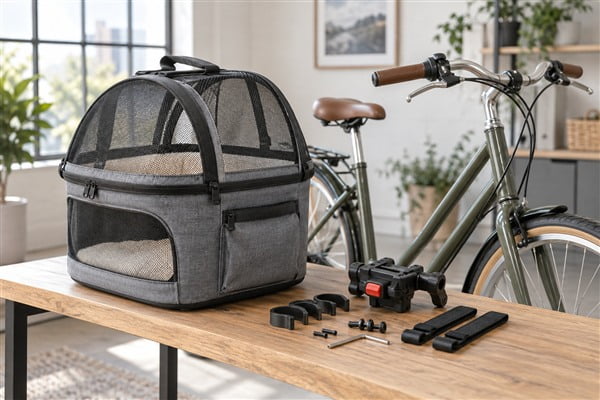

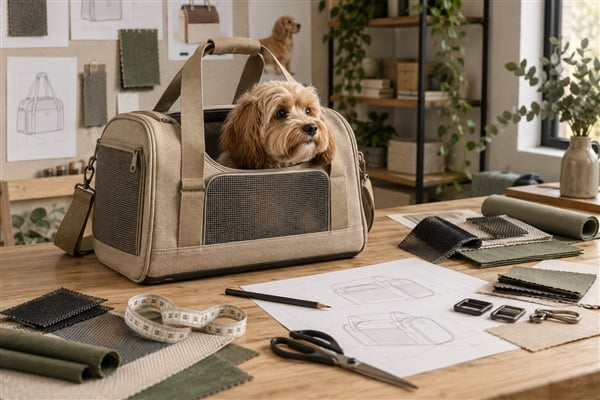
Adding a logo to a carrier is different from moving its opening or increasing its height. Buyers sourcing pet travel bags and carriers should classify requested changes before asking for a price. Otherwise, a project quoted as simple customization may require new patterns, reinforcement, and repeated sampling.
A change needs development when it alters fit, panel geometry, assembly, support, access, or load transfer. Judge the effect on the complete carrier, not just the size of the visible change.
Which changes are usually cosmetic?
Color, label artwork, and some print placements may retain an existing pattern when material properties and construction remain equivalent. Even then, confirm print durability, dye transfer, application temperature, and placement near seams or closures.
Review carrier customization options with a marked drawing. Distinguish “appearance only” from “same appearance, different material.” Changing from flexible fabric to a thicker coated shell can alter folding, seam buildup, machine settings, and zipper alignment despite identical dimensions.
When planning a focused carrier range, identify which design elements your brand truly needs. A focused brief can preserve useful existing construction while concentrating development effort on the feature that matters to customers.
What normally requires pattern changes?
Changes to width, height, length, entry size, pocket location, mesh layout, or zipper route usually deserve a pattern review. The effect can spread to adjacent panels, binding lengths, reinforcement, and packaging.
Use the framework in soft-sided versus structured carriers to identify how the support system works. Enlarging a mesh panel removes shell material; moving a handle can change where force enters the bag. An extra centimeter is not automatically a minor change.
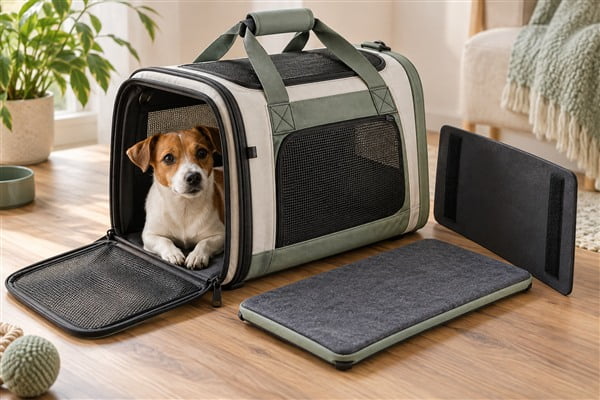
Ask for revised drawings showing finished dimensions, seam allowances, opening geometry, and component placement. Require the developer to identify reused parts and newly created parts so the quotation reflects actual work rather than a generic customization fee.
Which changes need structural development?
Changing the base, support rods, frame, handle anchors, shoulder-strap connections, or intended load calls for structural review. Trace the path from the supported base to the carrying points. Check what happens when the user lifts, turns, sets down, or reassembles the carrier.
ASTM D6775 webbing test method can inform strap-material evaluation, and ASTM D1683 for woven sewn seams addresses relevant woven seams. The ASTM textile test-method directory includes zipper tests. These are component references; the finished carrier needs a test plan suited to its actual design and intended use.
Set test loads, directions, conditioning, observations, and acceptance criteria with the developer or laboratory. Do not increase the advertised carrying capacity merely because one stronger buckle has been added.
Can customization change travel suitability?
Yes. New dimensions, openings, ventilation arrangements, or support components may change where and how the carrier can be used. IATA Traveler’s Pet Corner provides air-travel context, while IATA cabin-travel guidance clarifies that IATA does not certify commercial carriers. Check the relevant airline’s requirements for the revised version.
For cat-focused designs, use Cat Friendly Homes carrier guidance to review access and cleaning priorities. A fashionable flap should not obstruct required airflow or make the pet harder to remove calmly. Document how each new feature operates in the complete design.
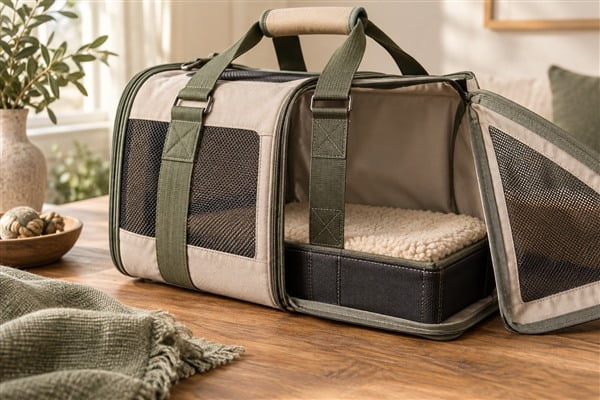
If a vehicle-safety claim is involved, compare the exact configuration with CPS certified-product listings. Treat revised attachment points or dimensions as a reason to review coverage, rather than assuming an earlier model’s evidence transfers automatically.
How should buyers control development cost?
Divide the sample development process into clear deliverables: change classification, revised drawings, first prototype, fit and function review, necessary tests, and preproduction approval. Agree the scope of each sample round and the process for additional changes.
When choosing a carrier manufacturer, ask who owns approved pattern files, what component minimums apply, and how repeat orders are identified. Request a revision log connecting artwork, pattern, materials, and test evidence.
Review the final packed form with the ISTA test-procedure overview as a transport-testing reference where appropriate. A structural change may also alter folding instructions, carton size, insert protection, or packing time.
Compare total development cost, not only the first sample fee. Include pattern work, tooling, material trials, testing, packaging changes, and obsolete parts. Freeze the approved specification before bulk purchasing so avoidable late changes do not spread across production.
Frequently Asked Questions
Does changing fabric always require a new pattern?
No, but it requires review. Thickness, stretch, stiffness, coating, and sewing behavior determine whether the existing pattern remains suitable.
Can a supplier reuse previous test reports?
Only when the evidence legitimately covers the revised construction and claims. Ask the testing provider to identify what remains applicable and what needs reassessment.
To scope your project accurately, contact FungoMate with a reference design and a marked list of proposed changes, intended uses, quantities, and target cost.