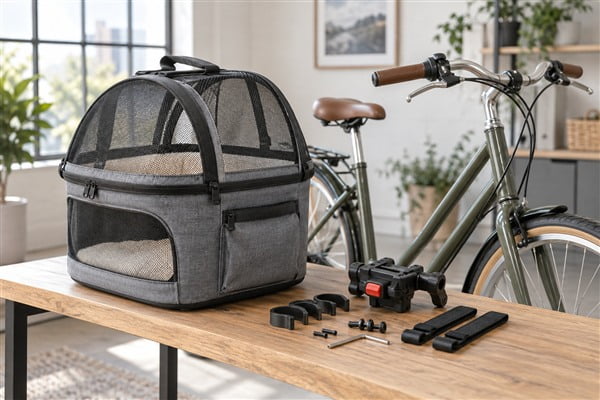

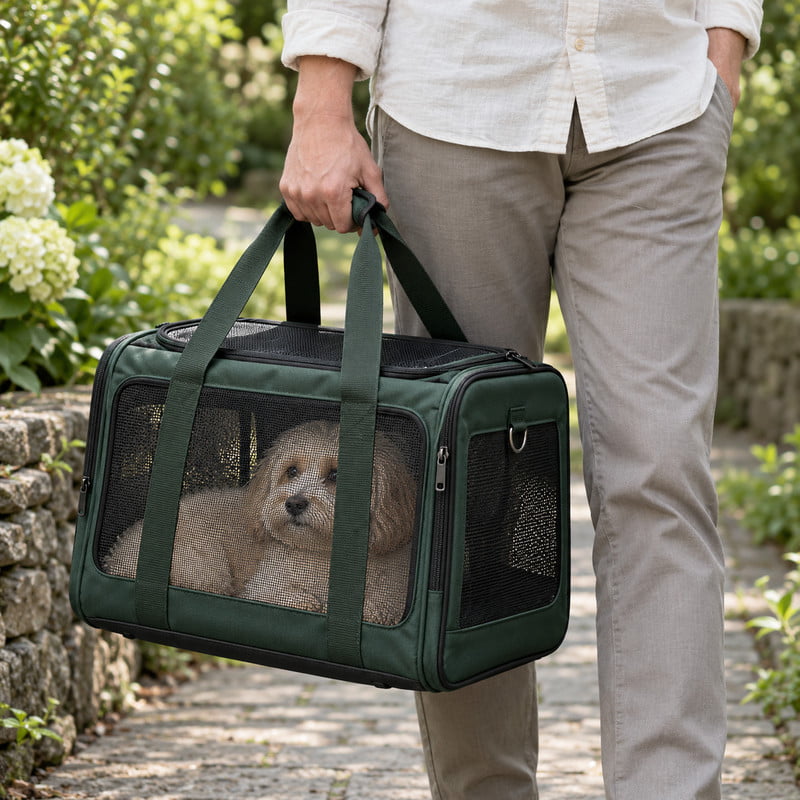
Soft-sided vs. structured pet carriers spark buyer confusion. The problem isn’t the label; it’s whether the support, base, and vent/durability choices match your use case. If you misjudge those, returns pile up. The fix is a simple framework: compare support scheme, base-load path, vent/durability, and compliance by scenario. Start with the pet travel bags and carriers range to compare the formats available for your target market.
Wholesale buyers should compare soft-sided vs. structured pet carriers by four decision variables: support scheme, base-load path, ventilation/durability, and scenario-specific compliance. Match these to in-cabin, car, or vet travel needs. Verify construction and test reports with your supplier. Avoid relying on “kg capacity” alone.
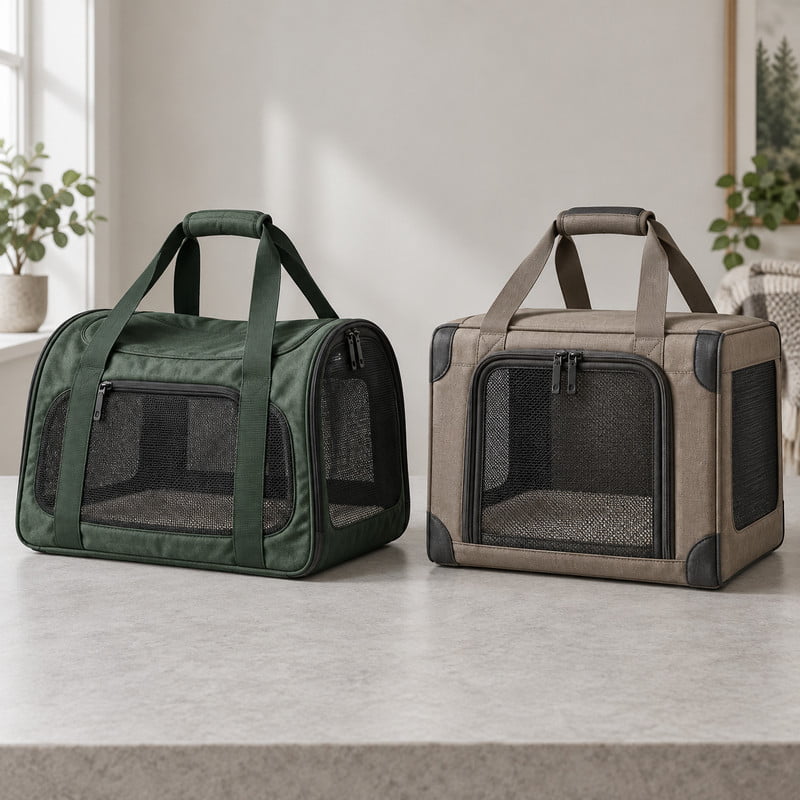
You now have the gist. Let’s dig into what actually drives fit, safety, and reviews, plus the small construction choices that make or break your launch. For planning across formats, see how to build a focused pet carrier product range.
Which support scheme fits your scenario for soft-sided vs. structured pet carriers?
We all love a neat “soft vs. hard” headline, but that’s not how carriers perform. The real issue is shape retention versus flexibility. If you choose the wrong support scheme for under-seat or car use, you invite deformation complaints and “doesn’t fit” returns.
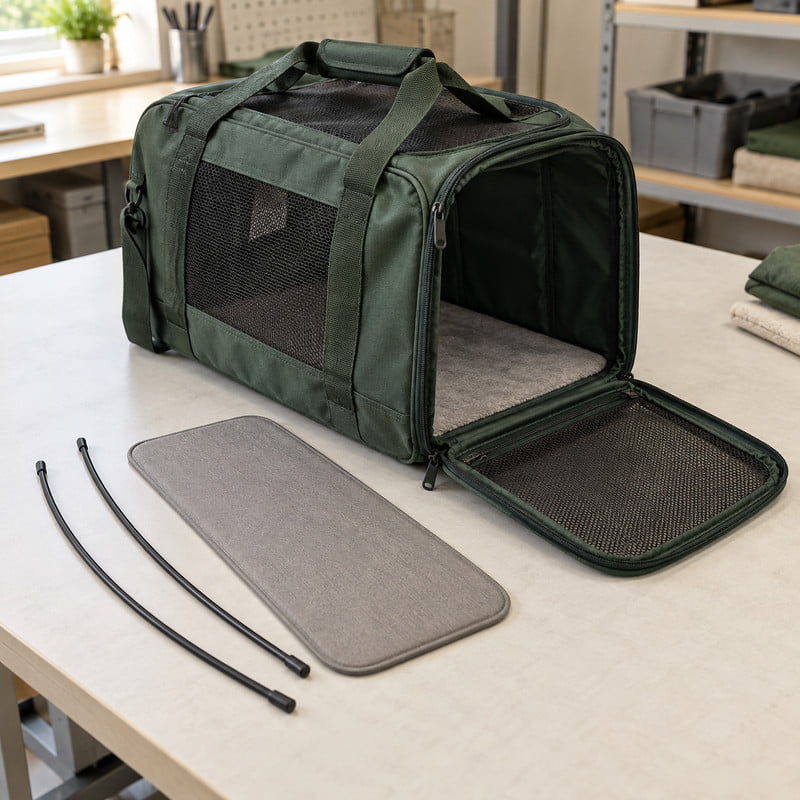
A good match starts with the use case: removable rods or semi-rigid panels for in-cabin compression; full frames for heavier pets or longer ground transport. Compare insertable rods, panel stiffness, and foldability against storage CBM and any assembly steps your customer must handle. Review the available material and construction customization options before you lock the support specification.
Dive deeper
- Removable rods: These keep shape but allow top compression under an airline seat[^1]. They also lower shipping/storage CBM and give you smaller cartons. The trade-off is light assembly by the user.
- Semi-rigid panels: Great for daily commute or vet visits. Panels resist collapse without becoming bulky. They balance shape and weight.
- Full frames: Best for reducing deformation under load and for larger pets.[^2] They’re less forgiving in tight spaces and usually increase CBM.
I once guided a buyer from fixed side panels to removable top rods for a “in-cabin” SKU. Returns tagged “won’t fit under seat” dropped after launch, and reviews highlighted “flexible top still keeps shape.” We tracked return rate and “fit” keywords. Support changed; the label didn’t.
For soft-sided vs. structured pet carriers, how should you judge the baseboard and load path?
A high “kg capacity” can mislead.[^3] If the baseboard is soft, badly bound, or poorly fixed to the shell, weight shifts to side panels and zippers[^4]. That causes sag, sway, and pet anxiety[^5]—even when capacity looks fine on paper.
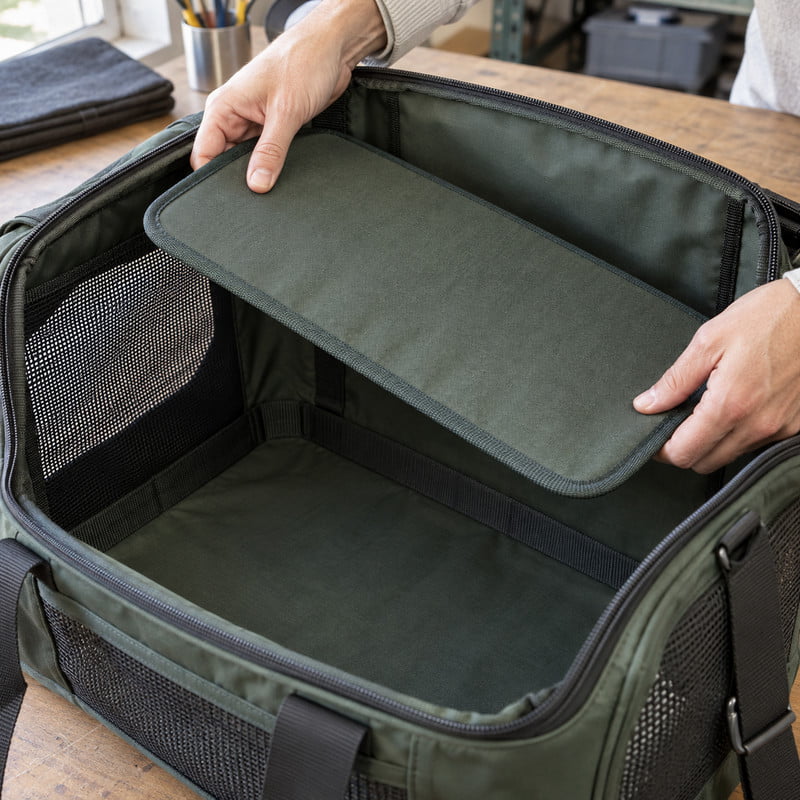
Check base stiffness, edge binding, fixation points, and handle/strap anchoring to the base. You want pet weight transferred to the platform, not the sides. Ask for supplier test reports and samples you can load-test yourself.[^6] For a broader supplier checklist, read our guide to choosing a pet carrier manufacturer.
Dive deeper
- What to verify:
- Baseboard thickness and material (e.g., PP board with foam lamination).
- Edge binding quality (no frayed edges; clean, reinforced stitching).
- Base-to-shell fixation (Velcro + bartacks or screw rivets in structured designs).
- Handle/strap anchoring that passes through the shell to the base.
- Symptoms of poor load path:
- Sway while carrying.
- Side-panel collapse.
- Zippers stressed or separating under load.
A buyer switched from single-point handle anchoring to a wrapped strap path stitched into the base. “Sags when walking” complaints dropped. The star rating improved because the carrier “felt steady.” We tracked sag notes in reviews and monitored warranty claims.
What compliance and sizing strategy cuts returns for soft-sided vs. structured pet carriers?
Airline policies vary by carrier and route.[^7] No supplier should promise compliance. Still, you can set a strategy that reduces risk: match internal height with flexible top compression, manage footprint, and provide fit guidance. For ground transport, stock multiple sizes with clear pet weight and length guidance.
Compliance is scenario-specific. For in-cabin, choose semi-rigid support with removable rods. For car travel, a stiffer frame can help.[^8] Always ask buyers to verify dimensions with their target airlines before purchase.[^9]
Dive deeper
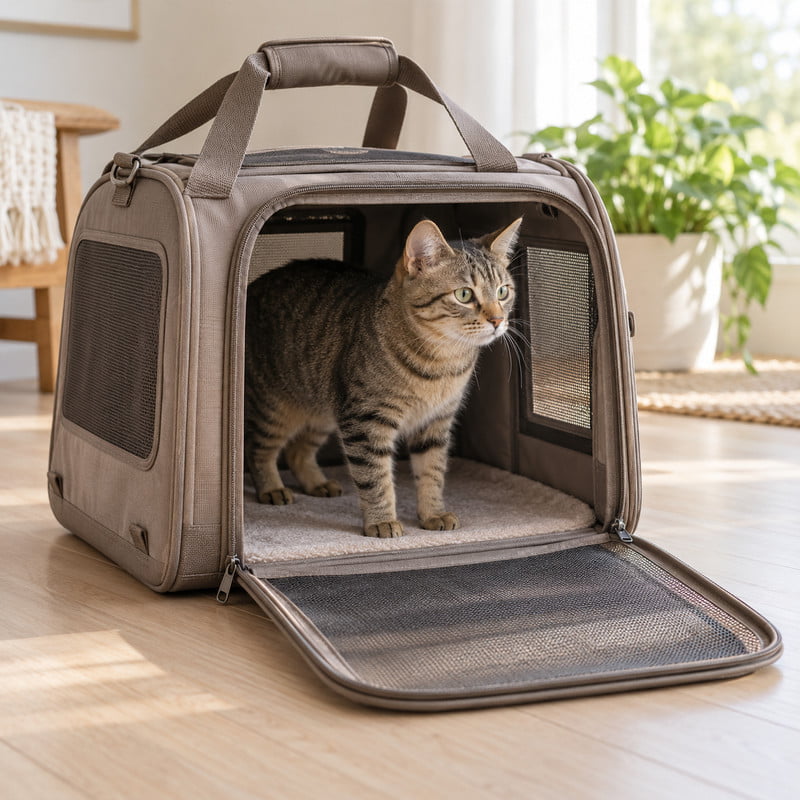
- In-cabin focus:
- Internal height vs. flexible top compression.
- Footprint that aligns with common under-seat zones.
- Auto-lock sliders and leash tethers for escape prevention.
- Ground transport focus:
- Multi-size assortments (XS–L).
- Clear fit guidance: pet length, shoulder height, and temperament.
- What to include in PDP:
- “Verify with your airline” notice.
- Photos of the base and anchoring.
- Mesh type and reinforcement notes.
We replaced “fits most airlines” copy with a sizing guide and an “verify-before-you-fly” reminder. Returns labeled “airline refused” fell. It wasn’t magic; just a better compliance strategy and honest PDP content. Build fit checks and listing reviews into the sample development and approval process before approving the final SKU.
Frequently Asked Questions
Do soft-sided vs. structured pet carriers have different safety levels?
Neither is inherently safer. Safety depends on the baseboard, load path, support scheme, and hardware quality. Verify base stiffness and handle anchoring, then match support to your scenario. Ask for supplier test reports and run your own sample checks. Review the supplier’s manufacturing and quality-control capabilities alongside those sample results.
How should I evaluate ventilation and durability together?
Treat mesh type, weave density, and reinforcement as one system. Tighter weaves resist claws but can reduce airflow.[^10] Reinforce zipper paths and openings. Add auto-lock sliders and a leash tether to reduce escape risk. Test with sample pets or simulated load.
What should I include in my listing to cut returns?
Show base construction, anchoring points, and support inserts. Provide a sizing guide with pet length and shoulder height.[^11] Add an airline verification note for in-cabin SKUs. Use simple visuals that explain assembly steps for removable rods.
Conclusion
Choosing between soft-sided vs. structured pet carriers is about scenario-driven trade-offs: support scheme, base-load path, vent/durability, and compliance. If you want help mapping those choices to your brand’s use cases, contact FungoMate in Ningbo. I can share samples, test reports to verify, and run OEM/ODM iterations that reduce returns and improve reviews.
[^1]: "Airline Approved Pet Carrier Guide (2026)", https://mrpeanutspetcarriers.com/pages/airline-approved-pet-carrier-size-guide-2026?srsltid=AU7gw4VS8B-VP248JYKlsRuUxMdzV3vvj_ZIe77iqGzqDjAM1-Ty_3rF. Airline in‑cabin policies commonly state that pet carriers must fit entirely under the seat, and several specify that soft‑sided carriers may exceed posted dimensions slightly if they can be compressed to conform to the under‑seat space. Evidence role: general_support; source type: institution. Supports: That airlines require in-cabin pet carriers to fit under the seat and often note that soft-sided carriers may be slightly larger if they can be compressed to fit.. Scope note: Exact allowances differ by airline, aircraft type, and route, so this is not a universal rule. [^2]: "Deflection of rigid frames stressed beyond the yield point", https://dr.lib.iastate.edu/rtd/13546. Independent pet‑carrier evaluations have reported that products with more rigid, reinforced structures are better able to maintain enclosure integrity under load/impact than minimally structured soft designs. Evidence role: mechanism; source type: institution. Supports: That independent crash-testing and evaluation indicate more rigid carrier structures better maintain integrity under load compared with less-structured designs.. Scope note: Most available tests simulate crash forces rather than routine carrying, so results speak to structural robustness rather than everyday comfort. [^3]: "2015 Carrier Study Results | Center for Pet Safety", https://centerforpetsafety.org/2015-carrier-study-results/. Independent testing programs have documented failures of certain pet carriers under dynamic conditions despite manufacturer representations, illustrating that labeled weight capacity does not by itself predict performance in real use. Evidence role: general_support; source type: institution. Supports: That independent testing has found some pet carriers fail under dynamic loads despite manufacturer representations, indicating labeled capacity alone is not a reliable safety indicator.. Scope note: Tests cover a subset of products and conditions and may not reflect every model or loading scenario. [^4]: "Load path analysis - Wikipedia", https://en.wikipedia.org/wiki/Load_path_analysis. Engineering texts explain that clear load paths are essential to direct forces to intended supports; when a primary support is insufficiently stiff, loads are redistributed into other components, elevating deformation and stress in those unintended paths. Evidence role: mechanism; source type: education. Supports: That in structural systems, properly designed load paths transfer loads to supports; inadequate primary support redirects forces into secondary elements, increasing deformation and stress.. Scope note: This is a general structural principle; it explains the mechanism but is not a pet‑carrier–specific test. [^5]: "Effects of Interactions with Cats in Domestic Environment on ... - PMC", https://pmc.ncbi.nlm.nih.gov/articles/PMC10340037/. Veterinary studies report elevated physiological and behavioral stress indicators in cats and dogs during transportation and handling, indicating that motion and the transport context can contribute to anxiety. Evidence role: general_support; source type: paper. Supports: That transportation and handling are associated with measurable stress responses in companion animals.. Scope note: Studies typically assess overall transport stress; they do not isolate the specific effect of carrier sag or sway. [^6]: "Pets on Planes Lesson 1: Preparing and Receiving Pets for Air Travel", https://www.aphis.usda.gov/pet-travel/pets-on-planes/preparing-pets-air-travel. Independent organizations have issued pet‑carrier test protocols to evaluate containment and structural performance, which can be used to substantiate supplier reports and guide buyer verification testing. Evidence role: general_support; source type: institution. Supports: That independent organizations have published test protocols for pet carriers, providing a basis for requesting and reviewing test reports.. Scope note: Protocols are voluntary and focus on specific scenarios (e.g., crash conditions), not all aspects of product use. [^7]: "Flying with Pets | Federal Aviation Administration", https://www.faa.gov/travelers/fly_pets. Industry guidance notes that requirements for transporting pets, including in‑cabin policies, are determined by individual airlines and can vary with the carrier and itinerary. Evidence role: expert_consensus; source type: institution. Supports: That pet travel rules, including in-cabin requirements, are set by individual airlines and may vary by itinerary.. Scope note: Guidance documents summarize industry practice but do not enumerate each airline’s specific rules. [^8]: "Car Seat & Booster Seat Safety, Ratings, Guidelines | NHTSA", https://www.nhtsa.gov/vehicle-safety/car-seats-and-booster-seats. Vehicle‑oriented pet‑carrier evaluations emphasize that carriers with more robust, stiffer structures are better able to maintain containment during crash simulations than minimally structured soft carriers. Evidence role: general_support; source type: institution. Supports: That independent vehicle-related evaluations highlight the importance of structurally robust carriers for maintaining containment during sudden stops or crashes.. Scope note: Crash tests simulate extreme conditions; benefits in everyday driving are inferred rather than directly measured. [^9]: "Traveler's Pet Corner", https://www.iata.org/en/programs/cargo/live-animals/pets/. Authoritative travel guidance for animals advises passengers to confirm carrier dimensional requirements and acceptance conditions directly with their airline prior to travel. Evidence role: general_support; source type: institution. Supports: That authoritative guidance advises travelers to confirm pet carrier requirements, including dimensions, directly with their airline.. Scope note: Specific dimension limits and verification processes differ by airline and aircraft. [^10]: "Investigation of the air permeability of fabric weaves to increase the ... - PMC", https://pmc.ncbi.nlm.nih.gov/articles/PMC12062212/. Textile engineering references describe that as weave density (cover factor) increases, fabric porosity decreases and air permeability drops, reflecting a trade‑off between openness and airflow. Evidence role: mechanism; source type: education. Supports: That air permeability of woven materials decreases as weave density/cover factor increases, reflecting reduced porosity.. Scope note: This principle addresses airflow; specific claw resistance also depends on fiber type and construction beyond weave density. [^11]: "Traveler's Pet Corner - IATA", https://www.iata.org/en/programs/cargo/live-animals/pets/. Established transport guidance specifies crate sizing using the animal’s body length and standing height measurements to ensure adequate space for natural posture. Evidence role: definition; source type: institution. Supports: That established animal transport guidance sizes containers based on the animal’s body length and height measurements.. Scope note: Formal formulas are designed for cargo/hold transport; for in‑cabin carriers, airlines may impose smaller, under‑seat constraints.