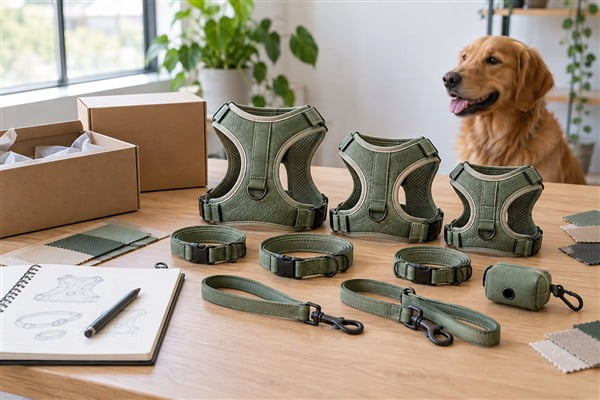


A pet product bundle only works when it solves a real task. New dog owners face daily-walk stress: fit, control, and cleanup[^1]. If the harness slips, the leash jerks[^2], or the bag dispenser rattles, frustration rises. The fix is a task-chain bundle with specs teams can verify and repeat.
A strong pet product bundle starts by mapping the daily-walk task-chain (fit → control → cleanup), translating each task into verifiable specs, then engineering material and hardware consistency across the harness, leash, and dispenser. Size from the harness first, keep a lean matrix, and set guardrails for price, MOQ, and packaging.
Most bundles fail because they bolt SKUs together without a shared logic. Below, I show how I plan bundles for brand and marketplace teams, including quick try-outs, simple pass/fail criteria, and commercialization guardrails you can use immediately.
How do you map the task-chain for a pet product bundle?
Daily walks expose weak links fast. Owners need secure fit, predictable control, and easy cleanup in one kit. If any piece fights the user, they blame the bundle. We start with tasks, define roles and non-negotiables, then convert them into spec placeholders the team can test.
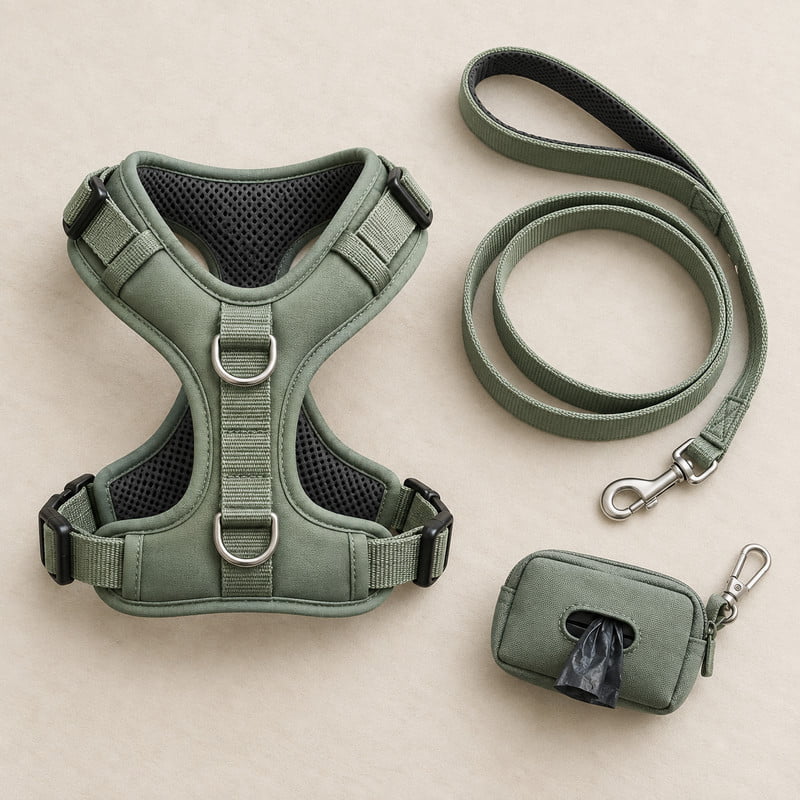
A task-led pet product bundle uses clear roles: harness = stable fit and even pressure[^3]; leash = predictable control and tested tensile strength; dispenser = one-hand pull with a quiet, secure mount. Convert these into specs: adjustment range by chest girth, stitch integrity thresholds, hardware lock type, and dispenser pull friction.
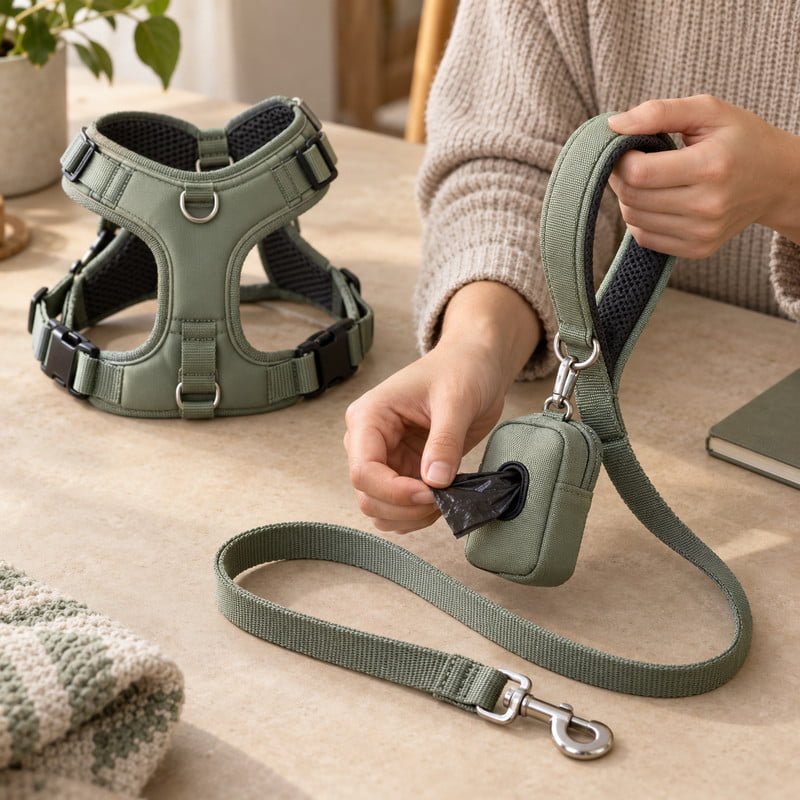
I run simple, replicable try-outs before we pick finish details. For fit, we check harness adjustment on chest-girth[^4] dummies (e.g., 40–55 cm) and log strap-slip after 50 pulls. For control, we target leash webbing tensile[^5] bands (e.g., ≥300 kg for M/L), plus 200-cycle snap/lock checks[^6] on hooks. For cleanup, we test pull friction on bag cores and verify dispenser mounts on both harness and leash with no rattle after a brisk shake. I keep notes to cut rework later, like “left chest strap slips 5 mm under load—tighten ladder lock spec.”
How do you engineer consistency in a pet product bundle?
“Franken-bundles” happen when components feel and behave differently. That inconsistency drives returns. Users notice handfeel mismatches, hardware glare differences, and uneven strength. We fix it by locking one material family and a shared hardware logic across the set.
A consistent pet product bundle uses one webbing base, padding logic, and thread class across parts, plus aligned hardware finish and gauge. The goal is a uniform tactile experience and predictable mechanical behavior, backed by quick slip, snap, and abrasion checks instead of vague adjectives.
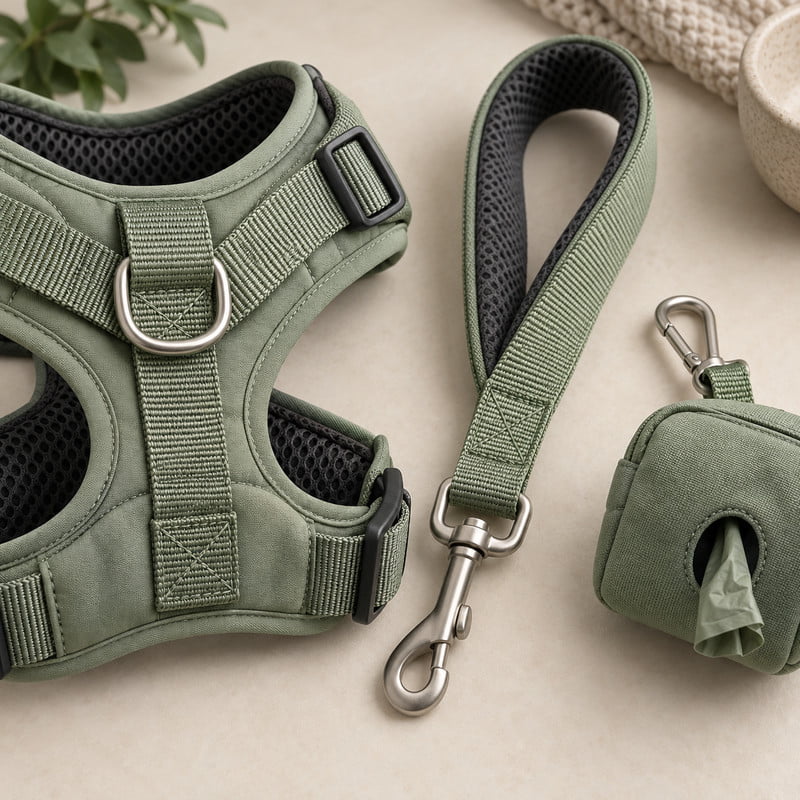
I anchor everything to the leash load and harness fit. If the leash is specced for strong pullers, the harness D-ring and buckle gauge rise to match. We keep webbing surface finish consistent (e.g., matte nylon) and stitch thread class uniform (e.g., bonded 40s) to avoid weak seams[^7]. Reflective trims[^8] and handle padding live inside the target landed-cost band; if cost pressure hits, I drop non-critical trims before mixing unmatched materials. Two anonymized client runs proved this: after we standardized webbing and locks, sample iterations dropped from three rounds to two, and fit confusion in reviews fell by half.
Frequently Asked Questions
How should I size and color a daily-walk pet product bundle?
Start sizing from the harness. Publish a chest-girth guide, then cascade leash length and dispenser placement. Keep a lean matrix: 2–3 harness sizes covering most breeds, plus 2–3 coordinated colorways. Lock trim and print rules for painless replenishment and clearer PDP guidance to cut returns.
What price and MOQ guardrails protect margins?
Set a target landed-cost band first. Trade off extras like reflective trim or handle padding without breaking material consistency. If MOQ pressure rises, modularize the dispenser as an add-on pack instead of mixing unmatched fabrics. Verify barcode logic and inner-pack arrangement[^9] early to avoid relabeling delays.
Any compliance or retailer-specific requirements?
Treat compliance as market/channel-specific. Confirm substance restrictions, labeling, and packaging claims[^10] per retailer or region. We flag these in the spec sheet as “to be verified,” then align with your QA or lab partner. Avoid universal promises until you have a documented pass.
Conclusion
A well-built pet product bundle solves the daily-walk task-chain with verifiable specs, material and hardware consistency, and a simple sizing system. If you want an OEM/ODM partner who can turn this logic into samples and stable mass production, contact FungoMate in Ningbo. Let’s map your bundle, lock costs, and reduce returns together.
[^1]: "Leash Up! Must-Have Dog Walking Gear and Accessories", https://www.aspcapetinsurance.com/resources/dog-walking-accessories/. Guidance from major animal-welfare organizations advises using a well-fitted collar or harness, maintaining leash control, and carrying bags to pick up waste during walks, indicating these elements are core to routine dog-walking practice. Evidence role: generalsupport; source type: institution. Supports: Responsible dog-walking guidance emphasizes a secure collar or harness, appropriate leash control, and carrying waste bags.. Scope note: These guidelines speak to best practices rather than measured stress among new owners. [^2]: "Effects of the application of neck pressure by a collar or harness on ...", https://pubmed.ncbi.nlm.nih.gov/16611932/. A peer-reviewed study reported that applying pressure to the neck via collars significantly increased intraocular pressure in dogs, suggesting that abrupt leash forces on collars can have measurable physiological effects. Evidence role: mechanism; source type: paper. Supports: Neck pressure from collars can elevate intraocular pressure in dogs, which abrupt leash forces may exacerbate.. Scope note: The study examined controlled collar pressure and intraocular pressure changes; it does not quantify real-world jerk magnitudes or broader injury risks. [^3]: "Review of Collars, Harnesses, and Head Collars for Walking Dogs - PMC", https://pmc.ncbi.nlm.nih.gov/articles/PMC12345489/. Veterinary welfare guidance explains that well-fitted harnesses distribute force across the chest and shoulders, reducing neck pressure compared with collars when a dog pulls. Evidence role: mechanism; source type: institution. Supports: Harnesses distribute force across the dog’s chest/shoulders rather than concentrating it on the neck.. Scope note: This is general veterinary guidance rather than a quantitative biomechanical study. [^4]: "How to Measure a Dog for a Harness", https://www.chewy.com/education/dog/general/measuring-dog-harness. Animal-welfare fitting guides instruct owners to measure around the dog’s chest (ribcage) to choose and adjust a harness correctly. Evidence role: definition; source type: institution. Supports: Standard guidance for selecting and adjusting dog harnesses emphasizes measuring chest/ribcage girth.. Scope note: This guidance defines common practice; it is not a formal industry standard specification. [^5]: "Tensile Test Experiment - Michigan Technological University", https://www.mtu.edu/materials/k12/experiments/tensile/. University textile testing resources describe tensile strength testing as a standard method for determining the breaking strength of fabrics and webbings, which is directly applicable to evaluating leash materials. Evidence role: mechanism; source type: education. Supports: Textile testing standards use tensile strength measurements to assess fabric/webbing breaking strength.. Scope note: These methods support the use of tensile testing but do not specify performance thresholds for pet leashes. [^6]: "Fatigue (material) - Wikipedia", https://en.wikipedia.org/wiki/Fatigue(material). Reference works on material fatigue explain that repeated cyclic loading degrades materials and components over time, supporting the rationale for cycle-based durability checks on snap/lock mechanisms. Evidence role: mechanism; source type: encyclopedia. Supports: Repeated cyclic loading can lead to fatigue and failure in hardware, justifying endurance cycle testing for snaps/locks.. Scope note: General fatigue principles do not prescribe a specific number of cycles or test protocol for pet leash hardware. [^7]: "Effect of Different Sewing Parameters on Lockstitch Seam ...", https://www.academia.edu/67471432/Effect_of_Different_Sewing_Parameters_on_Lockstitch_Seam_Strength_for_Denim_Fabric. Textile engineering studies report that seam strength is influenced by thread type, size, and stitch parameters, supporting the practice of standardizing thread class to reduce weak seam incidence. Evidence role: mechanism; source type: paper. Supports: Seam strength depends on thread properties and stitch parameters; consistent thread specification supports predictable strength.. Scope note: Findings are based on specific fabrics and constructions; exact effects may vary with materials used in pet products. [^8]: "Newspaper Article 2: Nighttime Visibility | FHWA", https://highways.dot.gov/safety/pedestrian/newspaper-article-2-nighttime-visibility. Transportation safety guidance shows that retroreflective materials substantially increase nighttime conspicuity, implying that adding reflective elements to pet-wear can improve visibility in low-light walks. Evidence role: mechanism; source type: government. Supports: Retroreflective materials enhance nighttime conspicuity under vehicle headlights.. Scope note: Evidence is based on human pedestrian visibility; benefits for dogs are inferred but contextually similar. [^9]: "Packaging Levels in Data Hub", https://www.help.gs1us.org/packaging-level. GS1 guidance specifies how GTINs and barcodes are assigned at different packaging levels (each, inner pack, case), supporting the need to validate barcode logic and pack configuration early to avoid relabeling. Evidence role: definition; source type: institution. Supports: GS1 standards define GTIN/barcode assignment across item, inner pack, and case levels.. Scope note: Standards must be applied correctly and may be supplemented by retailer-specific requirements. [^10]: "SVHC Compliance: A Guide to Substances of Very High Concern", https://go.ipoint-systems.com/blog/svhc-compliance. EU regulatory guidance states that articles placed on the market are subject to chemical restrictions and may trigger obligations to communicate about substances of very high concern, exemplifying region-specific substance and labeling duties. Evidence role: definition; source type: government. Supports: Under EU REACH, companies placing articles on the EU market must manage restricted substances and communicate SVHC information when thresholds are exceeded.. Scope note: This pertains to the EU; other jurisdictions (e.g., US states) have different compliance regimes.