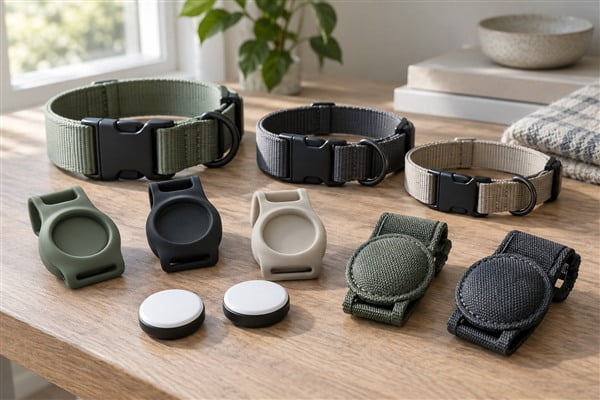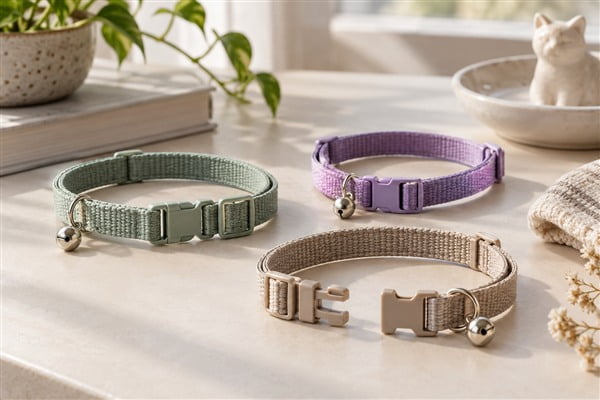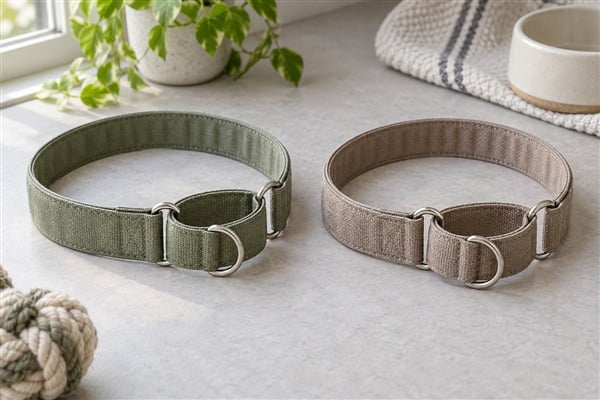

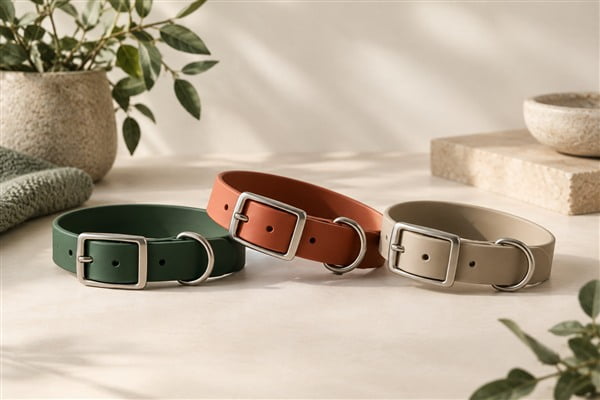
Coated webbing collars can offer a clean appearance and a wipeable surface, but similar-looking materials may differ in stiffness, construction, and processing behavior. Buyers adding them to harnesses and walking gear should identify the exact material and assess the finished collar before approving a range.
Compare the webbing core, coating grade, dimensions, flexibility, edges, connections, cleaning behavior, and hardware together. A material name or color swatch is not a complete collar specification.
What material is the supplier proposing?
Request the manufacturer, product code, core construction, coating type, width, thickness, and tolerances. BioThane material FAQs explains that BioThane is a brand of coated webbing. Do not use that trademark as a generic name for unrelated coated straps.
The BioThane PVC product range illustrates that even one manufacturer offers different coating options. Ask for data tied to the selected grade. For example, a BioThane grade-specific data sheet is useful as a model of product-specific documentation, not evidence for every coated collar.
When choosing a harness manufacturer, apply the same traceability discipline to collars: the purchase specification should identify the approved material rather than say only “waterproof webbing.” Keep supplier substitutions subject to review.
How does the material behave in a collar?
Wrap the sample around representative neck forms and inspect how it curves near the buckle, keeper, and ring. Check whether adjustment is smooth, the end stays controlled, and the surface or edges create uncomfortable contact.
Consider private-label harness customization when planning a coordinated range. Matching colors across harnesses, collars, and leads does not mean their materials should be interchangeable. Each product still needs an appropriate construction and evaluation.
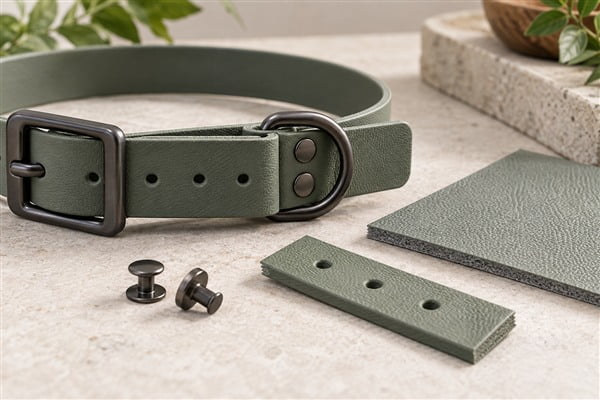
Review material and hardware options before finalizing the strap width and buckle. Coating thickness can affect fit through slots, folding around a ring, and the reach of a buckle tongue. A nominal width alone does not establish compatibility.
What should you inspect at holes and connections?
Look at punched holes, cut ends, folded sections, stitching, rivets, screws, and any welded joins. Check for burrs, damaged coating, distorted cores, and sharp fastener edges. Record the exact construction and component codes.
ASTM D6775 webbing test method addresses webbing material strength and elongation. Use appropriate material testing where relevant, then assess the finished collar connection separately. A strong uncut strip does not establish the strength of a perforated, folded, or fastened assembly.
Define load direction, conditioning, test fixtures, and acceptance criteria with a competent provider. Do not derive a pet-weight claim directly from a loose material’s breaking-force figure. Inspect adjustment retention and closure function as separate requirements.
Which cleaning and appearance checks matter?
Use the actual material supplier’s instructions. BioThane processing and cleaning guidance provides brand-specific processing and cleaning information; it should not be applied automatically to a different coating formulation.
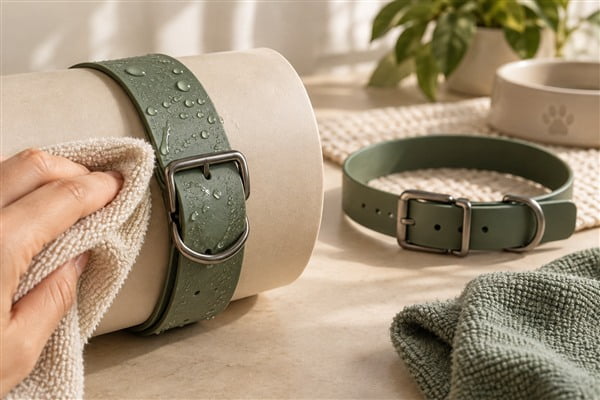
Evaluate the intended cleaning routine and likely dirt exposure on finished samples. Compare surface condition, flexibility, odor retention, edge changes, and hardware operation afterward. Avoid promising resistance to every cleaner or outdoor chemical without supporting evidence.
For suitable textile surfaces or components, the ISO 105-X12 rubbing-fastness method can inform color-transfer assessment; ask the laboratory whether it fits the selected coated material. Metal corrosion requires a separate approach, such as relevant ISO 9227 salt-spray methods procedures with agreed exposure and evaluation criteria.
How do you approve a repeatable range?
Use the sample development process to compare the same collar size, hardware, and fastening method across material candidates. Keep a reference sample and approved color standard. Record tolerances rather than relying on a photograph of a shade.
Review manufacturing capabilities for incoming material checks, cutting accuracy, hole placement, fastening consistency, and traceability. Where testing is outsourced, ISO/IEC 17025 laboratory guidance provides a starting point for evaluating laboratory competence and the relevant scope.
Agree how material, coating, hardware, or process changes will be reported. Include labeling and care instructions in approval. A coating change that looks identical may still justify new processing trials or performance checks.
For quotations, request the exact grade, widths, thicknesses, colors, hardware finishes, size ratios, minimum quantities, and packaging. Compare complete collar costs, including assembly and rejected parts, instead of comparing strap price alone.
Frequently Asked Questions
Is all coated webbing BioThane?
No. BioThane is a specific brand. Use accurate material descriptions and retain evidence for any branded material claim.
Does a water-resistant strap mean a maintenance-free collar?
No. Closures, fasteners, rings, edges, and accumulated dirt still need attention. Provide care instructions appropriate to the complete product.
To evaluate a coated-webbing collar range, contact FungoMate with your target sizes, colors, material expectations, hardware preferences, and intended retail channel.