
A dog harness range should cover useful body profiles, not simply offer more letters on a size chart. Buyers sourcing harnesses and walking gear can lose time on repeated samples when chest circumference is treated as the only dimension that matters.
Build the range around measured body shapes, usable adjustment, strap position, and validated size boundaries. Add sizes or pattern families when they solve an identified fit gap, not just to make the range look broader.
Which measurements should define the starting point?
Record chest circumference, the relevant neck measurement, body proportions, and the position of the intended straps. The AKC measuring guide provides a useful measuring reference. Keep body measurements separate from finished strap lengths and panel dimensions.
When choosing a harness manufacturer, ask how the supplier measures samples and records adjustment limits. A published range should describe usable fit, not the greatest length achievable by pulling a strap to its mechanical endpoint.
Collect representative measurement profiles from the intended audience. Include different chest depths, neck-to-chest relationships, and body lengths. Breed names can help organize discussion, but they do not replace measurements or prove that every individual will fit.
When does one pattern family become insufficient?
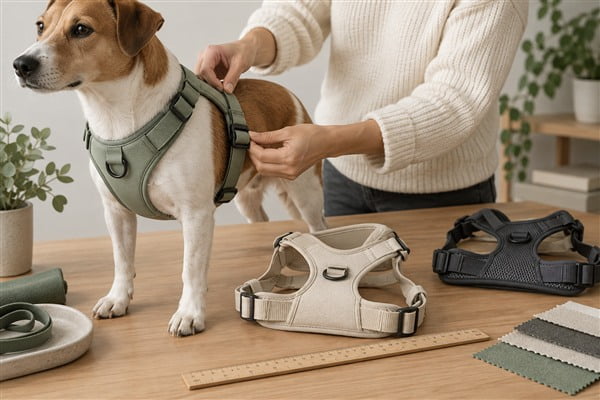
A harness that fits a broad chest may place straps differently on a narrow, deep chest. Enlarging the same pattern can also change panel position, strap angles, and hardware placement. Review those effects before assigning the next size label.
The AKC harness-fit guidance discusses appropriate fit and movement. Translate that into observations for your actual construction: clearance near the elbows, shoulder movement, neck position, stable adjustment, and whether the panel stays correctly located during normal activity.
Our discussion of private-label harness customization helps separate appearance changes from development. Consider a second pattern family when repeated trials show that more adjustment cannot solve the same structural mismatch.
How should you set size boundaries?
Create a matrix showing intended body profiles, finished measurements, adjustment positions, and approved component codes. Test near the lower and upper boundaries of each proposed size, not only a convenient middle measurement.
Define how customers should choose between overlapping sizes. Avoid a universal “always size up” instruction if a larger neck opening or misplaced strap compromises fit. If neither size works, the appropriate answer may be another pattern rather than greater looseness.
Include dressing and adjustment in the evaluation. Check whether instructions make strap routing and buckle closure clear. Observe supervised standing, walking, sitting, and turning, stopping if the dog shows discomfort. Do not test escape or overload behavior by putting an animal at risk.
What changes when materials and hardware change?
Review material and hardware options together. Thicker padding can reduce usable room, stiff webbing can change adjustment, and a larger buckle can contact the body differently. Repeat the relevant fit checks when these details change.
ASTM D6775 webbing test method addresses material breaking strength and elongation. The ASTM textile test-method directory provides other textile assessment references. These methods help characterize components but do not establish the fit or overall performance of an assembled harness.
For dyed materials, consider the ISO 105-X12 rubbing-fastness method where applicable. Agree care conditioning using ISO 6330 washing and drying procedures and assess dimensional change with the ISO 5077 dimensional-change method where suitable. Review strap adjustment and panel position again after the selected care sequence.

How do you turn fittings into production controls?
Use the sample development process to keep body measurements, sample revisions, adjustment positions, observations, and approval decisions together. Record failed configurations as well as successful ones so the range’s limits remain visible.
Check manufacturing capabilities against the approved matrix. Define measurement points, tolerances, strap threading, component identification, and workmanship criteria. Confirm that the packing label and customer chart refer to the same version as the factory instructions.
Where external testing is needed, ISO/IEC 17025 laboratory guidance provides context for laboratory competence. Agree the method, scope, conditions, and reporting requirements rather than requesting a generic “safety test.”
Use returns to refine the range. Separate complaints about chest room, neck opening, panel length, adjustment, and confusing instructions. A high return count in one size may reflect a pattern gap or labeling problem, not simply the need to add another letter size.
Frequently Asked Questions
Should every harness size use identical hardware?
Only if fit and performance support it. Smaller dogs may need different proportions, while structural requirements still need to be met. Validate changes instead of assuming uniformity is best.
How many sizes should a first launch include?
Enough to cover the defined audience with reliable combinations. Begin with evidence from the selected profiles and expand when a measurable gap appears.
To plan a useful size range, contact FungoMate with your intended body profiles, harness construction, target measurements, quantities, and customer-facing fit expectations.