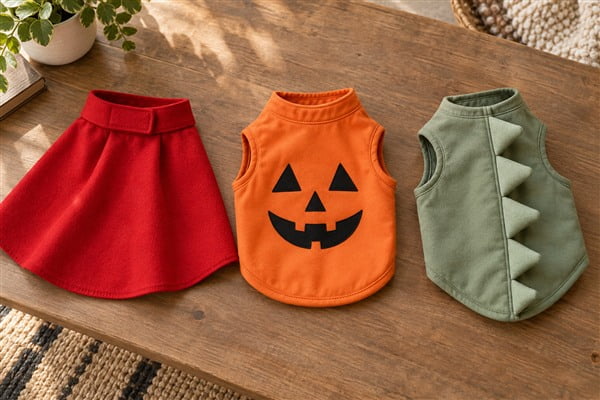


A bandana is a small product with several different wearing systems. A tie-on triangle, snap-fastened accessory, and over-collar sleeve may share artwork, but they require different sizing, instructions, and inspection. Brands adding bandanas to a pet apparel range should select the wearing method before treating the design as a simple print order.
Choose the style around the intended customer, neck-size range, handling routine, and existing collar. Specify usable dimensions, fastening details, fabric behavior, and care requirements before approving artwork or bulk quantities.
When does a tie-on style make sense?
A tie-on bandana offers a familiar appearance and flexible positioning, but finished fabric size is not the same as wearable neck range. Allow for the intended knot and tail length, then review how the accessory sits rather than advertising one triangle as universally sized.
Provide a measurement drawing and practical fitting instructions. AKC measuring guide is a useful reference for collecting body measurements, while the bandana still needs its own fit review. Check whether the point or loose ends interfere with normal movement or attract chewing.
Ask the supplier to finish narrow corners consistently. Small differences in seam allowance can change the appearance of the tips. Capture these details when writing clear sample revisions instead of requesting only a larger or smaller triangle.
What changes with snap fastening?
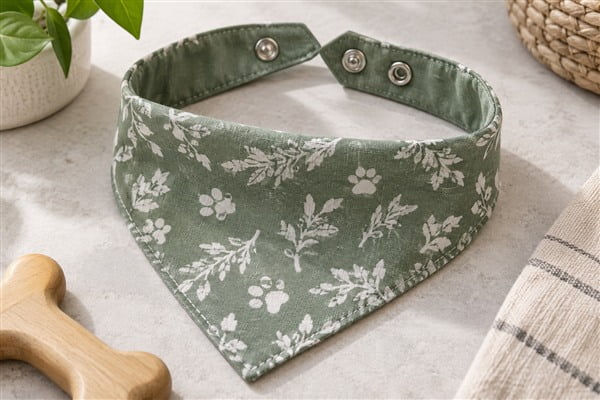
Snaps can create defined size positions and a clean presentation. Specify the number of positions, spacing, overlap, and orientation. Show which surfaces face the animal and how the bandana should lie when each position is used.
Check the fabric around every snap for distortion or tearing after the agreed operation sequence. Review attachment security on the completed sample. A catalogue snap specification alone does not establish performance in a thin or loosely woven fabric.
Do not describe an ordinary snap as a safety-release mechanism without appropriate development and evidence. Keep the accessory’s intended use clear and avoid combining decoration with an unsupported restraint function.
What should an over-collar bandana accommodate?
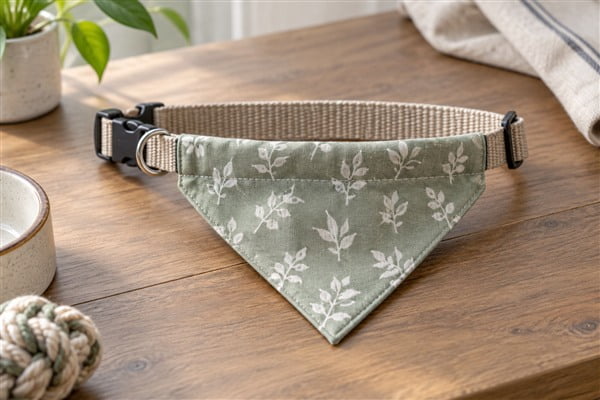
Define the collar width and thickness range, the channel’s finished clearance, and how the collar is threaded through it. Consider whether a buckle or fitting must pass through the channel during installation. A sleeve that fits the webbing may still be awkward to assemble.
Check that the bandana does not cover adjustment hardware or interfere with the collar’s function. Record the reference collars used during the sample development process. Compatibility should describe an evaluated range rather than imply that every collar construction will work.
Keep the decorative panel balanced once fitted. A channel that is too loose can let the bandana bunch or rotate, while an overly tight channel may make removal difficult. Compare the finished sample after normal handling.
Which fabric and print checks matter?
Agree the fabric reference, weight, finish, and grain direction. Compare appearance both flat and folded. A large print motif may disappear into a knot or channel, so approve placement on each wearing style rather than reusing one flat artwork proof.
Discuss suitable laundering checks using ISO 6330 washing and drying procedures and dimensional evaluation through ISO 5077 dimensional-change method. Include color transfer where relevant through ISO 105-C06 laundering colorfastness method and rubbing performance through ISO 105-X12 rubbing-fastness method. Agree acceptance criteria for the actual material and print combination.
Coordinate the resulting care instructions with ISO 3758 care-label symbols and the brand’s approach to planning clothing labels and packaging. Avoid copying the fabric supplier’s care wording without considering snaps, printing, or other assembled details.
How should the assortment be controlled?
Keep each style, size, and artwork version identifiable. ISO 10007 configuration-management guidance provides a useful document-control reference, while GS1 barcode implementation steps supports retail identification planning. A similar-looking snap and tie-on variant should not be packed under an ambiguous description.
Compare optional customization options against the supplier’s manufacturing capabilities. Ask for separate costs for fabric, printing, edge finishing, snaps, labels, and packaging. This reveals whether a lower quotation changes the wearing system or simply reduces a decorative feature.
Ask the packing team to demonstrate how each size and fastening style is identified. Similar folded bandanas can look alike, so the retail label and inspection reference should make the difference clear.
Frequently Asked Questions
Can one size serve the whole collection?
Only if the intended fit range is realistically defined and checked. Different fastening systems may require different size descriptions even when they use similar amounts of fabric.
Can the same artwork be used across all three styles?
Yes, with placement adjustments where needed. Review the visible area after tying, fastening, or threading the collar, and approve each finished arrangement.
Prepare a style-specific brief
Send the wearing method, dimensions, collar compatibility where relevant, artwork, and care expectations. Then contact FungoMate to compare samples that reflect the same retail objective. Clear fastening and fit decisions make a simple accessory easier to reproduce consistently.