
A harness opening can look correct on a flat jacket and still miss the attachment ring when the dog moves. Enlarging the hole may expose more of the back without fixing the mismatch. For brands developing a pet apparel range, opening placement should be treated as an interface between two products.
Specify the intended harness type, attachment location, opening geometry, reinforcement, and size-by-size position. Approve the jacket and harness together under normal movement rather than accepting an isolated opening detail.
Which harness is the jacket designed to accommodate?
Start with representative harness models or clearly defined attachment positions. State whether the opening serves a back attachment, a front attachment, or another arrangement. Do not describe a single back slit as universally compatible with all harnesses.
Provide photographs of the harness fitted as intended and record its size and adjustment. AKC harness-fit guidance is a useful consumer-fit reference, while the brand still needs a product-specific compatibility review. The jacket opening should allow access to the harness; it should not be presented as a leash attachment point.
Keep the reference harness available throughout development. When the harness model changes, repeat the interface check. Connect this record to writing clear sample revisions so the factory can distinguish an opening-position revision from a change in the underlying harness.
How should position and opening size be specified?
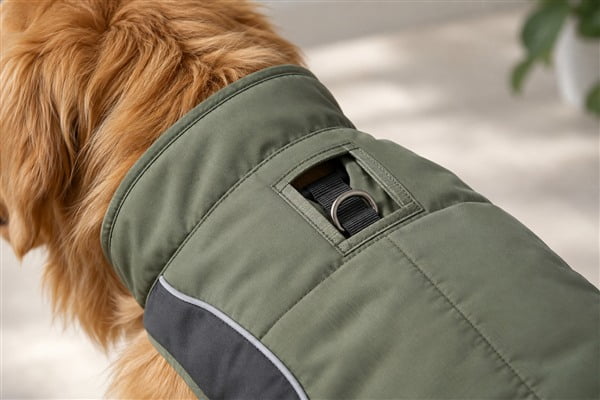
Measure from stable garment reference points, such as the center-back neckline seam, and identify whether the measurement is taken flat or on the fitted garment. Include orientation, finished length, finished width, and tolerances. A marked drawing is more useful than “place near the shoulders.”
Confirm access with the intended ring and leash clip, including space for the user’s fingers. Use AKC measuring guide to inform the body-measurement information collected for fitting, while specifying hardware clearance separately in the garment drawing.
Review placement separately across the size range. Body proportions and harness geometry may not scale by one constant increment. Include a practical compatibility check in the sample development process rather than copying a location from the medium sample into every size.
What reinforcement belongs around the opening?
Consider the fabric’s tendency to stretch, fray, or distort, then compare binding, facing, and local reinforcement options. Keep edges smooth against the harness and avoid excessive thickness that blocks access. Specify stitch placement so the opening is not unintentionally shortened during assembly.
For woven constructions, ask whether ASTM D1683 for woven sewn seams is relevant to the planned seam evaluation. Choose different methods where the material or failure mode requires them. Check the completed opening for tearing, exposed thread ends, and distortion after repeated access.
If the design includes a zipper or cover flap, confirm that it clears the harness ring and does not trap the leash clip. Relevant ASTM D2061 zipper-strength methods can inform component discussions, but repeated operation on the assembled garment remains necessary.
How should the finished combination be checked?
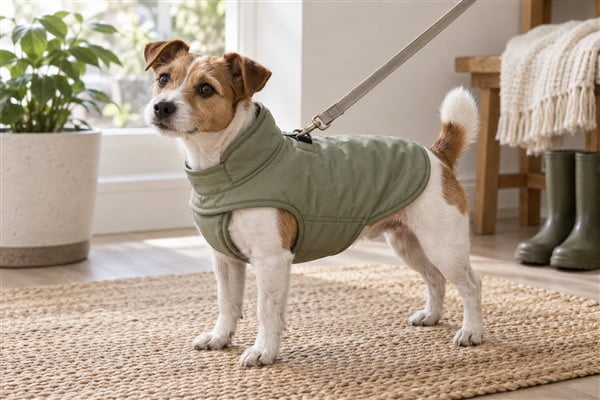
Observe standing, walking, turning, sitting, and normal head movement. Record whether the opening shifts away from the ring, presses against hardware, or pulls the jacket out of position. Use controlled fitting sessions; do not improvise high-load tests on a dog.
Check appearance and alignment after the agreed care procedure. ISO 6330 washing and drying procedures and ISO 5077 dimensional-change method provide references for planning washing and measurement. Test the actual layered construction because reinforcement and shell fabric may change differently.
For a rainwear claim, identify how the opening affects protection. Discuss suitable material checks through the AATCC test-method directory and assess the assembled opening separately. A water-resistant fabric report does not establish that rain cannot enter through an uncovered access slit.
What belongs in production instructions?
Approve drawings, opening dimensions, reinforcement materials, stitch details, and a photographed reference sample. Separate essential compatibility features from optional customization options. Ask the supplier to identify inspection points within its manufacturing capabilities, especially opening location and finished clearance.
Explain the intended harness arrangement in customer instructions and coordinate it with planning clothing labels and packaging. Use ISO 10007 configuration-management guidance as a reference when organizing drawing revisions and approvals. The production file should identify which harness reference and garment version were checked together.
Frequently Asked Questions
Should the opening be as large as possible?
No. Excess size can reduce coverage or create an untidy appearance. Choose enough clearance for the intended hardware and handling task, then verify that the garment still sits correctly during movement.
Can one opening cover every harness design?
Usually this requires a defined compatibility range rather than a universal promise. Publish the intended attachment arrangement and make exclusions clear where testing shows a mismatch.
Prepare a compatibility brief
Send garment drawings, reference harness details, opening measurements, and photos of the fitted combination. Then contact FungoMate to discuss construction and sampling. Clear interface requirements help the factory resolve placement early and reduce revisions after the collection’s photographs and packaging have already been prepared.