
“Too tight around the chest” is useful feedback, but it is not a factory instruction. Without a measurement point, sample identity, and intended result, the next version can solve one problem while creating another. Buyers developing a pet apparel range need a repeatable way to convert fitting observations into controlled revisions.
Record what happened, identify the affected construction, define the requested change, and state how the next sample will be checked. Keep one revision record that both the brand and factory can follow.
What should be recorded before requesting a change?
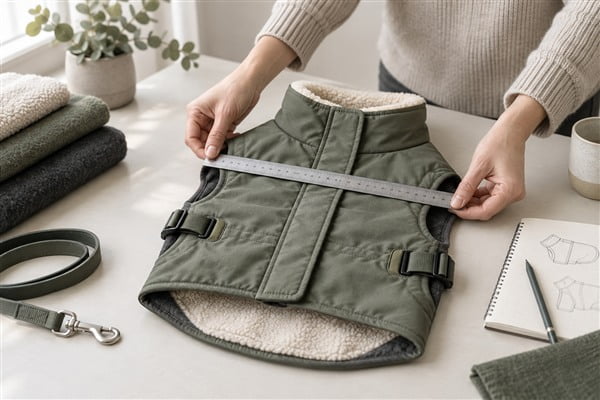
Identify the style, size, color, sample version, materials, and fitting date. Record the dog’s relevant measurements and the garment’s actual measurements. The AKC measuring guide provides a useful body-measurement reference; do not confuse those dimensions with a flat garment measurement.
Photograph the same views before and after adjustment, including normal standing and movement where appropriate. Note whether the problem appeared during dressing, walking, sitting, or fastening. A single close-up without orientation can hide where the garment is pulling.
The discipline of turning a jacket concept into a production brief continues through revisions. When choosing a pet clothing manufacturer, ask for the measurement sheet and revision format the development team will actually use, not simply assurances that changes are possible.
How do you separate observations from instructions?
Write the observation first: “The belly closure reaches its limit on the measured profile.” Then identify the proposed response, affected measurement point, and review requirement. Let the pattern technician confirm whether changing strap length, panel shape, or both addresses the cause.
A useful entry includes the current measurement, proposed target, tolerance, location, reason, and linked photograph. If you do not yet know the correct target, request a pattern proposal instead of guessing a number that the factory may treat as approved.
Distinguish required changes from suggestions. Mark unchanged areas explicitly in the revision sheet so the developer does not unnecessarily alter an approved neckline, print position, or seam. This is especially helpful when several people comment on the same sample.
How should the revision record be organized?
Use one numbered list rather than scattered messages. ISO 10007 configuration-management guidance provides a broader reference for identifying and controlling product versions. The practical goal is simple: everyone should know which drawing, material list, and sample define the current proposal.
Include the response from the factory beside each request: accepted, alternative proposed, clarification needed, or not feasible as written. Close the item only after the new sample has been checked. A reply saying “noted” does not establish that a change was implemented.
Build these exchanges into the sample development process. Keep photographs and measurements attached to the revision they describe, and record who can approve changes before sampling or production proceeds.
Which related checks can a fit change trigger?
Review customization options as connected construction decisions. More padding, a different elastic, or a wider closure can alter usable room even when the pattern outline looks unchanged. Check adjoining seams and openings after any geometry change.
ASTM D1683 for woven sewn seams and the ASTM textile test-method directory are references for relevant seam and fastener assessments. Select checks based on the revised construction rather than automatically repeating every available test.
If care affects the reported problem, use defined conditioning such as ISO 6330 washing and drying procedures and assess dimensions through an appropriate approach such as the ISO 5077 dimensional-change method. Record whether measurements were taken before or after cleaning. Review ISO 3758 care-label symbols when a change affects the proposed care instructions.
What closes the revision cycle?
Compare the new sample against every open item and inspect previously approved areas for unintended changes. Repeat representative fitting observations, recording the actual adjustment position and any remaining limits.
Check the supplier’s manufacturing capabilities for transferring approved changes into patterns, measurement sheets, and production instructions. When external evaluation is needed, ISO/IEC 17025 laboratory guidance helps frame questions about the relevant testing competence and scope.
Approve a complete version, not a collection of messages. The final package should identify the accepted sample, pattern revision, materials, measurements, workmanship requirements, labels, and packaging. Archive superseded versions so they cannot accidentally become the production reference.
Before remeasuring, agree whether closures are fastened, elastic is relaxed, and the sample has been conditioned. Different handling can create an apparent revision error even when the factory used the intended pattern.
Frequently Asked Questions
Should all feedback be sent immediately?
Record observations immediately, but consolidate conflicting comments before issuing factory instructions. A clear combined list reduces unnecessary sample rounds.
Can photographs replace measurements?
No. Photographs explain location and appearance, while defined measurements make the change reproducible. Use both for fit-related revisions.
To organize your next sampling round, contact FungoMate with the current specification, sample photographs, measured feedback, and the changes your brand needs to evaluate.