

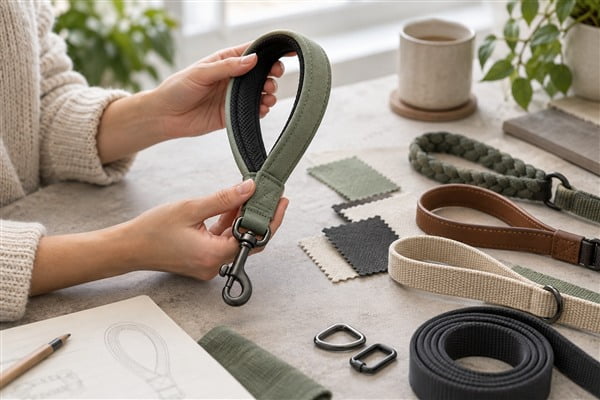
A leash handle is the part the customer touches most, but comfort cannot be judged separately from the loop’s construction. Buyers developing harnesses and walking gear need to compare grip, lining, seams, load transfer, cleaning, and assembly cost before approving a handle that looks premium.
Evaluate the handle as a complete loop connected to the leash. Match the dimensions and materials to intended use, then compare comfort, durability, and production steps on equivalent samples.
What should the handle brief define?
State the intended walking use, customer preferences, leash width, loop dimensions, lining, padding, and connection to the main strap. Identify whether the product also includes a secondary grip and how it is meant to be used.
The logic behind building a harness size range also applies to handle options: define the audience rather than assuming one proportion suits everyone. Avoid making a very small loop difficult to release or a large loop awkward to manage.
Review specifying leash clips and D-rings as part of the same product. A comfortable handle does not compensate for an unsuitable clip, ring, or connection. Keep the full leash specification together when comparing design alternatives.
How should buyers compare comfort?
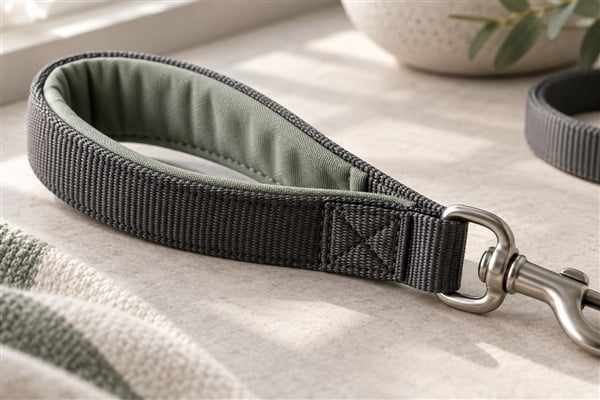
Compare unpadded webbing, lined loops, and padded constructions under the same ordinary handling conditions. Note edge contact, seam position, bulk, grip, and how the loop sits in different hand positions. Record observations instead of relying only on “soft” or “luxury” descriptions.
Review customization options before choosing a lining. A soft surface may introduce additional drying time, sewing complexity, or friction against other layers. Inspect how the lining ends near the junction, where thickness can build up.
Use safe handling trials without sudden pulling or hazardous loading. Keep structural evaluations separate and use appropriate fixtures. The goal is to understand everyday interaction without treating a person’s grip as test equipment.
What determines the handle’s durability?
Trace the continuous webbing and the stitched or fastened junction that closes the loop. Identify whether padding carries any structural role or simply covers the load-bearing strap. Record seam positions, thread, overlap, and reinforcement details.
ASTM D6775 webbing test method concerns strap-material strength and elongation. ASTM D1683 for woven sewn seams addresses applicable woven sewn seams. The ASTM textile test-method directory provides further method references, but none of these alone proves the performance of your finished leash.
Agree assembly-level conditions and criteria with a competent provider. Evaluate deformation, connection damage, and functional changes as well as a final breaking result where appropriate. Compare designs with the same strap and junction when the aim is to isolate handle differences.
How should cleaning and finishes be reviewed?
Define the proposed care routine and evaluate relevant textile components using suitable conditions, with ISO 6330 washing and drying procedures as a reference. Check whether padding shifts, lining wrinkles, binding becomes abrasive, or the loop changes shape afterward.
The ISO 105-X12 rubbing-fastness method can help assess color transfer where applicable. Include contact between dark webbing, light lining, and other adjacent materials. An attractive color combination should remain practical after the intended use and cleaning.
If the handle includes a metal ring or other fitting, consider relevant ISO 9227 salt-spray methods procedures for corrosion assessment. State the exposure and evaluation criteria; a general “rust resistant” description does not define what the supplier must deliver.
Which cost differences should be visible?
Ask suppliers to separate webbing consumption, lining, padding, binding, hardware, cutting, sewing, and inspection. A padded loop may add several operations even when the material cost appears small.
Use the sample development process to compare prototypes with their assembly steps and actual material specifications. Record how the handle is positioned during sewing and which details are sensitive to operator variation.
Review manufacturing capabilities for repeatable junction placement and lining quality. ISO 10007 configuration-management guidance is a useful reference for controlling approved versions when a cost reduction changes material, padding, or construction.
For outside evaluation, ISO/IEC 17025 laboratory guidance helps frame competence questions. Require reports to identify the tested assembly and relevant conditions. The lowest-priced handle is not necessarily the best value if extra rework or inconsistent finishing offsets the saving.
Ask for a clear section drawing at the loop junction. It should show which layers continue through the joint, where lining ends, and how the approved reinforcement is positioned during sewing.
Frequently Asked Questions
Does thicker padding always improve comfort?
No. Excess bulk, poorly placed seams, and unsuitable dimensions can reduce usability. Compare actual loops, not padding thickness alone.
Can the handle lining change late in production?
Treat it as a proposed change. Review sewing, feel, care, appearance, and any affected performance before approval.
To develop a handle around your retail brief, contact FungoMate with the leash construction, target customer, preferred feel, quantities, and cost priorities you want to balance.