

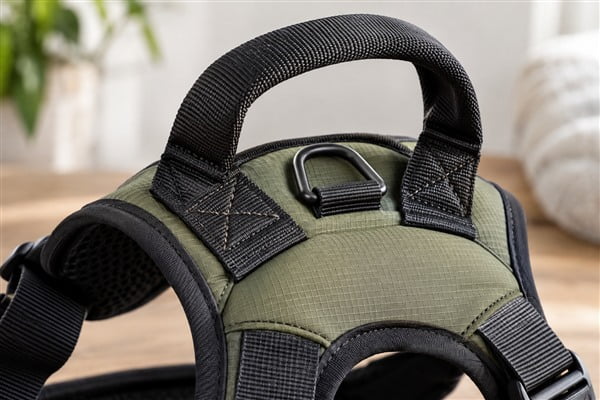
A grab handle can be easy to see in a product photograph yet difficult to grip on a fitted harness. Adding more height may improve finger access while increasing snagging or movement. Private label buyers developing harnesses and walking gear need to define what the handle is intended to do before approving its shape.
Specify grip space, hand approach, placement, padding, and the load path into the harness. Treat a control handle and a lifting handle as different product claims, each requiring appropriate evidence.
What is the handle’s intended task?
State whether the feature supports brief close control, assisted positioning, or another defined activity. Do not describe a standard walking harness as suitable for lifting or rescue without development and testing for that purpose. The intended task determines the structural questions.
Use AKC harness-fit guidance as background for fitting the harness correctly before reviewing handle access. A handle cannot compensate for a harness that rotates, sits too loosely, or interferes with movement.
Record the task and reference version alongside the drawing. ISO 10007 configuration-management guidance provides a useful approach to controlling these decisions. If marketing later changes the claimed use, reopen the review rather than assuming the original sample approval covers it.
How should grip clearance be measured?
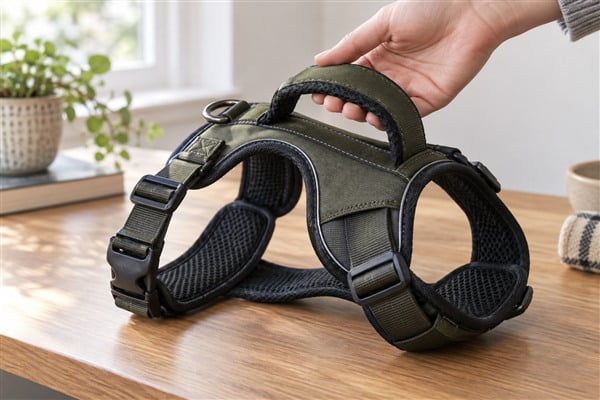
Specify usable length, width, and clearance above the fitted back panel. Identify whether these dimensions are measured relaxed or under a defined light handling condition. Include the intended hand approach and whether users may wear gloves.
Compare a flat webbing loop, a padded loop, and a more structured handle only if they address the same task. Examine how fingers enter and exit, whether edges press into the hand, and whether nearby hardware blocks access.
Include different harness sizes in the sample development process. A handle copied unchanged from a large harness can overwhelm a small back panel, while a proportionally reduced handle may become too small to use. Grip dimensions and garment grading should be reviewed together.
Where should the handle connect to the harness?
Ask the supplier to show the load path from each handle end into the main structure. Compare reinforcement, webbing continuity, seam placement, and local panel distortion. A large stitch pattern does not automatically make the connection strong.
Discuss ASTM D6775 webbing test method for applicable webbing tests and ASTM D1683 for woven sewn seams where woven seam methods suit the construction. Use ASTM textile test-method directory to identify alternatives when different materials or failure modes are involved. Agree actual acceptance limits separately.
When specifying clips and D-rings, check whether the handle interferes with leash-ring movement, buckles, or adjustment. Keep sufficient access to essential controls and avoid placing the handle where it encourages the user to grab an unintended component.
How should brands review durability and comfort?
Define loading directions, fixtures, repeated-use conditions, and inspection criteria with the test provider. Use controlled equipment rather than applying improvised loads to an animal. ASTM E4 force-verification practices provides a force-verification reference, and ISO/IEC 17025 laboratory guidance helps buyers assess relevant laboratory competence.
After the agreed sequence, inspect stitching, handle elongation, padding movement, and distortion of the fitted harness. A connection that remains attached may still fail the intended grip or fit requirement.
Check the handle after the proposed cleaning process. ISO 6330 washing and drying procedures can inform an applicable washing procedure. Examine drying access, retained moisture, and whether padding bunches. Care claims should reflect the complete handle and harness combination.
What should remain controlled in production?
Record handle material, finished dimensions, reinforcement, thread, stitch placement, and inspection points. Apply the brand’s process for approving material substitutions whenever the supplier proposes another webbing, foam, or thread. Small substitutions can change grip feel and assembly behavior.
Review optional customization options only after the basic function is approved. Decorative patches, contrast stitching, and handle covers should not obscure inspection points or reduce clearance. Confirm the relevant sewing operations within the supplier’s manufacturing capabilities before fixing the quotation.
Frequently Asked Questions
Is more padding always more comfortable?
No. Extra padding can reduce finger space or make the loop less stable. Compare the finished shape, edge feel, and grip under the intended task instead of judging foam thickness alone.
Can a grab handle support the dog’s full weight?
Do not assume so. A lifting claim requires an appropriate design, fit assessment, and validation of the complete system. Keep instructions aligned with the use actually evaluated.
Turn the handle into a clear specification
Send the intended task, grip measurements, placement drawing, reinforcement proposal, and sample priorities. Then contact FungoMate to discuss development. A well-defined handle gives the factory a functional target and helps the brand avoid making promises that the approved construction does not support.