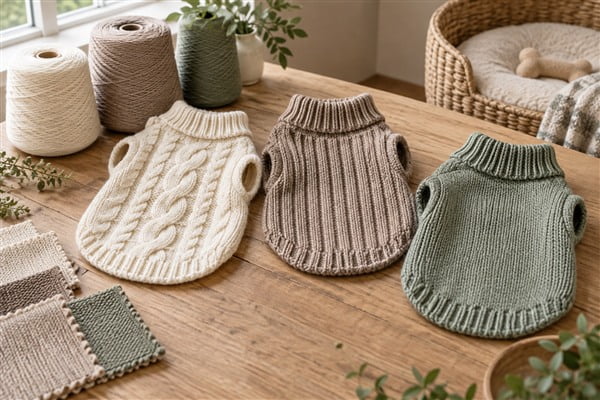
Two dog sweaters can share the same fiber description yet behave differently on the dog and after washing. Yarn construction, stitch density, shaping, and finishing all influence the result. When adding knitwear to a pet apparel range, buying by blend percentage alone leaves too many important decisions to the sample stage.
Compare yarn and knit structure as a combination. Approve the exact yarn specification, knitted swatch, garment measurements, recovery behavior, and care performance before committing the wholesale collection.
What information should accompany each yarn proposal?
Request fiber percentages, yarn count, number of plies, supplier reference, available colors, and intended finishing route. Ask whether the quotation uses stock yarn or a custom dye lot. Keep a physical reference and identify the version in your sample record; ISO 10007 configuration-management guidance offers a useful framework for this control.
Discuss how the blend supports the product’s purpose. A soft handfeel may suit lightweight indoor wear, while a denser construction may suit a different seasonal position. Avoid treating “wool blend,” “cotton blend,” or “acrylic blend” as a complete performance specification.
Ask the supplier to knit comparable swatches rather than presenting unrelated finished sweaters. Hold the target appearance and approximate weight consistent where practical, and record any tradeoff. Woolmark knitwear development guidance illustrates the importance of knitting technology and garment construction in development; it is not a certification of the proposed pet sweater.

How do knit structures change the buying decision?
Plain knit gives a relatively simple surface for comparing yarns and color. Rib structures can provide useful stretch at necklines and body openings, but their recovery must be checked after extension. Cable textures create visual depth and can add bulk at seam intersections.
Compare the garment while relaxed and gently extended. Note whether gaps become obvious, edges curl, or the neckline stays stretched. Ask the supplier to define the measurement condition because a stretched sample and a relaxed sample cannot be compared fairly.
Check how the belly shaping, leg openings, and back panel connect. A decorative stitch that works across a large panel may be unsuitable near a narrow opening. Review these transitions during the sample development process, with particular attention to the smallest and largest planned sizes.
Which checks should come before bulk approval?
Choose a care sequence appropriate to the proposed consumer instructions, using ISO 6330 washing and drying procedures as a washing-procedure reference when applicable. Measure before and after conditioning according to the agreed plan, informed by ISO 5077 dimensional-change method. Record both dimensional change and visible distortion.
Discuss pilling through ISO 12945-2 pilling method and agree the exposure and acceptance criteria in advance. Also assess snagging risks from the actual knit surface, loose yarn ends, and contact with hook-and-loop accessories. No single appearance test replaces a garment review.
For dark yarns or contrasting patterns, consider ISO 105-C06 laundering colorfastness method when planning laundering colorfastness checks. Keep the test specimen and production yarn identity linked. Passing a different color or a different yarn finish does not establish the result for every proposed variation.

How should brands control fit and assortment costs?
Specify chest and neck measurements, back length, opening placement, and the intended ease. Do not assume that stretch will compensate for an unsuitable shape. Fit feedback should distinguish an undersized pattern from poor recovery or an overly restrictive cuff. Use a consistent approach to writing clear sample revisions.
Quote the initial range by yarn, color, size, and knit structure. Identify which changes require separate machine setup or additional linking and finishing. Review manufacturing capabilities before approving a complicated assortment that depends on techniques outside the supplier’s regular production.
Record available customization options without treating every option as a launch requirement. A smaller, well-controlled collection can reveal which sizes and textures deserve expansion. Keep approved yarn references available for replenishment rather than relying only on photographs.
Frequently Asked Questions
Can the supplier select the care label?
The supplier can propose it, but the brand should approve instructions against the finished garment’s evidence. Consult ISO 3758 care-label symbols for symbol selection where applicable, and coordinate the result with planning clothing labels and packaging. A generic yarn instruction may not cover trims or combined colors.
Is a premium fiber enough to justify a premium claim?
No. Document what the product actually contains and how the complete sweater performs. Avoid unsupported promises about warmth, durability, or skin benefits. For objective testing, choose an appropriate laboratory and review the relevance of its scope using ISO/IEC 17025 laboratory guidance.
Build a useful comparison brief
Send the target retail position, yarn candidates, knit references, size chart, color plan, and care expectations together. Then contact FungoMate to discuss a focused sample comparison. The objective is a repeatable garment specification that balances appearance, fit, maintenance, and cost across the whole collection.