

A leash coupler combines two dogs into one handling system, so length and swivel choices affect more than appearance. Unequal walking positions can pull the center junction sideways, while excessive hardware can make a compact product heavy. Buyers adding couplers to harnesses and walking gear should start with the intended pair of dogs and walking environment.
Specify branch length, adjustment range, junction geometry, clip dimensions, and intended use together. Evaluate the complete coupler for handling, tangling, adjustment movement, and attachment integrity before approving a wholesale range.
Which use case should define the first model?
Describe the intended size range, relative height of the dogs, walking pace, and the connecting main leash. A coupler designed for similar-sized dogs may not suit a pair with very different reach. Avoid presenting one branch length as universally comfortable.
Clarify that a coupler is a walking accessory rather than a vehicle restraint or unattended tether. For harness attachment, AKC harness-fit guidance provides useful fitting context. The brand still needs to establish the compatibility and handling limits of its particular product.
Record the product drawing and version using principles from ISO 10007 configuration-management guidance. Link the coupler specification to the main leash and attachment hardware so sample reviewers are evaluating the same complete arrangement.
How should branch length and adjustment be compared?
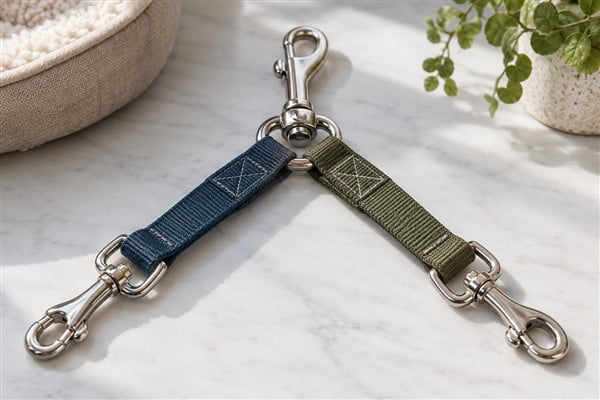
Specify the finished distance between connection points, not just cut webbing length. Hardware and stitched folds contribute to reach. For adjustable branches, record minimum and maximum effective lengths and the amount of loose tail at each setting.
Compare short and longer settings in a controlled handling review. Observe whether the dogs’ positions can separate appropriately without branches repeatedly crossing legs. Begin with simulated movement and suitable fixtures before supervised trials involving animals.
Check the webbing and slider as a matched pair. ASTM D6775 webbing test method can inform material-strength evaluation, while ASTM textile test-method directory helps locate other applicable methods. Neither resource establishes a universal coupler rating or replaces a finished adjustment-slip check.
What should a swivel junction achieve?
A swivel may help a connection rotate, but it cannot guarantee a tangle-free walk. Ask the supplier to demonstrate rotation under the agreed loading condition, rather than spinning an unloaded fitting by hand. Compare clearance between clips, rings, and adjacent webbing.
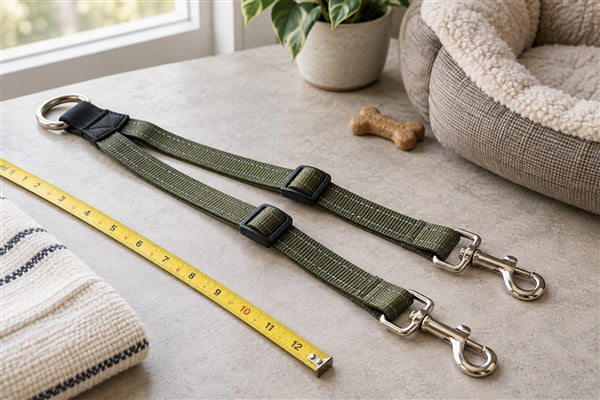
When specifying clips and D-rings, record gate opening, swivel construction, attachment eye dimensions, finish, and component identity. Supplier catalogues such as Wichard’s industrial hardware catalogue illustrate the level of dimensional and rating information buyers can request; marine hardware data must not be transferred to a different pet component.
Review the junction for sharp edges, trapped webbing, and contact between moving parts. Consider metal exposure through ISO 9227 salt-spray methods where relevant, and inspect function after conditioning. An attractive plated finish does not establish corrosion performance.
Which checks belong in the sample plan?
Define static, repeated-use, and adjustment evaluations with a competent test provider. State loads in force units, fixtures, duration, directions, and acceptance criteria. ASTM E4 force-verification practices is a reference for force-verification practices where applicable, while ISO/IEC 17025 laboratory guidance helps frame laboratory competence questions.
Inspect branch seams, center attachment, clips, and sliders after the agreed sequence. Record permanent movement or damage, even if the assembly has not separated. Include these checks in the sample development process before photography and range release.
Keep approving material substitutions under control. A different webbing thickness can change adjustment behavior, and a different clip can change weight or reach. Reassess affected functions whenever a cost-saving proposal alters the approved combination.
How should the range be priced?
Compare fixed and adjustable branches, shared versus independent swivels, and hardware finishes as separate customization options. Ask the supplier to identify sewing operations and sourcing constraints within its manufacturing capabilities. Avoid multiplying sizes or colors before the basic handling arrangement is validated.
Include instructions, identifiers, and spare-part expectations in the quotation. Clarify which main leash and attachment styles are included in the claimed compatibility range. Photographs should show the intended connection rather than leaving customers to infer it.
Frequently Asked Questions
Does a swivel remove the need to monitor tangling?
No. Dog movement, branch length, and walking behavior still matter. Describe the swivel’s intended function without an absolute tangle-free promise.
Can the same coupler serve very different dog sizes?
Only within an evaluated range. Adjustable length may help with reach, but it does not resolve every difference in pace, strength, or handling. Define the intended pairing and communicate exclusions clearly.
Prepare a focused coupler brief
Send branch measurements, hardware references, main-leash details, target users, and your sample-check priorities. Then contact FungoMate to discuss a practical development plan for the wholesale range.