
A no-pull dog harness looks simple, but the real difference hides in geometry. Brands chase padding and coverage, then get returns when control and comfort fall short. I’ve seen this play out. The fix: compare load paths first, then fit, then materials and usability. That’s how you source with fewer surprises. Compare the dog harnesses and walking gear range to shortlist the constructions relevant to your market.
Buyers should compare no-pull dog harnesses by redirection mechanism (front ring placement, strap angles, sternum/shoulder routing), then require independent fit adjustability, then set materials and stitch standards, and finally validate usability and labeling. Geometry drives control; fit and construction drive comfort and durability. Padding is secondary.
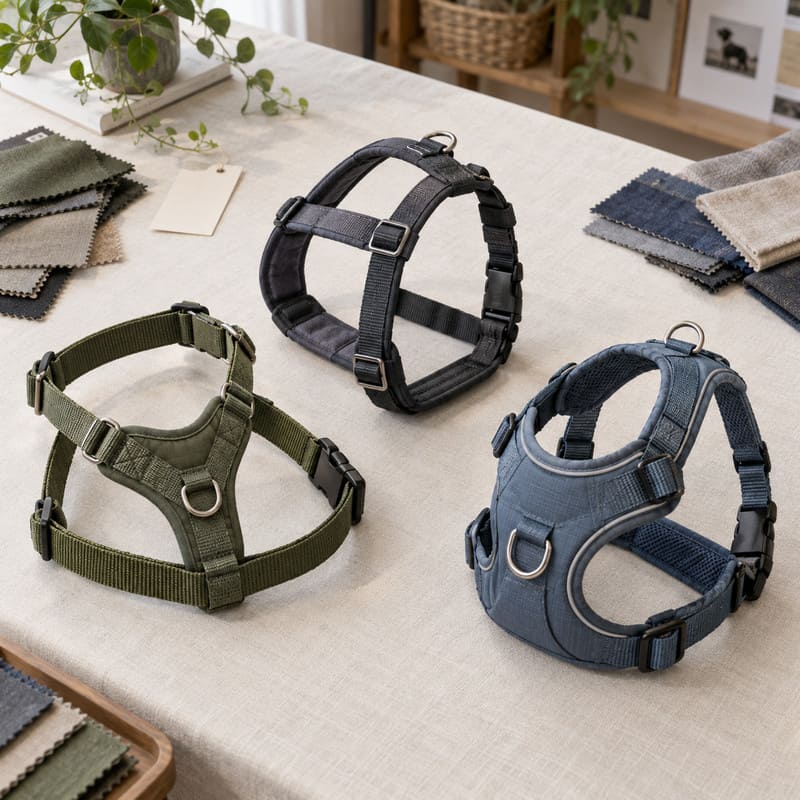
Most product pages promise “stops pulling.” That claim backfires. Keep scrolling and I’ll show how ring position and strap paths change leash angles, why misfit causes rubbing and poor control, and what acceptance tests cut failure rates in mass production.
Before requesting prototypes, review what to look for in a dog harness manufacturer before ordering samples so material and workmanship requirements are defined alongside the design.
Which no-pull dog harness mechanism actually redirects leash force?
You pick a harness that looks right. Later buyers report rubbing or zero redirection. The problem is mechanism, not aesthetics. The solution is to choose the right archetype and specify ring placement and strap geometry that suit your target breeds and use cases.
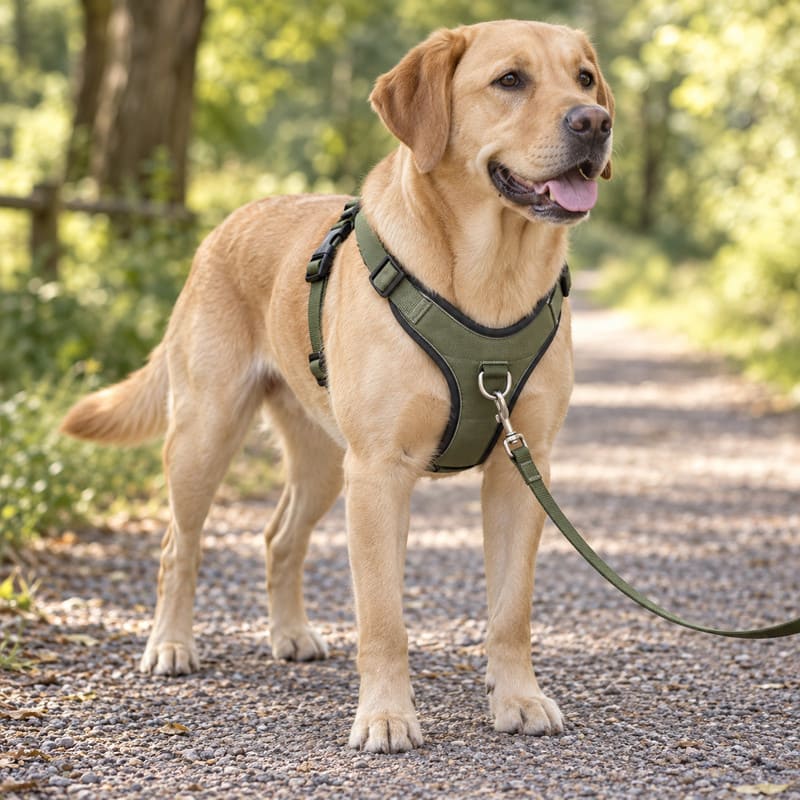
The most reliable redirection comes from a front-attachment layout[^1] that sits in the sternum target zone, keeps straps clear of the shoulder (acromion)[^2], and preserves shoulder freedom. Dual-clip designs add flexibility for training and daily walks. Avoid constricting chest straps unless you control labeling and fit testing tightly.
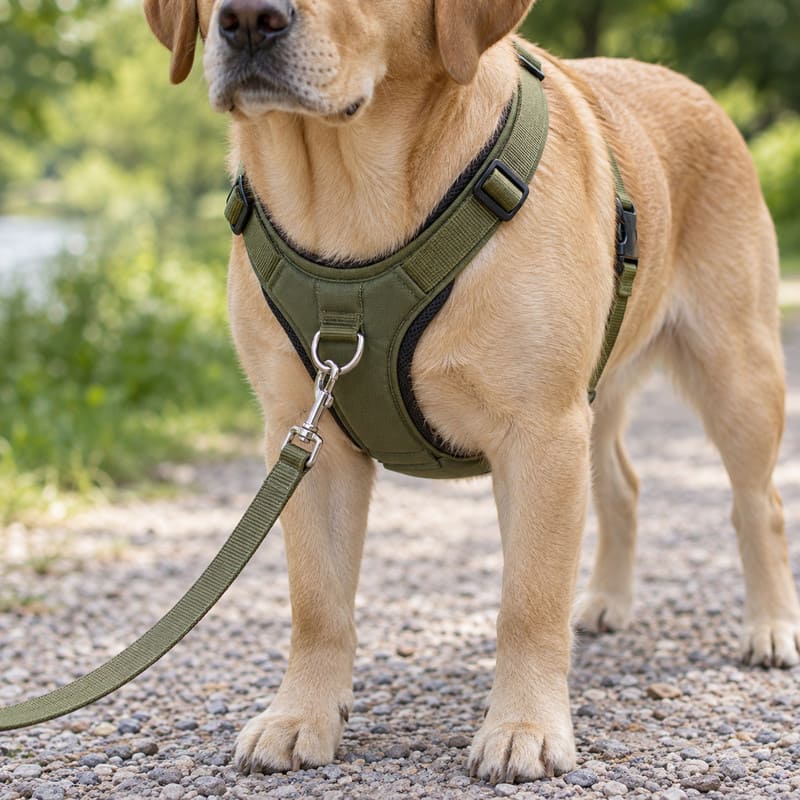
Dive deeper
- Y-front with front ring (sternum-guided)
- H-back with front/side ring
- Dual-attachment (front + back)
- Front chest with limited/half-slip strap
I map each by how leash force changes the dog’s centerline. On our A/B samples, redirection improved when the front ring sat over the sternum notch zone (near the manubrium)[^3] instead of drifting laterally into soft tissue. Rings too high ride up; rings too low collapse into the chest. Strap angles matter just as much.
Y-front with front ring
- Pros: Clear redirection, good shoulder freedom when the upper straps route away from the acromion.
- Cons: If the girth strap rides too far forward, it rubs the axilla[^4]; if the Y is too wide, the ring floats and loses control.
- Spec tips: Target a leash angle that pulls slightly off-center, not perpendicular; bind webbing edges to avoid chafe.
H-back with front/side ring
- Pros: Stable on barrel-chested dogs; easier donning for some users.
- Cons: Side rings can create uneven pull and rubbing on the shoulder[^5] if strap angles aren’t tuned.
- Spec tips: Keep strap clearance over the shoulder head; avoid stiff webbing that limits shoulder motion.
Dual-attachment (front + back)
- Pros: Training flexibility; front clip for redirection, back clip for relaxed walks or car tethering.
- Cons: Misuse risk (users clip to the back only and expect “no-pull”).[^6]
- Spec tips: Label “front attachment for redirection” clearly; add contrasting hardware or iconography.
Front chest with limited/half-slip strap
- Pros: Strong burst-pull control for short training intervals.
- Cons: High misuse risk and potential constriction if fitted or adjusted poorly.
- Spec tips: Use cautiously; require fit guidance and do not promise “stops pulling.”
Buyer Q&A, anonymized: “Our medium sample felt soft but didn’t redirect.” We moved the front ring 12–15 mm toward the sternum and opened the Y angle 5°. Feedback: “Redirection noticeable; no shoulder rub in 20-minute walk.” These are small geometry moves with big results.
For the commercial trade-offs between simple branding changes and structural development, see our private-label dog harness customization guide.
Fit is the prerequisite. Review the fit and construction customization options when defining the size specification. I require independent neck and chest adjustment, clear girth placement behind the foreleg, and enough size-span logic per breed clusters to handle seasonal coat changes. Misfit equals poor control, chafing[^7], and returns—every time.
Materials and construction keep performance consistent. Review the supplier’s manufacturing and quality-control capabilities before approving the production specification. We approve supple but stable webbing, breathable lining, bound edges, and stitches that resist creep: box‑X plus bar‑tacks on high-load points. Hardware needs clean welds and verified strength. In-house pulls (to be verified against your program) flag typical failure modes: ring deformation, buckle slip, seam elongation.
Usability matters as much. Include these checks in the sample development and approval process before the specification is finalized. I evaluate donning paths and buckle layout for novice-proof use, minimize strap twisting, and add front-clip callouts. Validation should go beyond static pulls: cycle/fatigue, abrasion against common fabrics, and salt spray for coastal markets.[^8] Clear claim language helps buyers and end users understand the intended attachment points, fitting requirements, and product limitations.
To discuss your target market, preferred harness construction, size range, and sample requirements, contact FungoMate with your sourcing brief.
[^1]: "Review of Collars, Harnesses, and Head Collars for Walking ...", https://pmc.ncbi.nlm.nih.gov/articles/PMC12345489/. Guidance from major animal welfare and training organizations explains that front-clip harnesses attach at the chest to redirect the dog toward the handler and typically give more control for dogs that pull than back-clip attachments. Evidence role: general_support; source type: institution. Supports: That front-clip (chest) attachments tend to steer dogs toward the handler and provide better control for pullers than back-clip designs.. Scope note: Practice guidance reflects expert consensus rather than controlled comparative trials. [^2]: "Effects of restrictive and non-restrictive harnesses on ...", https://pubmed.ncbi.nlm.nih.gov/30455191/. A kinematic study in dogs reported that both Y‑shaped and chest-strap harnesses reduced shoulder extension during walk and trot, indicating that strap placement across the shoulder region can restrict limb motion. Evidence role: mechanism; source type: paper. Supports: That harness strap placement can reduce shoulder extension, implying that avoiding contact near the shoulder complex helps preserve motion.. Scope note: Small sample sizes and treadmill conditions limit generalizability, and not all consumer harness geometries were tested. [^3]: "Sternal Abnormalities on Thoracic Radiographs of Dogs and ...", https://pmc.ncbi.nlm.nih.gov/articles/PMC10093590/. Veterinary anatomy teaching resources identify the manubrium as the cranial segment of the canine sternum at the ventral midline, establishing the bony landmark beneath the chest where a front attachment would sit. Evidence role: definition; source type: education. Supports: That the manubrium is the cranial, midline segment of the canine sternum, providing a firm central landmark under the chest for front-attachment placement.. Scope note: Anatomy sources establish location but do not experimentally compare leash redirection at different ring positions. [^4]: "Guide: How Should a Harness Fit on a Dog and More", https://www.tailsofconnection.com/resources/guide-how-should-a-harness-fit-on-a-dog-and-more. Veterinary charity guidance notes that if a harness sits too far forward or too tight, it can rub behind the front legs (axillae) and cause soreness or chafing. Evidence role: general_support; source type: institution. Supports: That improper harness fit—especially too far forward/too tight—can cause rubbing in the axillary area.. Scope note: This is practical care guidance rather than quantified incidence data. [^5]: "Dog Shoulder Harness : The University of Akron, Ohio", https://www.uakron.edu/tiered-mentoring/2026/Quantifying-Pressures. Pressure-mapping studies of working dogs wearing harnesses have demonstrated localized high pressures at specific harness contact areas, indicating that design and attachment location can create asymmetric load on the shoulder region. Evidence role: mechanism; source type: paper. Supports: That harnesses can impose uneven or localized pressures at contact points near the shoulder/sternum, depending on design.. Scope note: Available studies often involve specific working-dog harness types and small samples, so findings may not generalize to all consumer designs. [^6]: "Front Clip vs. Back Clip Harness : r/Dogtraining", https://www.reddit.com/r/Dogtraining/comments/i7uv67/front_clip_vs_back_clip_harness/. Welfare and training organizations advise that front-clip attachments help redirect dogs toward the handler and provide better control for pullers, whereas back-clip attachments afford less steering influence and may not reduce pulling. Evidence role: expert_consensus; source type: institution. Supports: That front-clip attachments provide more steering control for pullers than back-clip attachments, which may not diminish pulling.. Scope note: This reflects practitioner consensus and instructional guidance rather than randomized comparative trials. [^7]: "you should be able to slip two fingers under any strap ...", https://www.facebook.com/HilltownsVeterinaryClinic/posts/that-harness-fit-matters-more-than-you-think-a-harness-thats-too-loose-can-let-y/1479639667299632/. Veterinary welfare guidance emphasizes ensuring a correct harness fit to prevent rubbing and discomfort and to maintain safe control during walks. Evidence role: general_support; source type: institution. Supports: That correct harness fit is necessary to avoid rubbing/chafing and to maintain effective control of the dog.. Scope note: Guidance is qualitative and does not quantify the rate of control loss or injury from misfit. [^8]: "Salt spray test", https://en.wikipedia.org/wiki/Salt_spray_test. International standards such as ISO 9227 (and analogous ASTM B117) specify neutral salt spray methods widely used to evaluate corrosion resistance of metallic components, supporting the relevance of salt-spray validation for hardware intended for coastal environments. Evidence role: general_support; source type: institution. Supports: That standardized neutral salt spray tests are used to assess corrosion resistance of metallic components likely to face marine or saline exposure.. Scope note: Accelerated corrosion tests are comparative laboratory exposures and may not predict exact in-service lifetimes.