
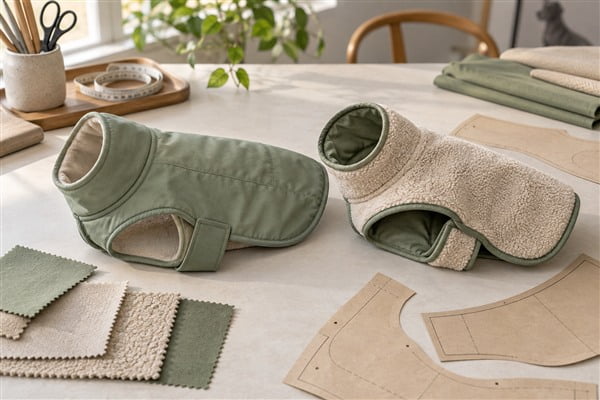
A reversible coat promises two looks in one SKU, but the second face also changes how the garment is sewn, fastened, labeled, and inspected. A design that looks finished on the outside may expose bulky seams or an awkward closure when reversed. For a growing pet apparel range, these decisions belong in the brief before the first sample is cut.
Approve both wearing directions as complete products. Define the fabric pairing, edge finish, closure operation, fit allowance, care route, and label position together, then test the assembled jacket in both orientations.
Which decisions should the first brief settle?
State whether the jacket has two equally important appearances or one primary face with an occasional alternative. Specify the intended weather, approximate layering, target size range, and retail price position. A fashion-led reversible vest needs a different development brief from a coat advertised for wet-weather walks.
Create separate front, back, and underside views for each orientation. Identify which face is outward in every drawing. Use revision codes rather than descriptions such as “the green version”; ISO 10007 configuration-management guidance provides a useful reference for controlling these changes. Apply the same discipline when writing clear sample revisions.
Resolve the label before selecting expensive trims. A label that becomes conspicuous or rubs against the dog when reversed can undermine the concept. Decide which information remains permanently attached and which belongs on packaging, with requirements checked for the intended market.
How should brands compare the two fabric faces?
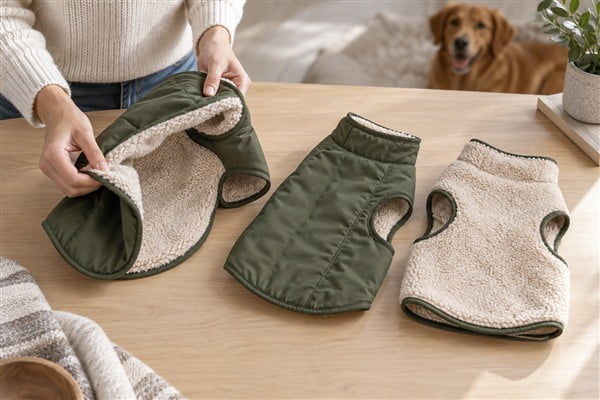
Request swatches of the actual proposed materials, including finish and backing. Compare thickness, drape, surface friction, color, and how the pair behaves when bent together. Two attractive fabrics can still form an excessively stiff jacket when combined with binding and reinforcement.
Wash the proposed combination before approving it. Discuss ISO 6330 washing and drying procedures with the laboratory, then use an agreed measurement plan based on ISO 5077 dimensional-change method where appropriate. Record changes separately for chest width, back length, and edges. Unequal shrinkage may leave one face pulling the other into ripples.
For strong color contrasts, include laundering color transfer in the review using a suitable method such as ISO 105-C06 laundering colorfastness method. Consider rubbing transfer through ISO 105-X12 rubbing-fastness method where one face repeatedly contacts harnesses or upholstery. These methods do not set the brand’s acceptance limits; those must be agreed before testing.
Will closures and seams work in both directions?
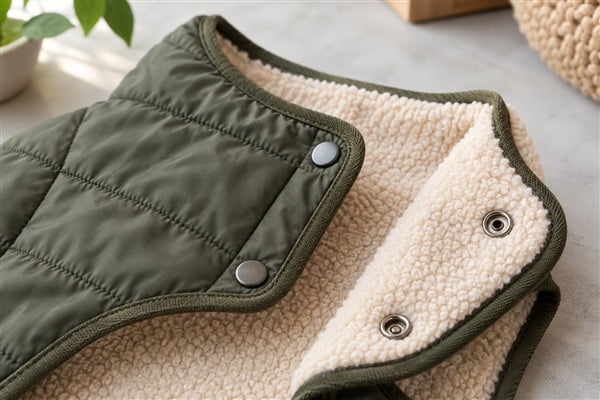
Ask the factory to demonstrate fastening while each face is outward. Check reach, hand clearance, overlap, and whether exposed hook material catches the opposite fabric. Avoid choosing a reversible fastening simply because it looks symmetrical in a drawing.
Review binding width, seam intersections, label attachment, and closure reinforcement on an assembled sample. Extra layers often accumulate near neck and belly straps. Include those locations in the sample development process, rather than assessing only the large flat panels.
If a zipper is used, review relevant ASTM D2061 zipper-strength methods with the supplier and test operation in the finished garment. A component report cannot show whether the chosen seam allowance catches the slider. For other closures, agree operation, attachment, and repeated-use checks suited to the actual construction.
What should the sample review record?
Fit the same size in both orientations on representative body shapes. Check neck comfort, shoulder movement, belly coverage, and clearance during toileting. Record any twisting after walking and whether a harness changes the result. Identify the harness and adjustment used so the next review can reproduce the conditions.
Photograph each orientation before and after the agreed care sequence. Record which defects appear only after reversal. A useful decision sheet separates mandatory corrections from optional customization options, preventing a cosmetic request from obscuring a fit problem.
Finalize care wording using evidence from the finished combination. Discuss applicable symbols through ISO 3758 care-label symbols and align the result with planning clothing labels and packaging. The easier-care fabric cannot automatically determine instructions for the whole jacket.
Frequently Asked Questions
Does a reversible jacket always cost twice as much?
No. Ask for a cost breakdown covering both materials, finishing, closures, sewing time, and inspection. Compare the supplier’s manufacturing capabilities with the required construction. Material yield and difficult edge work may matter more than simply counting fabric faces.
Can one approved size release the full range?
It should not be the only evidence. Review the smallest and largest proposed sizes for closure reach, seam bulk, and body coverage. Agree the sampling plan and, where independent testing is needed, discuss laboratory competence using ISO/IEC 17025 laboratory guidance.
Prepare the next sample round
Send paired fabric references, drawings for both directions, a measurement chart, fastening details, and a prioritized revision list. To discuss feasibility and sampling for your reversible collection, contact FungoMate with these files and your target quantity. A complete brief makes the first sample useful for decisions rather than merely attractive for photographs.