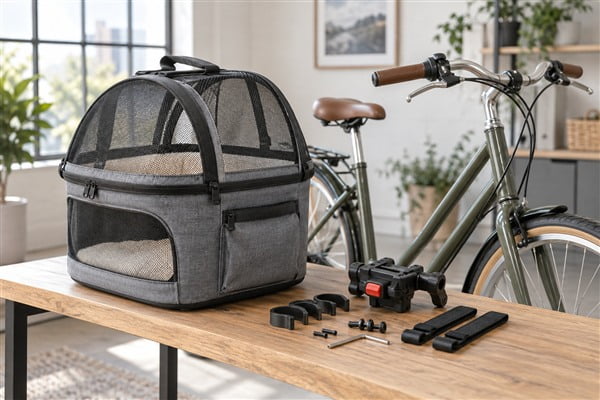


A carrier marketed for both cats and small dogs can simplify a range, but equal body weight does not guarantee equal suitability. Buyers developing pet travel bags and carriers should evaluate body dimensions, entry behavior, containment, cleaning, and the intended journey before choosing one shared design.
Use a common platform only when it meets the needs of the actual pets and travel scenario. Share colors and components where useful, but separate designs when access, space, or structure requires it.
What should you compare before body weight?
Measure the intended pet profiles and examine usable interior space. Body dimensions matter more than a weight label alone. A long-bodied dog and a compact cat of similar weight may need different floor length, height, and opening geometry.
Define the trip: a veterinary visit, short walk, public transport journey, flight, or car ride. Our guide to planning a focused carrier range helps narrow the product brief. Avoid asking one carrier to satisfy unrelated use cases without checking the compromises.
Compare soft-sided versus structured carriers by support, base stability, and opening behavior rather than using “soft” or “hard” as the entire decision. The assembled interior must remain usable under the intended conditions.
Do cats and small dogs need different access?
Some pets enter readily; others need more controlled access. Cat Friendly Homes carrier guidance highlights features such as easy cleaning and useful openings. An accessible top or removable upper section can matter for a cat-focused product, particularly during veterinary visits.
Assess the actual design rather than assuming every cat needs the same carrier or every small dog behaves alike. Check how the door is held open, how it closes, and whether the handler can manage the pet without leaving another opening unsecured.

Review carrier customization options for entry size, zipper routes, privacy panels, and pad attachment. A shared outer shape can still need different access details. Any cover or flap should be assessed for its effect on ventilation in the intended position.
What containment and comfort checks are useful?
Inspect closure engagement, zipper endpoints, mesh attachment, internal edges, and gaps created under movement. Use appropriate fixtures for structural checks; never expose a pet to destructive testing. Supervised fit trials should focus on normal entry, positioning, and calm handling.
The ASTM textile test-method directory identifies zipper assessment methods, while ASTM D1683 for woven sewn seams is relevant to suitable woven seams. Specify the finished construction and acceptance criteria rather than assuming one material test proves escape resistance.
Check base support, surface grip, removable bedding, and cleaning access. Look for corners that trap dirt or require removing structural parts without clear instructions. The ISO 3758 care-label symbols can support care-label preparation for applicable textile components.
Can one design cover every travel channel?
No universal marketing phrase establishes travel suitability. IATA Traveler’s Pet Corner provides air-travel information, and IATA cabin-travel guidance states that IATA does not approve commercial pet carriers. Check the relevant airline and route using the exact assembled dimensions and configuration.
A carrier’s ability to fold does not automatically make it suitable beneath a seat. Likewise, an attachment loop does not establish crash protection. Consult CPS certified-product listings for exact certified products when evaluating vehicle-safety claims.

Consider which claims your channel actually needs. A veterinary-visit carrier may prioritize controlled access and cleaning; a walking carrier may prioritize carrying balance. Write those priorities before adding pockets, folding panels, or decorative details.
How do you decide between shared and separate designs?
Create a matrix covering internal space, access, containment, support, cleaning, carrying method, and channel-specific requirements. Put representative pet profiles into the matrix rather than relying on two labels marked “cat” and “dog.”
Use the sample development process to compare a shared prototype with any necessary specialist version. Record what changes solve a real problem and what merely changes appearance. If one compromise weakens an essential function, separate that part of the range.
When choosing a carrier manufacturer, ask how materials, opening geometry, support parts, and revisions remain traceable. Include the ISTA test-procedure overview in discussions of shipping-package validation when relevant; a good consumer design still needs to arrive undamaged.
Keep inventory practical by sharing components that genuinely remain suitable, such as an approved fabric family or certain trims. Do not standardize the base or entry simply to reduce part numbers if the evaluation shows different needs.
Frequently Asked Questions
Can the product name say “cats and small dogs”?
Yes, when the intended dimensions, use, instructions, and evaluation support that audience. Give customers actual sizing guidance instead of only a weight limit.
Does a second opening always improve the design?
Not always. It may improve access but also adds closures and construction details to validate. Judge its benefit in the intended handling routine.
To evaluate a shared carrier platform, contact FungoMate with your target pet profiles, journeys, preferred format, quantities, and the requirements your retail channel expects.