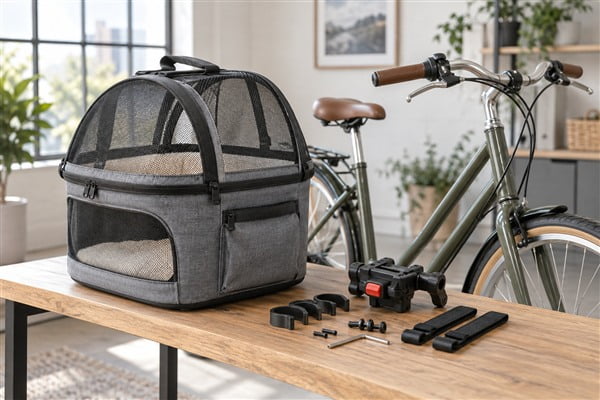

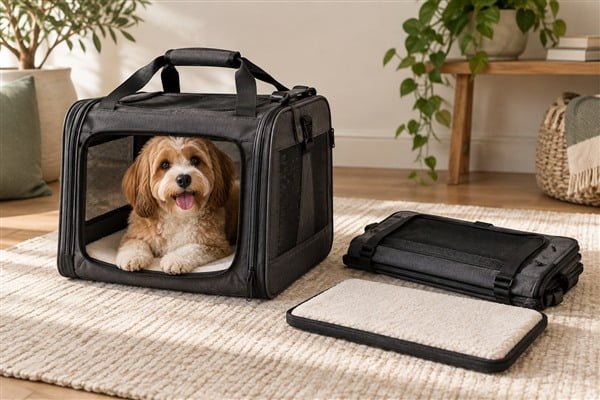
A foldable carrier can save warehouse space and still disappoint customers if the assembled product sags or is difficult to set up. Buyers comparing pet travel bags and carriers need two specifications: the packed format that travels through the supply chain and the working structure that holds the pet.
Compare packed volume, assembly steps, internal space, base support, and repeated-folding behavior together. A smaller shipping carton is valuable only when the carrier remains practical in use.
Which dimensions should a quotation include?
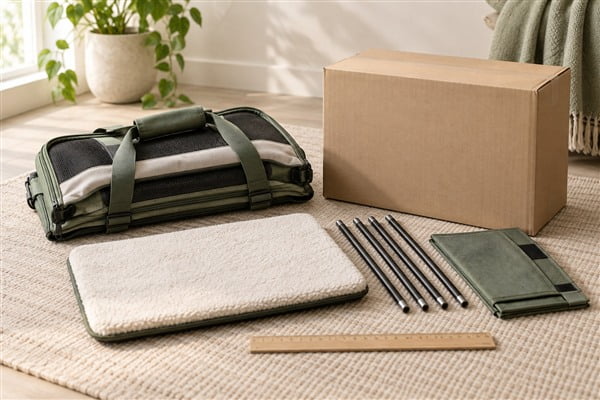
Request assembled external dimensions, usable internal dimensions, collapsed product dimensions, individual retail-pack dimensions, and master-carton details. State whether removable pads, support rods, and straps are included in each measurement.
Compare the actual packing arrangement. UPS dimensional-weight guidance explains why parcel dimensions can affect charges. A folded shell may look compact while loose inserts or protective packaging erase much of the saving. Use the carrier’s final packed sample for costing.
Our comparison of soft-sided versus structured carriers helps separate material softness from structural support. Begin planning a focused carrier range with the intended journey and customer rather than choosing the smallest folded sample first.
What makes the assembled carrier stable?
Inspect how the base, side panels, support members, and handle anchors work together. Ask what prevents the floor from sliding, the walls from folding inward, and the zipper from becoming an unintended load-bearing connection.
Review carrier customization options before changing the base insert or reinforcement. A thinner panel can reduce packed thickness while altering stiffness and usable space. Check an assembled sample with the agreed test load, never by using an animal in a destructive or overload test.
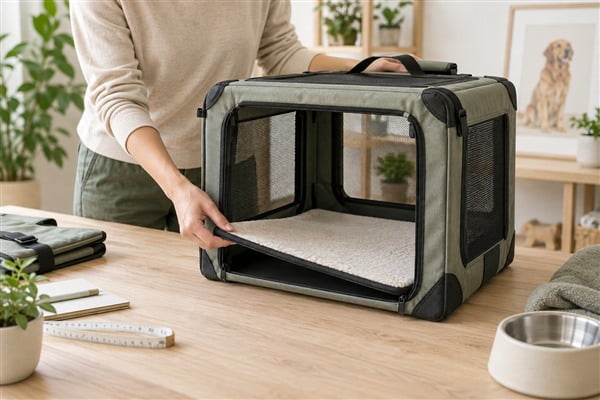
Record sag, tilting, opening distortion, and handle position under defined conditions. Examine the fully loaded structure from several directions. A catalogue weight limit without the procedure, configuration, and acceptance criteria is not enough to compare two designs.
How should folding and assembly be assessed?
Give the instructions and packed product to someone unfamiliar with the sample. Observe setup time, misplaced components, frame engagement, and whether incomplete assembly is obvious. Include the reverse process and check that all parts fit back into the intended storage format.
Agree a repeated folding and setup sequence in the sample development process. Inspect creases, support pockets, stitching, zipper operation, and base retention afterward. Distinguish a development screening check from a validated lifetime claim.
For relevant woven seams, ASTM D1683 for woven sewn seams can support targeted assessment. The ASTM textile test-method directory includes zipper methods. Choose tests that address the actual failure risks; neither method by itself establishes the stability of the complete carrier.
Does compactness meet the intended travel need?
Usable room must be evaluated with the carrier assembled as instructed. Consult IATA Traveler’s Pet Corner for air-travel context and check the airline’s current requirements for the actual route. Cabin and cargo use are different scenarios.
IATA cabin-travel guidance makes clear that IATA does not approve commercial pet carriers. Avoid a blanket “airline approved” label based only on outer measurements. Confirm the permitted configuration and whether under-seat positioning compromises the intended internal space or ventilation.
For cats, Cat Friendly Homes carrier guidance provides context on secure access and easy cleaning. A fold-flat feature should not make the opening difficult to control or prevent inspection of hidden corners and seams.
What evidence belongs in the sourcing decision?
Ask for the bill of materials, dimensional drawings, assembly instructions, sample revision, and test records. When choosing a carrier manufacturer, check whether the supplier can trace frame, mesh, zipper, and base changes to the approved version.
Review shipping-package evaluation using the ISTA test-procedure overview. Transport testing concerns the packaged product and distribution route; it is separate from carrying performance. Likewise, consult CPS certified-product listings if vehicle-crash certification is claimed, checking the exact model and installation rather than assuming every carrier from a brand is covered.
Create a comparison sheet with packed volume, carton quantity, usable space, assembly steps, observed deformation, cleaning access, and repairable parts. Record costs separately from pass/fail requirements. Rejecting an unsuitable design should not depend on whether its freight saving looks attractive.
Frequently Asked Questions
Is the smallest folded carrier the best option?
Not necessarily. Compare savings against setup difficulty, missing-part risk, structure, and actual pet space. A slightly larger packed format may be easier to use consistently.
Can one base insert serve every size?
Only if the construction and evaluation support it. Larger spans, different loads, and attachment geometry can change performance.
To compare foldable designs on the same basis, contact FungoMate with target dimensions, intended journeys, quantities, packaging expectations, and the configuration your customers will use.