
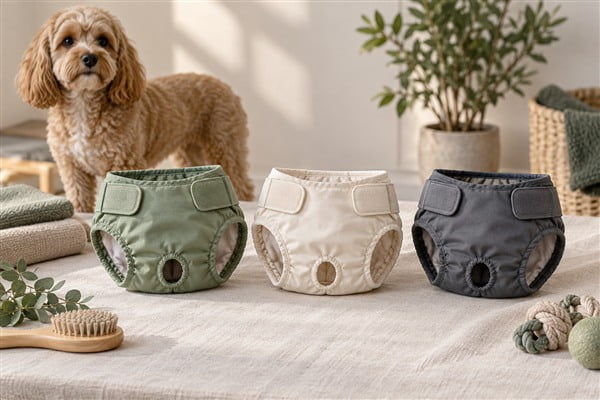
A reusable dog diaper must do more than look tidy before washing. Wholesale buyers need to understand how its layers, openings, closures, and fit perform together after repeated care. When expanding a pet apparel range, compare constructions under the same conditions rather than relying on “high absorbency” descriptions.
Specify the intended anatomy, layer construction, leakage checks, fit points, and wash procedure. Review both new and washed samples before approving the production version.
Which product are you actually sourcing?
Define whether the design is a belly wrap or a full diaper, which body area it covers, and the intended use. The AKC dog-diaper guidance explains the importance of fit and hygiene. Diapers manage soiling; they should not be marketed as treatment for the cause of incontinence.
For choosing a pet clothing manufacturer, include construction and care questions alongside sizing. Compare existing styles versus custom apparel development to establish whether the existing pattern suits the target anatomy or needs development. A different print does not fix a misplaced absorbent panel or unsuitable opening.
Set the planned size range and quantities, then identify the measurements customers must provide. Waist circumference, body coverage, closure reach, and tail-opening position may all matter. Do not use weight as the sole size rule.
What should the construction specification show?
Request a layer-by-layer bill of materials covering the contact lining, absorbent core, barrier material, binding, elastic, and closure. Record the placement and attachment of each layer. Inspect exposed seams, rough edges, bulky overlaps, and areas where moisture could escape.
Review customization options as a complete assembly. Changing the core thickness can affect fit, drying time, closure overlap, and sewing. Compare samples using the same intended loading and observation procedure so a thicker diaper does not automatically receive a higher performance rating.

Agree how fluid is introduced, where it is applied, the waiting period, the pressure or movement condition, and what counts as leakage. Keep these project criteria distinct from standardized textile tests. The AATCC test-method directory lists absorbency and moisture-management methods, but a fabric result is not a finished-diaper capacity claim.
How should closures and fit be reviewed?
Check that the closure remains secure at the intended adjustment positions without concentrating pressure or leaving abrasive surfaces exposed. Inspect tail and leg openings across representative body profiles. Conduct supervised fitting and stop if the animal shows discomfort.
The ASTM textile test-method directory includes hook-and-loop peel and shear methods that may support closure assessment. Ask the laboratory to choose the suitable procedure and conditions. For woven seams, ASTM D1683 for woven sewn seams is another targeted reference, not a complete product approval.
Include dressing and removal in the trial. A caregiver should be able to identify the front, align the absorbent area, and fasten the product consistently. If the design only works when positioned with unusual precision, revise the instructions or construction.
What does a meaningful washability check include?
Define temperature, detergent, machine procedure, drying method, closure preparation, and number of cycles. ISO 6330 washing and drying procedures provides standardized washing and drying procedures; it does not prescribe the life expectancy of your diaper.
Measure before and after using a consistent approach such as the ISO 5077 dimensional-change method. Record waist range, opening dimensions, elastic recovery, core bunching, seam distortion, and closure performance. Repeat the agreed leakage check after washing, because unchanged appearance alone does not demonstrate unchanged function.

Review color transfer with an appropriate method such as the ISO 105-X12 rubbing-fastness method where relevant. Inspect the complete sample for delamination, roughness, trapped moisture, or changes in drying behavior. Keep actual results separate from unsupported “wash after wash” claims.
How do you turn results into a purchase specification?
Use the sample development process to approve the tested material combination and revision. Agree measurement tolerances, workmanship defects, test intervals, and what happens if production materials differ from the sample.
Check manufacturing capabilities for incoming material control and lot traceability. Base care instructions on the verified construction, using ISO 3758 care-label symbols as a symbol reference where appropriate. Explain how to secure closures for laundering and which treatments are unsuitable when supported by the results.
Frequently Asked Questions
Does more padding always mean better performance?
No. Placement, retention, barrier construction, fit, and drying all matter. Compare the finished designs using the same agreed procedure.
Should buyers promise a fixed number of washes?
Only when evidence supports that claim under stated care conditions. A few sample washes cannot establish an unrestricted service-life promise.
To compare reusable diaper samples on a clear basis, contact FungoMate with your intended design, size range, care expectations, quantities, and performance requirements.