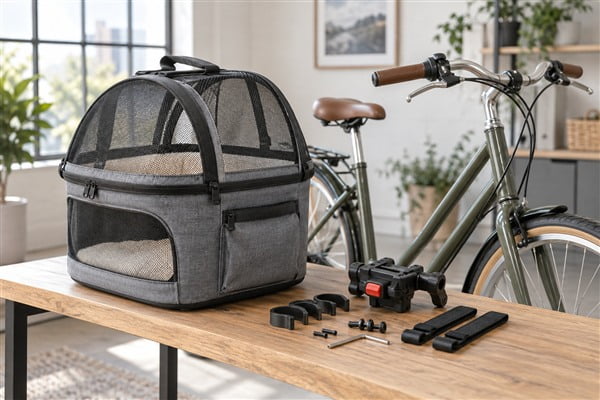


Changing carrier suppliers is not simply sending a finished sample to a new factory. The sample may hide reinforcement, material grades, tolerances, and assembly decisions that affect performance. Buyers transferring pet travel bags and carriers need an explicit record of what must stay the same and what may change.
Build an authorized transfer package, inspect the reference design, document gaps, and validate the new supplier’s version before bulk production. Visual similarity alone is not design equivalence.
What should the transfer package include?
Start with the design files and information your business is entitled to share. Confirm ownership or permission for patterns, artwork, tooling, and proprietary documentation. Resolve missing rights or files through the relevant owners rather than assuming possession of a sample grants access to everything behind it.
Include drawings, measurements, bill of materials, approved component codes, workmanship criteria, labels, packing instructions, and available evaluation reports. ISO 10007 configuration-management guidance is a useful reference for identifying the approved version and controlling changes.
Our guide to carrier pattern and structural development helps identify which details need more than a visual copy. Include the full folding and assembly specification when comparing foldable carrier size and stability, because storage and setup behavior may depend on hidden parts.
How do you deal with missing specifications?
Create a gap list before asking for a production price. Measure the reference sample using agreed points and record its condition. A worn product may no longer represent original dimensions, stiffness, or appearance.
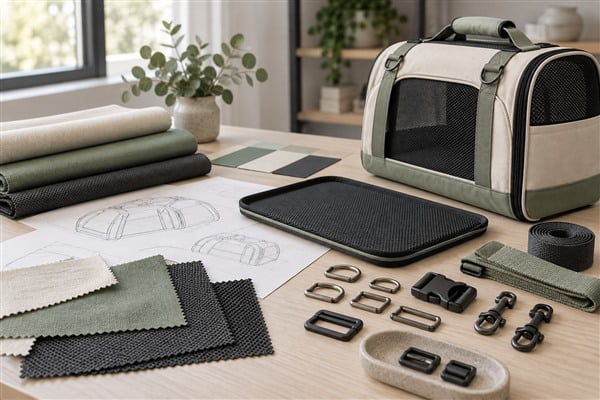
Separate confirmed facts from observations and proposed replacements. If the original mesh, zipper, or base material cannot be identified, ask the new supplier to propose an alternative with supporting data. Mark it as a change requiring evaluation.
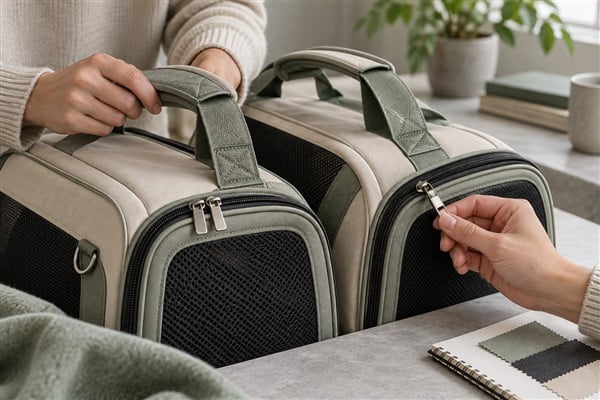
Use customization options to review unavailable components. Do not approve a substitution solely because it matches the color. Geometry, thickness, stretch, coating, and attachment can affect the surrounding construction.
Which construction details deserve special attention?
Inspect base support, handle anchors, reinforcement, zipper routes, openings, mesh attachment, and strap connections. Photograph hidden layers during an authorized inspection of a sacrificial sample where appropriate, preserving an intact reference separately.
ASTM D6775 webbing test method provides a reference for strap-material assessment, ASTM D1683 for woven sewn seams for applicable woven seams, and the ASTM textile test-method directory for other relevant methods. Component evidence helps compare materials but does not establish complete-carrier equivalence.
Require an assembly-level evaluation plan for the revised product. Define the setup, conditions, observations, and acceptance criteria. Record where the new construction intentionally differs so those differences cannot disappear in a general approval statement.
Can previous claims and reports be reused?
Review each report’s sample identity, revision, materials, dimensions, and scope. Ask the testing provider what remains applicable after the supplier or process change. ISO/IEC 17025 laboratory guidance helps frame competence questions; a laboratory name alone does not establish coverage.
Where textile cleaning is relevant, use defined conditions such as ISO 6330 washing and drying procedures and compare the cleaned assembly with its reference. Reinstallation, closure alignment, and pad fit may matter even if the fabric looks unchanged.
Check travel-related claims separately. IATA cabin-travel guidance explains that IATA does not approve commercial carriers. For a claimed vehicle certification, consult CPS certified-product listings and the certification provider about the exact transferred version. Do not assume a different factory inherits earlier coverage.
How should production move to the new supplier?
Use the sample development process to separate reference review, first prototype, discrepancy correction, evaluation, and preproduction approval. Ask the supplier to respond to every open item, including differences it believes are insignificant.
Review manufacturing capabilities for the operations and controls your carrier needs. Confirm incoming checks, component traceability, reinforcement placement, dimensional inspection, and the procedure for reporting shortages or substitutions.
Run an appropriately sized initial production review before committing to a larger repeat program. Compare actual production units with the accepted specification rather than only with a showroom sample. Keep old and new versions distinguishable during the transition.
Plan spare parts, packaging changes, order overlap, and remaining inventory. A transfer can succeed technically yet create customer-service confusion if replacement pads, support parts, or instructions no longer match earlier stock.
Assign responsibility for resolving each missing detail. The transfer schedule should allow time for those decisions before material orders, rather than treating undocumented features as issues to discover during bulk sewing.
Frequently Asked Questions
Is an exact visual copy enough?
No. Hidden materials, reinforcement, tolerances, and assembly can differ. Define the required functions and inspect the relevant construction.
Must every part remain identical?
Not necessarily. Approve intentional alternatives through documented review and appropriate validation rather than accepting unrecorded changes.
To plan a controlled supplier transfer, contact FungoMate with your authorized files, reference samples, known gaps, target quantities, and the product characteristics that must be preserved.