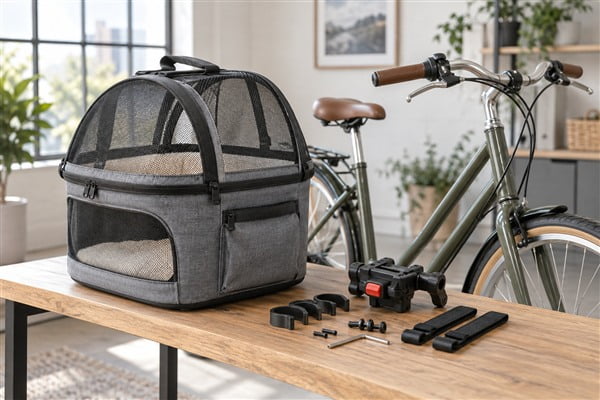

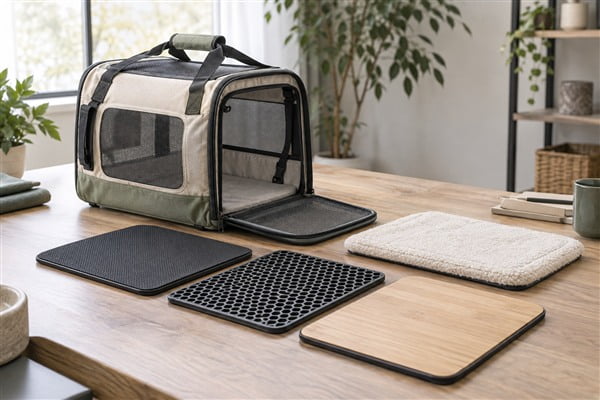
A carrier’s base panel can look like a simple removable insert, yet it affects usable space, balance, cleaning, and production cost. Buyers comparing pet travel bags and carriers should evaluate the complete floor system rather than choosing by thickness or a general material name.
Compare support, edge construction, retention, removability, care, and packed volume together. The right panel must work with the carrier shell and carrying points, not just feel rigid on a table.
What should the base specification describe?
Record the core material, dimensions, thickness, padding, cover, edge treatment, and method of retention. Distinguish the structural panel from a soft comfort pad. State which parts can be removed and which are intended to be cleaned separately.
Our guide to carrier pattern and structural development explains why a change to the base can affect the wider structure. When comparing foldable carrier size and stability, include the space needed for removed panels and pads, not only the collapsed shell.
Request an assembly drawing showing where the panel rests and how it transfers load into the carrier. Check whether the floor stays properly located during lifting and setting down. A rigid insert that slides inside an oversized pocket may not provide the intended support.
How should support be compared?
Use equivalent assembled samples and a defined loading setup. Record deflection, tilting, edge movement, and changes to the entry or wall shape. Keep the configuration consistent so the comparison reflects the base design rather than different straps or carrier dimensions.
Do not conduct overload or destructive checks with a pet inside. Agree the relevant test load, position, duration, and criteria with the developer or testing provider. A catalogue capacity without those details is difficult to compare.

ASTM D1683 for woven sewn seams can support assessment of applicable woven seams, while the ASTM textile test-method directory identifies other relevant methods. Select checks for the actual cover, retention, and shell construction. These component references do not establish a finished carrier’s capacity.
When is removability worth the added construction?
A removable panel can simplify cleaning, replacement, and compact packing. It can also introduce extra parts, closures, pockets, or customer assembly steps. Test whether users can remove and reinstall it correctly without forcing the panel or leaving retention points unsecured.
Review customization options with the cleaning instructions in mind. A washable cover over a non-washable core needs a clear separation method and unmistakable instructions. Check that the opening does not create uncomfortable edges or exposed fasteners.
For washable textile components, ISO 6330 washing and drying procedures provides procedure references and the ISO 5077 dimensional-change method supports dimensional-change assessment. Refit the cleaned cover afterward. A cover that looks intact can still become too tight, loose, or distorted for the core.
What costs should the quotation separate?
Request prices for core cutting, padding, cover sewing, binding, retention parts, assembly, and packing. Compare material yield and labor alongside purchased sheet cost. A cheaper core may require more reinforcement or a more complicated cover.
Measure the final packed arrangement using UPS dimensional-weight guidance as a freight-planning reference. Ask whether panels ship installed, separately, or in a shared position within the carton. Include the customer’s reassembly task in the decision.

Discuss packaged-product evaluation with the ISTA test-procedure overview where appropriate. The panel must arrive without damage or permanent distortion, but a shipping test does not substitute for in-use structural evaluation.
How do you approve the complete floor system?
Use the sample development process to review support, retention, cleaning, packing, and assembly on one identified revision. Keep the approved panel and carrier together; mixing a panel from one version with a shell from another can invalidate the comparison.
Review manufacturing capabilities for dimensional checks, edge quality, material traceability, and control of substitutions. ISO/IEC 17025 laboratory guidance provides context for assessing external testing competence and relevant scope when specialist evaluation is needed.
If vehicle-crash certification is claimed, check the exact model and configuration against CPS certified-product listings. A different base construction should prompt a coverage review rather than an assumption that earlier evidence automatically applies.
Record replacement-part requirements, expected reorder quantities, and responsibility for changes. Define which defects stop shipment, including exposed sharp edges, incorrect dimensions, poor retention, or unapproved construction.
Keep comfort-pad preferences separate from structural decisions. A softer upper layer may improve the feel of the floor without changing the core, while a new cover can alter retention and cleaning access.
Frequently Asked Questions
Is a thicker base always stronger?
No. Material, span, geometry, support, and attachment all influence behavior. Compare the intended assembly under defined conditions.
Can one panel fit multiple carrier sizes?
Only if the approved construction supports it. Avoid compromising support or internal space merely to reduce the number of parts.
To compare base-panel options, contact FungoMate with carrier dimensions, intended use, cleaning expectations, packing requirements, and the construction you want to evaluate.