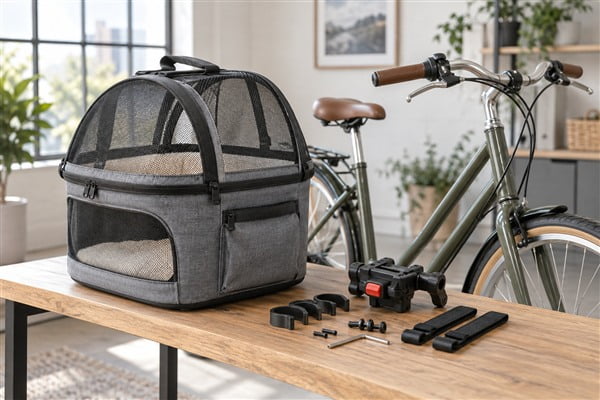

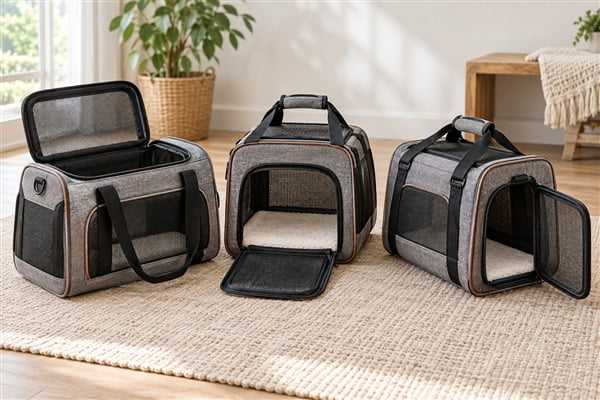
Adding another entrance can make a carrier look more versatile, but it also introduces another closure, seam path, and possible loss of panel support. Retail buyers need to decide which access task matters most. A clear entry strategy helps a pet travel bags and carriers collection offer useful differences rather than extra zippers without a purpose.
Choose entry positions around loading, unloading, cleaning, and normal handling. Compare access clearance and closed security together, then check how each opening affects structure, ventilation, and cost.
When does top access add value?
A top opening may help an owner reach into the carrier without using the front doorway. It also changes how the roof panel is supported. Ask whether the flap stays clear while open and whether closing it requires moving straps or handles out of the way.
Cat Friendly Homes carrier guidance discusses the value of top and front access for cat carriers. Use this as a species-specific design reference, while still testing the actual proposed carrier. A small decorative roof flap should not be treated as equivalent to a practical loading opening.
Specify clear opening dimensions, not only zipper length. Binding, frame members, and flap shape can reduce usable space. Include these measurements when preparing a carrier RFQ so quotations reflect the same access requirement.

What should buyers compare in front and side entries?
A front entry can support voluntary entry when the animal is accustomed to the carrier. A side entry may provide a different loading angle or wider access along the body. Compare the shape and floor-level clearance of each doorway rather than assuming one position is always easier.
Observe where the open flap rests. A flap that drags, folds into the doorway, or covers a ventilation panel can interfere with use. Ask whether it can be secured open during appropriate supervised activities and how that fastening is stored during transport.
For airline-oriented products, review IATA Traveler’s Pet Corner and IATA cabin-travel guidance alongside the intended operator’s requirements. An access feature does not make a carrier universally airline approved. Design and marketing should keep operator-specific conditions visible.
How do extra openings affect construction?
Every opening interrupts a panel. Compare remaining support, corner stiffness, zipper routing, and reinforcement when the carrier is both open and closed. Changes to the frame or load-bearing panel belong in carrier structural development, not merely a trim-change request.
Discuss suitable checks using ASTM D2061 zipper-strength methods for zipper components and ASTM D1683 for woven sewn seams where woven seam testing applies. Test the finished corners and closure ends as well, because material tests do not reproduce every assembled stress concentration.
Check that zipper pulls can be operated easily but cannot be displaced unintentionally under the agreed evaluation. Specify closure retention features and avoid unsupported escape-proof claims. Ask the supplier to demonstrate the proposed construction during the sample development process.

Which sample checks should decide the collection?
Compare loading space, hand access, cleaning reach, flap management, and closed shape using the same representative carrier size. Record whether the base stays flat and whether a panel collapses when opened. Use suitable test forms before supervised animal observations.
Check mesh coverage with every flap in its intended position. A rolled door or decorative pocket should not obstruct ventilation in normal use. Review customization options against these functional priorities rather than adding features independently.
Assess the packed product too. ISTA test-procedure overview can guide distribution-test selection, while UPS dimensional-weight guidance helps frame dimensional-weight comparisons. A more complex entry layout may require different packing protection or prevent the carrier from folding as compactly.
Finalize a drawing that identifies each entrance, usable clearance, opening direction, zipper specification, and retention detail. Apply a revision system informed by ISO 10007 configuration-management guidance, and confirm the relevant sewing and assembly steps within the supplier’s manufacturing capabilities.
Ask reviewers to complete the same loading and closing sequence on each candidate. Record the steps, hand positions, and any obstruction. A consistent sequence makes access differences easier to compare and gives the factory a specific problem to correct.
Frequently Asked Questions
Should every model have three entrances?
No. A focused collection may use different entry arrangements for different customer tasks. Extra entrances should earn their place through useful access, manageable cost, and acceptable structure.
Can a large opening replace a larger carrier size?
No. Loading clearance and internal living space are separate requirements. The animal still needs an appropriately sized interior for the intended use; a wider doorway cannot compensate for unsuitable internal dimensions.
Send an access-focused brief
Provide target users, species, internal dimensions, preferred loading method, opening sketches, and transport claims. Then contact FungoMate to compare practical entry layouts. A sample review built around real access tasks makes it easier to select a retail range with clear differences and consistent construction.