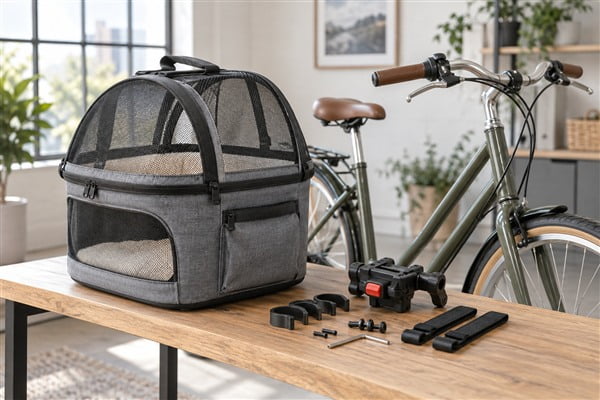


Wheels can make a pet carrier easier to move, but they also add joints, vibration, and a different load path through the base. A familiar suitcase handle is not automatically suitable for a carrier containing a moving animal. Buyers expanding their pet travel bags and carriers should compare the complete rolling assembly before choosing cosmetic details.
Define the loaded use case, surfaces, wheel arrangement, handle positions, and service expectations. Then evaluate wheels, mountings, base, and handle together under a documented test plan.
What operating conditions should the brief describe?
State the intended total load, including the carrier, accessories, and animal allowance. Describe likely floors, thresholds, storage conditions, and whether the carrier is pulled tilted or rolled upright. These assumptions determine which comparisons are meaningful.
TENTE wheel-selection guidance explains why wheel diameter, tread, bearings, load, and floor conditions affect rolling behavior. Use that guidance to frame supplier questions, not to transfer an industrial caster rating directly onto the finished pet carrier.
Clarify the product’s limits. A convenient rolling design does not establish aircraft acceptance or vehicle crash performance. Review IATA Traveler’s Pet Corner for travel context and keep any vehicle-restraint claims tied to relevant evidence, such as the scope shown in CPS certified-product listings.
Which wheel and mounting details need comparison?
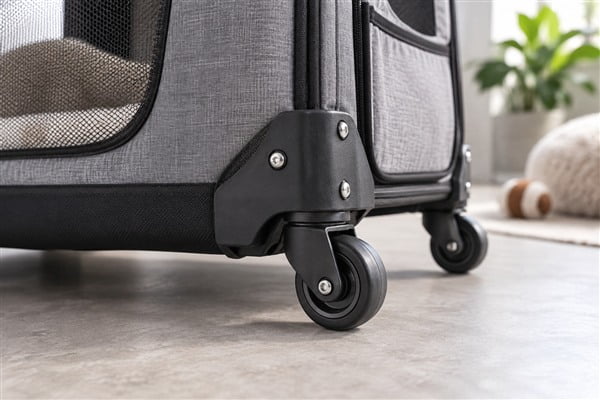
Request wheel diameter, tread material, axle construction, swivel arrangement, mounting method, and replacement procedure. Compare starting effort, straight tracking, turning, noise, and debris pickup on the intended surfaces. Record the loaded condition for every observation.
Inspect the connection between the wheel bracket and carrier base. A strong wheel attached to a flexible or poorly reinforced panel can still perform badly. Treat mounting changes as carrier structural development when they alter the base, frame, or load distribution.
Ask how the assembly behaves when a wheel encounters a threshold or the contents shift. Evaluate stability with a suitable test load before any supervised usability trial involving an animal. Define unacceptable wheel loosening, excessive rocking, sharp damage, and loss of function in advance.
What makes a telescopic handle worth approving?
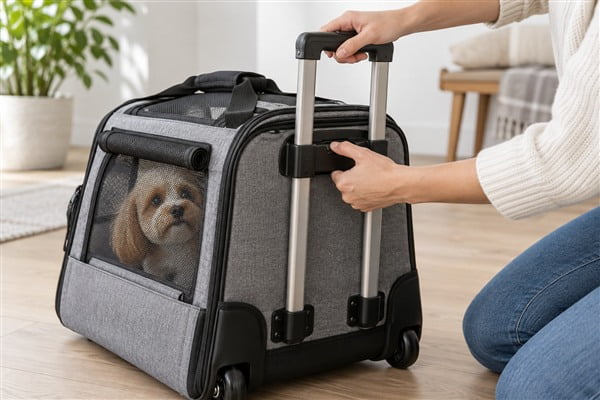
Check extended heights, grip clearance, tube play, locking engagement, release-button force, and movement at the attachment points. Ask whether the handle is intended only for pulling or also for lifting. Do not infer lifting permission from its appearance.
Cycle extension and retraction under agreed conditions, including a realistic contamination or wear scenario if relevant. Record the number of operations, inspection intervals, and failure criteria. The sample development process should include the final handle mounting, not an unattached catalogue component.
Inspect pinch points and access around the carrier opening. The handle should not prevent normal loading, closure, or cleaning. Review these interactions before selecting decorative customization options that may make the assembly harder to maintain.
How should testing and costs be documented?
Separate component evidence from finished-product checks. Discuss corrosion testing through ISO 9227 salt-spray methods where metal parts and the intended environment make it relevant. Do not convert a salt-spray duration into an unsupported years-of-use claim.
For independent work, review laboratory competence and applicable scope using ISO/IEC 17025 laboratory guidance. For shipping protection, select an appropriate procedure from ISTA test-procedure overview with the test provider. Distribution testing addresses shipment hazards; it does not replace rolling endurance or stability evaluation.
When preparing a carrier RFQ, itemize the rolling assembly, reinforcement, removable parts, spare components, packaging, and assembly labor. Compare packed dimensions using UPS dimensional-weight guidance because protruding wheels or handles can change freight economics even when the textile body is unchanged.
Keep a versioned assembly drawing and parts list, drawing on ISO 10007 configuration-management guidance for document control. Confirm the supplier’s manufacturing capabilities for mounting consistency, hardware sourcing, and repeat orders. A low initial price is less useful if a worn wheel cannot be identified later.
Keep a short comparison log for every proposed assembly: load used, surface, handle position, observed issue, and decision. This prevents a smooth showroom demonstration from outweighing a repeatable problem found on the route the product is actually intended to serve.
Frequently Asked Questions
Are four wheels always better than two?
No. Four-wheel designs and tilted two-wheel designs have different handling and stability characteristics. Compare them against the intended route, loaded balance, storage size, and user expectations rather than choosing by wheel count alone.
Should replacement wheels be included?
Agree this commercially. Specify whether replacements are user-installable or service-only, which fasteners are supplied, and how distributors identify the compatible version. Keep repair instructions consistent with the approved assembly.
Start with an operating brief
Send the target load, route conditions, carrier dimensions, handle-height expectations, replacement policy, and price objective. Then contact FungoMate to discuss a wheeled-carrier sample plan. These details allow suppliers to quote and develop a rolling system whose construction matches the intended use.